
Segment #1052
Before expanding government's responsibility for managing more of the economy, what evidence demonstrates that the people and institutions receiving that responsibility possess the managerial capability to execute it successfully?
That is different from asking whether the objective is compassionate or whether enough tax revenue can be raised.
Assume the left is right about the goals
For purposes of argument, assume the advocates of a much larger government are correct: healthcare should be more publicly financed, college should be heavily subsidized, housing should receive greater government support, industrial policy should expand, and additional social programs are desirable.
Then forget the tax question temporarily.
The next question should be: Who runs all of this?
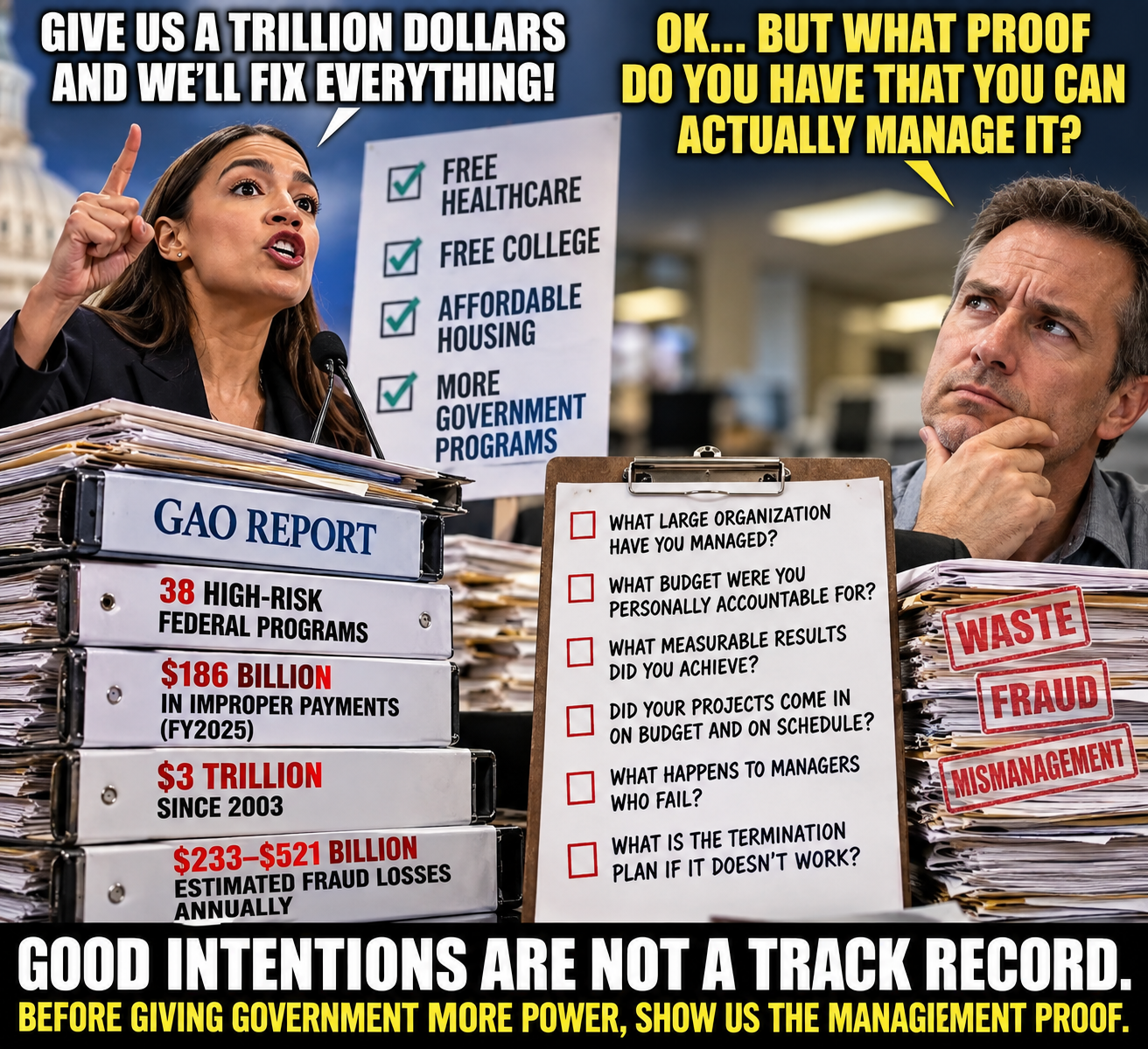
Running a trillion-dollar government program requires expertise in finance, personnel, procurement, logistics, information technology, fraud prevention, contracting, risk management, performance measurement and organizational leadership.
The federal government's existing record gives considerable reason to make managerial capacity part of the debate. GAO currently identifies 38 federal operations or programs as "high risk" because of vulnerabilities to waste, fraud, abuse or mismanagement, or because they require major transformation. Twenty of those areas involve staffing shortages or skills gaps.
Government Accountability Office
Improper Payments: And the numbers are substantial. In FY2025, federal agencies estimated $186 billion in improper payments, bringing the cumulative total since FY2003 to roughly $3 trillion. GAO emphasizes that an improper payment isn't necessarily fraud, but it is nevertheless an important indicator of administrative-control problems.
Government Accountability Office
Fraud: GAO separately estimates that federal fraud losses could be $233 billion to $521 billion annually, based on FY2018–22 data. It specifically identifies inadequate data and shortages of technically skilled personnel as obstacles to improving controls.
Government Accountability Office
So your question isn't theoretical. Administrative capacity is already a documented constraint on government.
The socialism question is somewhat different
We have to define "socialism" carefully. Medicare, Social Security, public schools and welfare programs aren't equivalent to the Soviet economic system. A large welfare state operating inside a market economy isn't the same thing as government ownership and central planning.
But as government moves farther toward state ownership or centralized allocation of economic resources, the managerial/incentive problem you're describing becomes considerably more important. The IMF's research on state-owned enterprises is particularly relevant. It finds recurring problems involving weak corporate governance, political interference, inadequate managerial skills, weak oversight and what economists call "soft budget constraints"—an enterprise can continue losing money because taxpayers ultimately stand behind it.
That last point is fundamental.
A badly managed private company eventually encounters an unforgiving constraint:
It runs out of money.
A badly managed government enterprise can encounter a very different response:
It receives more money.
That changes managerial incentives.
Historical research on centrally planned economies additionally identified distorted prices, inadequate incentives, automatic financing of unprofitable state enterprises, weak property rights and chronic shortages as structural problems—not simply failures to hire sufficiently intelligent administrators.
National Bureau of Economic Research
That distinction matters because even brilliant managers cannot necessarily overcome a system that deprives them of market prices, competitive pressures, profit-and-loss signals and credible consequences for failure.
Private-sector employment the test.
Someone can spend 30 years in private business and be an atrocious manager. Conversely, someone who spent a career running a military command, state government, major hospital system or enormous nonprofit could possess considerable executive ability without conventional corporate experience.
Demonstrated management at comparable scale.
Before entrusting political leaders with another $500 billion or $1 trillion undertaking, ask them to produce evidence:
What large organization have you successfully managed?
What budget were you personally accountable for?
How many employees reported through your organization?
What measurable results did you achieve?
Did your projects come in on budget and on schedule?
What happens to managers who fail?
What objective performance measurements will determine whether this program works?
What is the termination mechanism if it doesn't?
That standard should apply equally to Democrats and Republicans. A Republican proposing a $500-billion defense initiative doesn't acquire managerial competence simply by advocating smaller domestic government.
Note the difference between political skill and managerial skill.
Politics rewards coalition building, communication, campaigning, fundraising, negotiation and winning elections. Those are genuine skills. But they aren't necessarily the skills required to operate a gigantic organization.
Imagine a politician saying:
"Give me $800 billion. I have never managed an organization remotely this large, never operated a comparable enterprise, never been responsible for a comparable budget, and cannot show you a previous project demonstrating that I can accomplish what I'm promising. But my intentions are good and my economic theory says it will work."
A corporate board would have obvious questions before hiring that person as CEO.
Taxpayers are entitled to ask the same questions.
Congress recognized this problem itself.
It passed the Program Management Improvement Accountability Act of 2016 specifically to improve federal program-management capability. Yet GAO subsequently concluded that implementation remained incomplete and that the federal government still needed stronger standards, governance and management practices.
Government Accountability Office
There is also evidence that better management actually works. GAO reports that efforts addressing its High-Risk List have produced approximately $759 billion in financial benefits since 2006.
Government Accountability Office
The burden of proof should increase with the size, complexity and permanence of the government undertaking.
And that leads to a very different political debate.
Instead of:
"How much will it cost and whom will we tax?"
ask:
"Show me that you can actually run it."
Before approving a massive new program, Congress could require an operating plan identifying experienced management, measurable objectives, implementation milestones, independent audits, fraud controls, cost-overrun triggers, competitive benchmarking and—most importantly—a mechanism for restructuring or terminating programs that repeatedly fail their objectives.
Mamdani’s Work HIstory
2014 — Graduated from Bowdoin College, B.A. in Africana Studies. AP News
Post-college — Film/creative work. Mamdani has described himself as having worked as a production assistant (PA), something he reiterated as mayor in 2026. New York City Government
Music — Rapper/artist. He performed under Young Cardamom and later Mr. Cardamom, producing music and videos. AP describes this as a side career rather than a major full-time business career. AP News
Housing work — Foreclosure-prevention counselor. He worked in Queens helping homeowners facing foreclosure and eviction. This appears to be the most substantial conventional nonpolitical job generally identified in published biographies. AP News
Political organizing/campaign work. Before winning office, he worked on campaigns for Democratic candidates in Queens and Brooklyn. AP News
2021–2025 — New York State Assembly. Elected in 2020 and took office in 2021, representing the 36th Assembly District in Queens. New York City Government
January 1, 2026–present — Mayor of New York City. He became NYC's 112th mayor.