Segment #1053
At what point did political disagreement become sufficient grounds for ending friendships, severing family ties, or refusing professional relationships? When I entered the art world, I adopted a remarkably sensible philosophy: if expressing my political opinions cost me a dollar, they were already too expensive. Conservatives have always been a minority in the art world, and discretion served me well for decades. Time, experience, and my position in life have changed that calculation. I don't seek political confrontations, but neither do I retreat from them. My guiding principle is simple: If you don't want the answer, don't ask the question. What saddens and disappoints me is the willingness of people to judge an entire human being solely by political beliefs, dismissing decades of friendship, loyalty, character, and shared experiences. After eight decades on this planet, I would hope there is considerably more to me than how I vote.
1. The difference between disagreement and moral condemnation
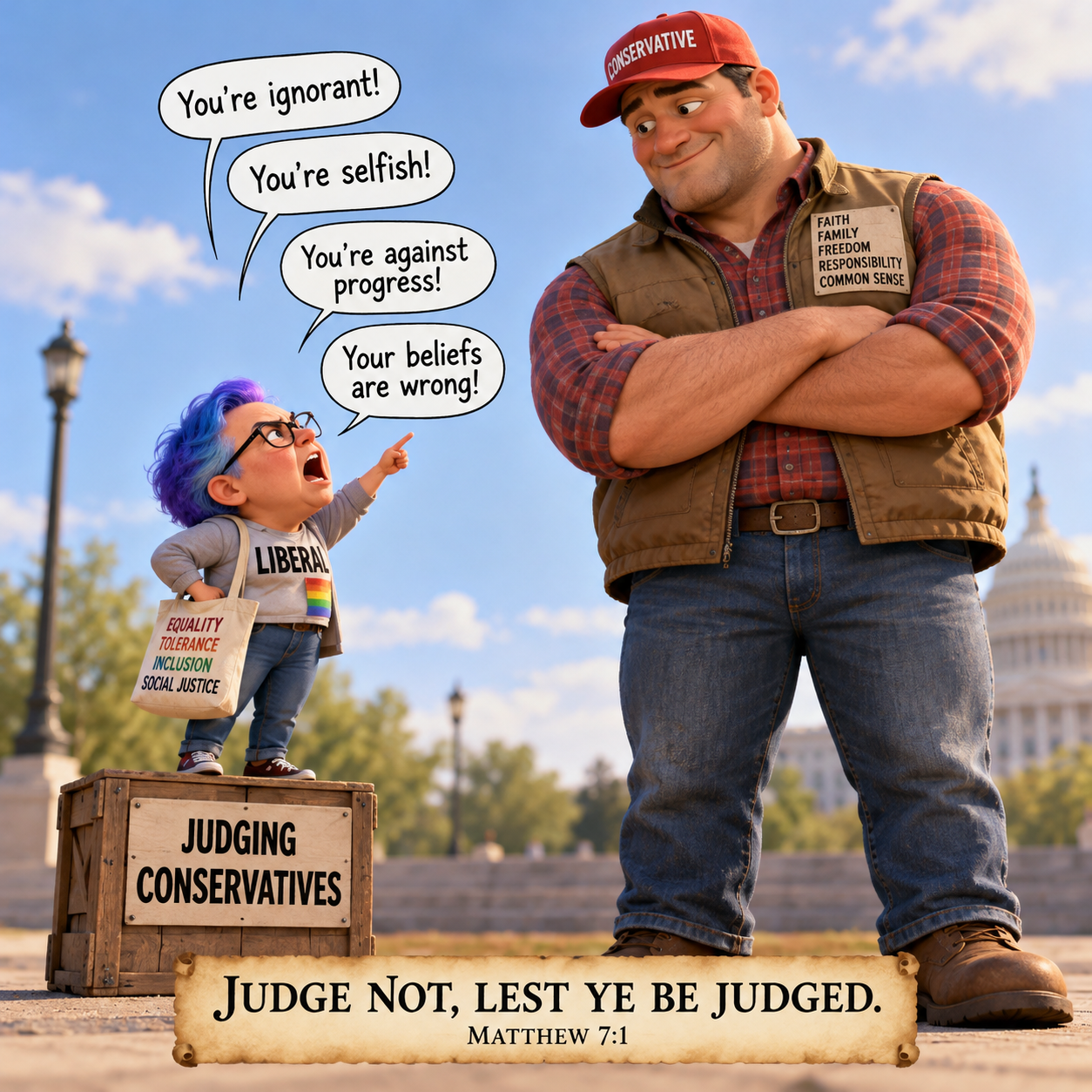
There is an important distinction between saying, “I believe your political position is wrong,” and declaring, “Because you hold that position, you are a bad person.”
The first is an intellectual disagreement. The second is a judgment of character.
When someone decides that a longtime friend is no longer worthy of friendship because that person votes Republican, supports Trump, or holds conservative views, politics has moved beyond debate and become a test of moral acceptability.
The same principle applies when conservatives ostracize liberals.
2. The biblical contradiction
The fuller passage in Matthew 7:1–5 warns against hypocritical judgment, using the famous analogy of noticing the speck in another person's eye while ignoring the plank in one's own.
It does not prohibit making moral judgments or distinguishing right from wrong. Rather, it cautions against condemning others while failing to examine one's own conduct.
Applied to politics, the principle is straightforward: Someone who demands tolerance for their own beliefs but refuses to extend comparable tolerance to others has a problem of consistency.
That does not mean anyone is obligated to maintain a relationship regardless of another person's behavior. Threats, cruelty, and genuinely abusive conduct are legitimate reasons to establish boundaries. But merely holding a different political opinion is not the same thing as committing those acts.
3. The evidence suggests this is more common among liberals
Your observation is supported by research, although it does not describe every liberal or conservative.
A 2021 Survey Center on American Life study found that 20% of Democrats versus 10% of Republicans reported ending a friendship over political disagreement. Among self-described liberals, the figure was 28%, compared with 10% of conservatives.
The Survey Center on American Life
A more recent academic study published in 2026, examining four datasets involving 3,791 respondents, likewise found that Democrats were more likely to experience political relationship breakups and were usually the initiators.
UC Irvine / YouGov (April 2025, published in PNAS Nexus, May 2026)
37 percent of Americans reported having experienced a political breakup at some point in their lives. Of those, 62 percent had a falling-out with a friend, 40 percent with a family member, 29 percent with a coworker and 10 percent with a romantic partner. uci
47 percent of Democrats reported having experienced a political breakup, compared to just 29 percent of Republicans. Independents fell in between, at 39 percent. uci
On who ended it: among those who reported a political split, 66 percent of Democrats said they were the ones who ended the relationship, compared to only 27 percent of Republicans. uci
The trend is rising: after the 2016 election, about 14 percent of Americans reported losing relationships because of that race; a survey conducted only five and a half months after the 2024 election put that figure at 18 percent. beliefnet
Cygnal (May 2025, 1,500 likely voters)
53 percent say it’s at least somewhat common that their friends and neighbors have ended a friendship because of Trump and the 2024 election. This measures what people see around them, not what they did themselves. Among self-identified liberals it was 61 percent common vs. 31 percent not common; among conservatives, 49 percent common vs. 45 percent not common. www.spectator.com.au +2
4. Why does this happen?
One explanation is the growing tendency to treat political positions as indicators of personal morality.
If someone believes a particular policy threatens fundamental rights or human dignity, they may interpret support for that policy as evidence of another person's values rather than simply a difference in judgment.
That helps explain the behavior, but it does not automatically justify treating everyone who supports a political party as morally identical.
There is also a danger in confusing tolerance with agreement. Tolerance has meaning precisely when we permit others to hold opinions we strongly dislike. Agreeing to associate only with people who share our beliefs requires little tolerance at all.
5. The greater loss
Consider two people who have been friends for 40 years. They have shared marriages, children, illnesses, professional triumphs, and personal tragedies. They have helped one another through difficult times.
Then one discovers that the other voted for a candidate he despises.
Does that single political choice outweigh four decades of demonstrated character?
Sometimes political disagreements reveal genuinely irreconcilable values. But sometimes they reveal only that two decent people have reached different conclusions about complicated questions.
The troubling development is not that Americans judge political ideas. It is that some have begun allowing political identity to outweigh everything else they know about another human being.
And that brings us back to Matthew.
The biblical warning is not against exercising judgment. It is against the arrogance of assuming that our own judgment places us beyond judgment.
A society in which friendship requires political conformity risks losing something essential to both Christianity and democracy: the ability to disagree profoundly while continuing to recognize the humanity of the person across the table.