
Segment #1051
A critical assessment • October 7, 2026
Assessment
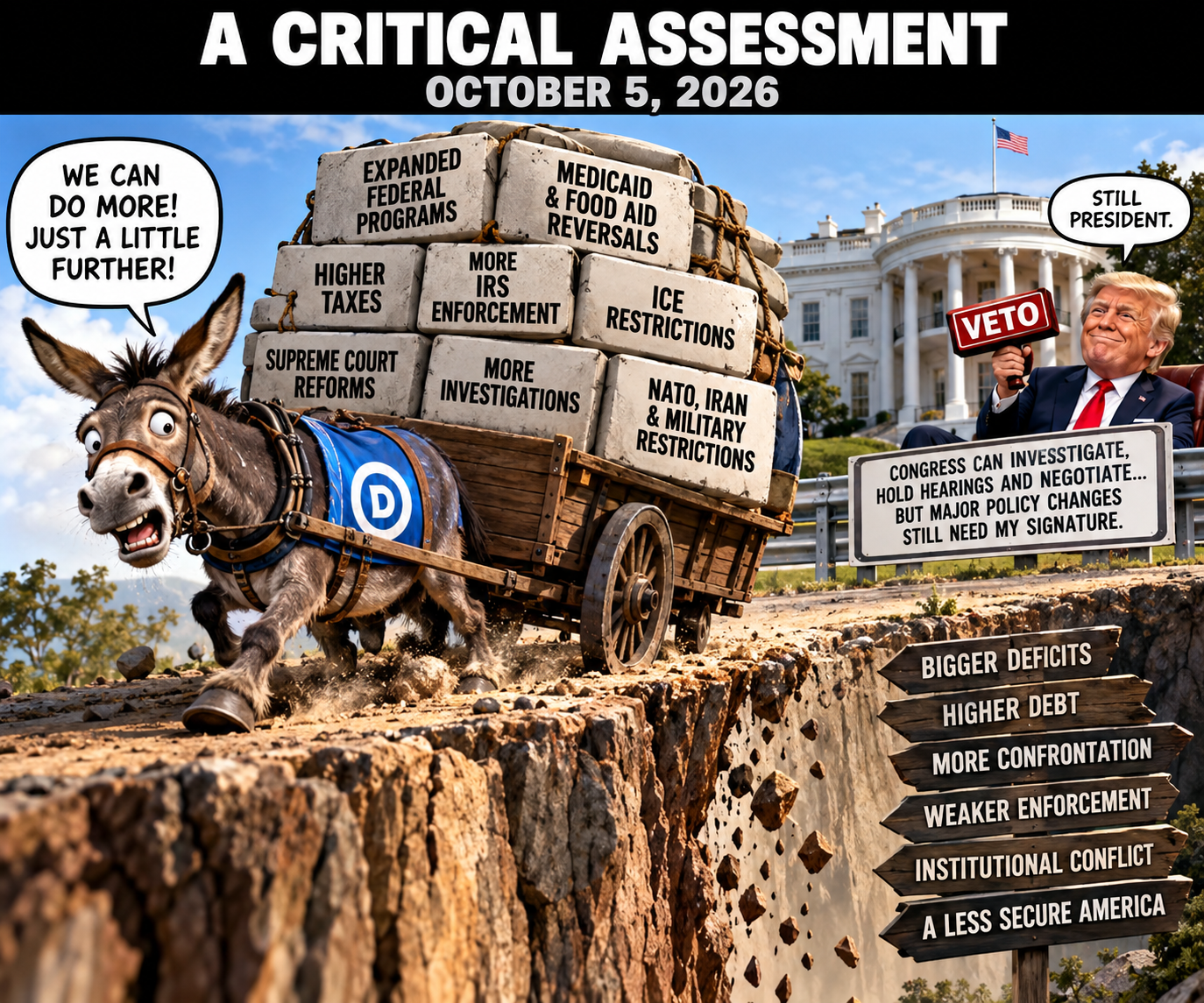
A Democratic victory in the midterms will expand federal commitments without establishing durable financing, while creating further conflict over immigration enforcement, the courts and executive power. That combination could be seriously damaging.
What a victory would actually change
Winning Congress would give Democrats control of committees, spending negotiations and legislation; a Senate majority would also control confirmation proceedings. Trump would remain president. Most major policy reversals would require his signature or a two-thirds veto override. Therefore, the immediate risk is prolonged confrontation and budget brinkmanship, rather than automatic enactment of every Democratic proposal.
1. Spending and debt: the clearest danger
CBO’s February 2026 baseline projects a $1.9 trillion deficit in 2026, rising to $3.1 trillion in 2036. Debt held by the public reaches 120% of GDP by 2036. Those are current-law projections, not the cost of a Democratic agenda. They show how little room exists for additional unfunded commitments. Democrats are campaigning to reverse Medicaid and nutrition-assistance reductions. Such reversals increase spending relative to current law unless accompanied by savings elsewhere. Healthcare subsidies also require continuing federal financing. No combined cost or net deficit estimate is supplied here because there is no single specified legislative package to score.
2. Who pays
The party’s 2024 platform proposed raising the corporate income-tax rate from 21% to 28% and higher taxes on affluent households. That establishes a funding direction, not a fully financed 2026 congressional program. Higher business taxes can reduce after-tax investment returns; their economic effects depend on design and other policy changes. Additional IRS enforcement can collect legally owed taxes, but projected receipts must be measured against its cost. Any remaining funding gap means borrowing, other taxes or spending cuts. Neither corporate taxes nor enforcement revenue is an unlimited source of money.
3. Border and enforcement
Jeffries and Schumer’s February 2026 demands seek substantial restrictions on ICE operations, including identification, judicial-warrant requirements and limits on enforcement locations. The critical concern is whether the resulting rules would obstruct lawful arrests and removals or divert resources from enforcement. That risk should be evaluated provision by provision. These demands do not by themselves establish a plan to abolish the border or grant universal amnesty.
4. Supreme Court
Jeffries has called for major Court reform without endorsing a specific expansion plan. Expanding membership to change the ideological balance would invite retaliatory expansion by future majorities and could weaken judicial credibility. That is a serious institutional risk if adopted. An ethics code is a different proposal and does not itself establish court-packing.
5. Military, Iran and NATO
The party platform supports NATO and combines diplomacy toward Iran with military deterrence. A critique should demand measurable allied burden-sharing, adequate readiness and verification before sanctions concessions. Restrictions on military operations could impair deterrence if poorly designed; avoiding an unnecessary war could instead save money and lives. The reviewed evidence does not establish an agreed Democratic program to dismantle the military or surrender to Iran. The duplicated military category in the earlier list is combined here.
6. Trump, DOJ and investigations
A Democratic Congress could subject Trump and federal agencies to extensive hearings and subpoenas. Investigations driven primarily by political retaliation would consume public resources and deepen distrust. Specific abuses must be demonstrated from records. Congress cannot simply replace Trump’s attorney general. Earlier assertions about Jack Smith, family travel and telephone monitoring are not treated here as verified evidence or as proof of future Democratic conduct.
Conclusion
The defensible warning is direct: expanding permanent programs without credible financing, obstructing effective enforcement, or restructuring institutions for partisan advantage could leave America more indebted, less governable and less secure. The case is strongest when tied to actual legislation, independent budget scores and documented conduct. It becomes weaker when proposals from individual politicians are presented as settled party policy or forecasts are presented as facts.
Sources and scope
Congressional Budget Office, The Budget and Economic Outlook: 2026 to 2036 (February 11, 2026): https://www.cbo.gov/publication/62105
Democratic Party, 2024 platform (historical policy direction, not a unified 2026 legislative package): https://democrats.org/where-we-stand/party-platform/
Jeffries and Schumer, ICE reform demands (February 4, 2026): https://jeffries.house.gov/2026/02/04/leaders-jeffries-and-schumer-deliver-urgent-ice-reform-demands-to-republican-leadership/
Washington Post, Democratic plans regarding the One Big Beautiful Bill (October 2, 2026): https://www.washingtonpost.com/politics/2026/10/02/dems-are-running-against-one-big-beautiful-bill-what-can-they-if-they-win/
Washington Post, Jeffries on Supreme Court reform (August 17, 2026): https://www.washingtonpost.com/politics/2026/08/17/hakeem-jeffries-says-he-wants-see-dramatic-reform-supreme-court/