
Segment # 1074
Political polarization, moral condemnation, resistance to evidence, and external manipulation
The Problem: From Disagreement to Moral Condemnation
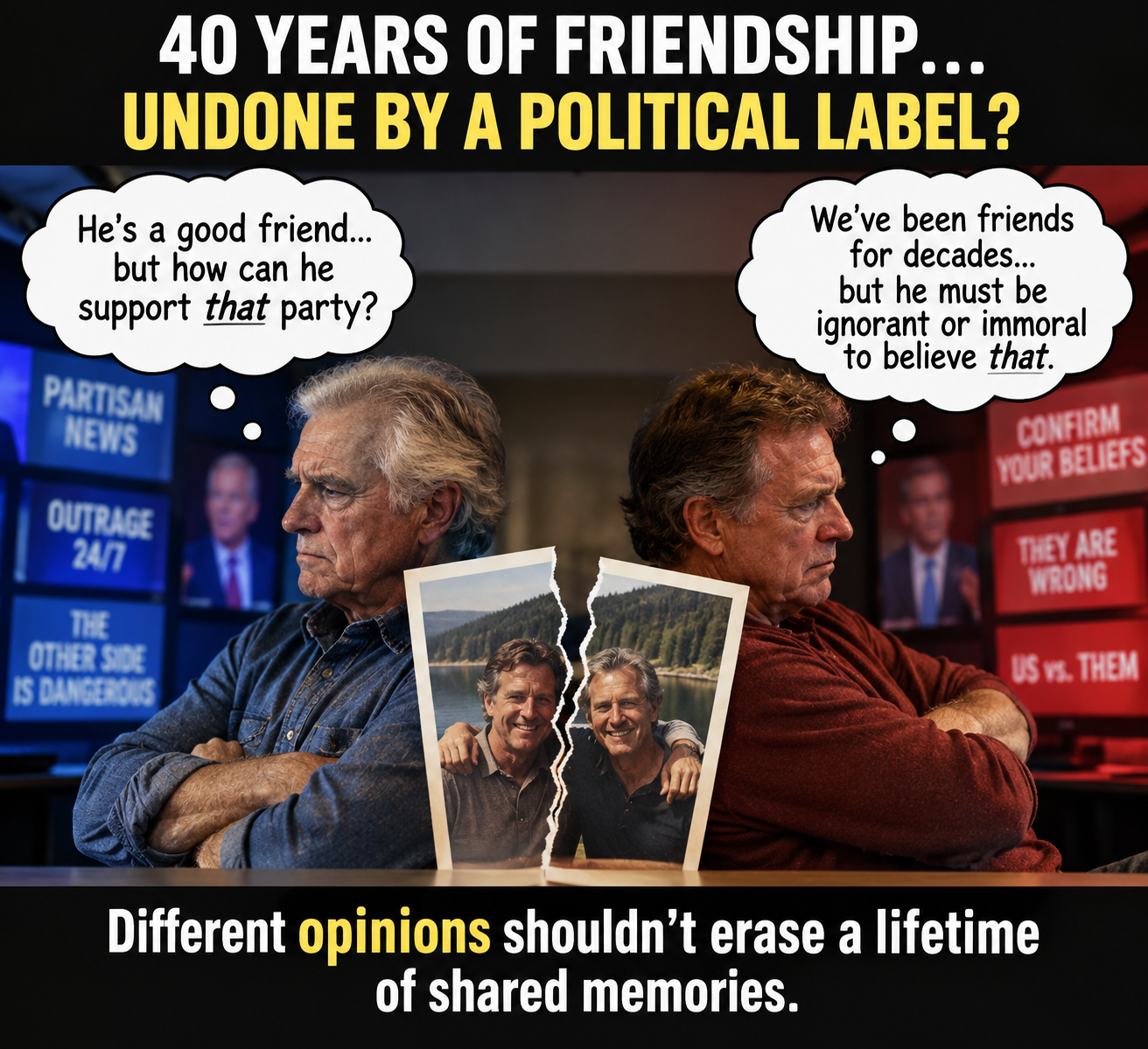
Political disagreements can end friendships built over decades. A 2026 PNAS Nexus study of U.S. respondents reported that approximately 37% of participants in an April 2025 survey had experienced a political relationship breakup, most often involving a friendship [1]. This is self-reported experience, not the percentage of all friendships that ended.
The crucial change occurs when an opposing opinion ceases to be an argument worth examining and becomes perceived evidence that its advocate is ignorant, dishonest, or morally inferior. Political sectarianism combines “othering,” aversion, and moralization: opponents are seen as fundamentally different, disliked, and morally suspect [2]. Decades of firsthand experience with a friend can then be overshadowed by a partisan stereotype. Disagreement alone, however, differs from repeated personal mistreatment or a genuine irreconcilable moral conflict.
Cultural Impact: Intellectual Discussion Ambushed by Contempt
When political affiliation becomes a proxy for character, debate can shift from evidence and competing interpretations to accusations about personal worth. Finkel and colleagues identify moralization as a key component of political sectarianism and warn that contempt based on partisan identity can impede cooperation [2].
The danger is not vigorous disagreement; it is the conviction that people who disagree are no longer worthy of respect. This discourages curiosity, makes concession feel like betrayal, and can damage families, friendships, workplaces, and civic life. Such effects vary across individuals and circumstances; they are not inevitable consequences of political conviction.
Why Intelligent People Resist Reconsideration
Education and intelligence do not ensure impartiality. Motivated reasoning can lead people to evaluate evidence in ways that protect preferred conclusions [3]. Experiments by Taber and Lodge found selective acceptance of congenial arguments and more aggressive scrutiny of contrary arguments, especially among people with strong prior attitudes [4].
Intellectual ability can support rationalization, but it can also improve accuracy: research by Pennycook and Rand found that analytical thinking helped people distinguish true from false headlines across partisan lines [5]. The relevant question is not simply “How intelligent is this person?” but “What credible evidence would change this person’s mind?” Refusal to consider any possible disconfirming evidence suggests a belief insulated from meaningful testing, not necessarily a false belief.
Domestic and Foreign Exploitation of Existing Divisions
Domestic political communicators, commercial media, and online influencers may gain attention, donations, or loyalty from provocative messages. Foreign actors can exploit the same social fault lines for strategic purposes, sometimes covertly. These incentives are not equivalent to one another, and ordinary domestic advocacy should not be confused with illegal or covert foreign interference.
A bipartisan Senate Intelligence Committee investigation documented how Russia’s Internet Research Agency impersonated Americans and amplified existing disputes involving race, immigration, and gun rights during the 2016 election period [6]. The documented goal included sowing discord, although the operation’s precise effect on individual attitudes or friendships is not established. Research on the illusory truth effect further shows that repetition can increase perceived credibility [7].
The especially corrosive tactic is to move beyond arguing that the other side is mistaken and imply that its supporters are morally unworthy of consideration. Once the person is discredited, even sound evidence may be dismissed without examination. This is a plausible mechanism linking hostile messaging to relationship damage—not proof that any particular breakup was orchestrated.
Conclusion
The most damaging form of polarization replaces intellectual disagreement with moral condemnation. An argument may be rejected forcefully—even on moral grounds—without assuming that everyone who holds it is morally inferior. Intelligence supplies the capacity to reason; intellectual independence requires willingness to reconsider. Respect requires recognizing that a disagreement alone does not erase a lifetime of character and friendship.
Research and Documentation
[1] Güngör & Ditto (2026), PNAS Nexus, “Political Breakups.” https://doi.org/10.1093/pnasnexus/pgag067
[2] Finkel et al. (2020), “Political Sectarianism in America,” Science. https://doi.org/10.1126/science.abe1715
[3] Kunda (1990), “The Case for Motivated Reasoning,” Psychological Bulletin. https://doi.org/10.1037/0033-2909.108.3.480
[4] Taber & Lodge (2006), “Motivated Skepticism in the Evaluation of Political Beliefs,” American Journal of Political Science, 50(3), 755–769.
[5] Pennycook & Rand (2019), “Lazy, Not Biased,” Cognition, 188, 39–50. https://doi.org/10.1016/j.cognition.2018.06.011
[6] U.S. Senate Select Committee on Intelligence (2019), Russia’s Use of Social Media, Volume II. https://www.intelligence.senate.gov/sites/default/files/documents/Report_Volume2.pdf
[7] Nature Communications (2026), meta-analysis of the illusory truth effect, 182 studies / 31,184 participants. https://www.nature.com/articles/s41467-026-70041-x