
Segment #1075
Updated October 31, 2026 | Special Report
Special Report | October 31, 2026
A $1 Billion Investment Is Only Part of a Much Bigger Story
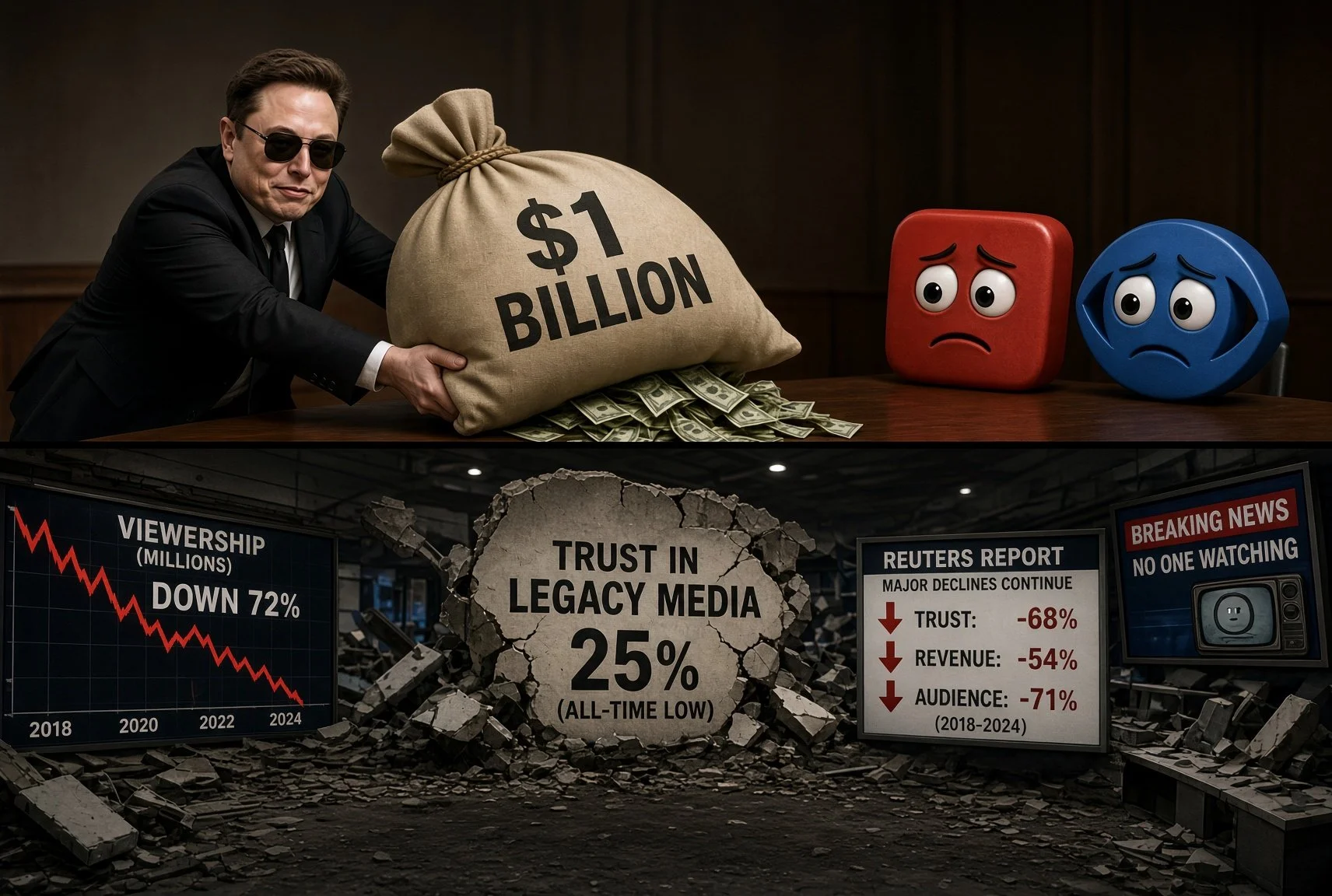
Elon Musk's reported $1 billion investment in Skydance, the new parent company of CNN and CBS News, highlights a fundamental restructuring of American journalism. Traditional media are losing audiences, advertising revenue, and public confidence while wealthy investors, technology companies, and independent digital publishers gain influence.
The larger issue is not whether CNN or CBS moves politically left or right. It is who will control the production and distribution of news, and whether journalism can remain credible and financially viable.
CNN and CBS Under New Ownership
On October 6, 2026, Paramount Skydance completed its approximately $110 billion acquisition of Warner Bros. Discovery, bringing CNN and CBS News under common ownership. David Ellison leads the combined company.
Musk's reported investment gives him a financial interest in the parent corporation, but there is no publicly established evidence that he has editorial authority over either network.
CBS News is already undergoing substantial changes under Bari Weiss, whose leadership challenges established editorial practices and seeks audiences dissatisfied with traditional journalism. CNN, under Mark Thompson, faces mounting pressure to reduce costs while preserving its international reporting operation.
The combined company is targeting at least $6 billion in operating synergies over three years. Consolidation could eliminate duplication, but excessive cuts could weaken investigative journalism and foreign reporting.
An editorial independence board is planned, although its effectiveness will depend on whether corporate management genuinely respects its authority.
The Crisis of Public Confidence
The greatest problem facing American journalism may be declining public trust.
According to the Reuters Institute's 2026 Digital News Report:
Only 25% of Americans trust most news most of the time.
45% sometimes or often avoid news.
Social media increasingly competes with traditional news organizations.
The problem extends beyond political bias. Selective coverage, sensationalism, commentary disguised as reporting, and inconsistent editorial standards have damaged credibility.
Replacing a perceived liberal bias with a conservative one, or vice versa, does not solve the problem. Journalism earns trust by applying the same standards of evidence and accountability regardless of political affiliation.
The End of Traditional Media Dominance
For decades, CBS, NBC, ABC, CNN, and major newspapers largely determined which stories received national attention.
That monopoly on public attention has disappeared.
Podcasters, YouTube personalities, independent journalists, and social media platforms now compete directly with established news organizations. They can expose overlooked stories and challenge institutional assumptions without traditional editorial gatekeepers.
But this freedom carries risks. Digital publishers may operate without meaningful fact-checking, editorial oversight, or disclosure of financial interests.
The old system concentrated editorial power in newsrooms. The emerging system distributes publishing power widely while concentrating distribution power among technology platforms.
Billionaire Ownership and Conflicts of Interest
Musk joins a broader transformation involving Jeff Bezos at The Washington Post, Patrick Soon-Shiong at the Los Angeles Times, and the Ellison family at Skydance.
These investors can provide capital, introduce technological efficiencies, and challenge outdated business practices.
However, owners with substantial interests in government contracts, telecommunications, artificial intelligence, and regulation create potential conflicts of interest.
The essential test is whether journalists can investigate their owners and their business partners without interference.
Artificial Intelligence Changes the Economics
Artificial intelligence may ultimately disrupt journalism more profoundly than corporate mergers.
AI can reduce production costs through transcription, translation, editing, research assistance, and automated summaries. But it also threatens the economic foundation of original reporting.
News organizations pay journalists to investigate events. Technology platforms can summarize that reporting and capture audience attention without necessarily returning sufficient revenue to those who produced it.
If this imbalance continues, the industry could lose the reporting infrastructure on which both traditional and digital news depend.
What Happens Next: 2027–2030
Three developments appear particularly likely.
Continued consolidation. CNN, CBS, and other traditional organizations will reduce operating costs, share resources, and expand streaming and digital distribution. Some established news operations may become smaller and less influential.
Greater political and audience fragmentation. News organizations will face growing commercial pressure to reinforce audience preferences rather than challenge them. Independent publishers will expand, but distinguishing reliable reporting from advocacy may become increasingly difficult.
Technology gains influence. Artificial intelligence, social media algorithms, and digital distribution platforms will increasingly determine how Americans encounter information. Original reporting may become more valuable even as its financing becomes more difficult.
Local journalism remains particularly vulnerable. As newspapers and broadcasters reduce reporting staffs, government agencies, school boards, and municipal institutions may face less independent scrutiny.
Conclusion: The Real Story Is Bigger Than Musk
Musk's reported investment may influence the future of CNN and CBS, but it is only one element of a much larger transformation.
American journalism is moving away from a system dominated by a few established institutions toward one shaped by billionaire ownership, digital platforms, artificial intelligence, and increasingly fragmented audiences.
This transition could produce greater competition, more diverse perspectives, and stronger challenges to institutional authority. It could also create a media environment in which political loyalty and commercial incentives outweigh accuracy.
The central question is no longer who controls the evening news. It is who controls the information Americans receive, who pays for its production, and whether the public can trust it.
The organizations that survive will need more than wealthy owners, new technology, or political appeal. They will need to demonstrate that credible, independent reporting remains worth paying for.