
Segment #1073
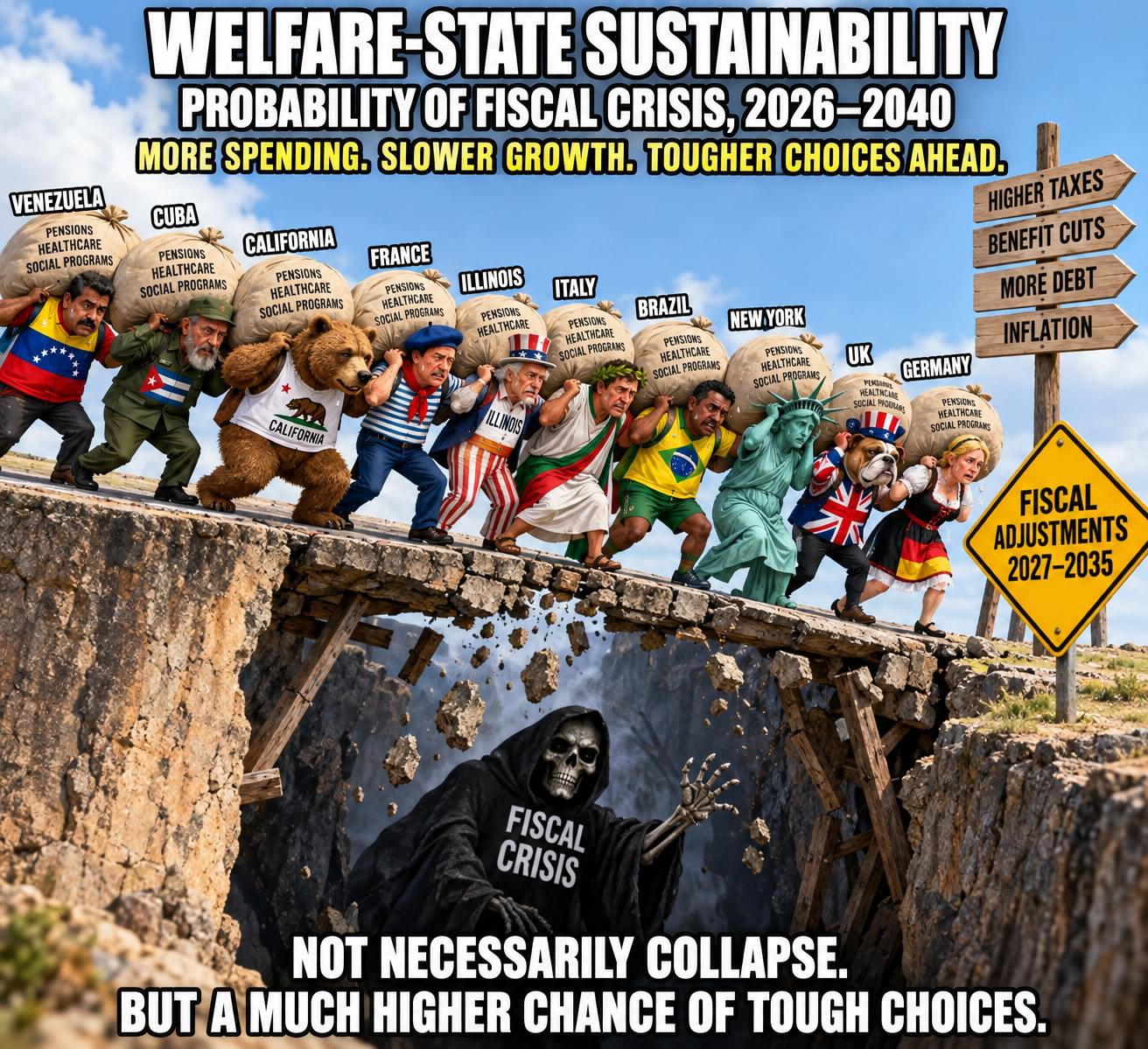
A probability-weighted assessment based on current economic and government spending trends
The central risk facing governments with expanding welfare commitments is not necessarily financial collapse. It is the growing possibility that public spending will outpace tax revenues and economic growth, forcing higher taxes, benefit reductions, additional borrowing, or inflation.
The critical variables are government debt, interest costs, economic growth, demographic aging, the number of taxpayers supporting beneficiaries, and political willingness to reform.
The most likely period for significant fiscal adjustments is 2027–2035. Countries and states that postpone reforms may face progressively more expensive corrections.
For this analysis, a major fiscal adjustment means substantial tax increases, benefit restrictions, or spending cuts needed to stabilize public finances. A severe fiscal crisis means significant disruption to financing or essential government services. These are different outcomes.
Predicted problems by country and state
The following rankings reflect current fiscal trends and the likelihood of substantial corrective action by 2035. They are qualitative assessments, not statistically validated probabilities of collapse.
Venezuela — Critical risk, already experiencing systemic problems. Oil dependence, weak institutions, inflationary history, and limited productive capacity threaten continued economic recovery. Without structural reforms, recurring shortages, currency instability, and inadequate public benefits remain likely through 2030.
Cuba — Critical risk, already in crisis. Weak production, foreign-currency shortages, energy deficiencies, and declining purchasing power threaten essential services. Further deterioration is a serious near-term possibility, particularly through 2030.
California — High risk, 2027–2030. The state continues to face structural budget deficits. Its August 2026 budget analysis projected operating shortfalls of $10.4 billion in 2027–28, $8.7 billion in 2028–29, and $8.3 billion in 2029–30. Continued fiscal pressure makes program restrictions, additional revenues, and spending reductions likely.
Legislative Analyst's Office
France — High risk, 2027–2032. Large public debt, substantial pension and social spending, weak fiscal flexibility, and political resistance to reform increase the likelihood of higher taxation, pension changes, and expenditure restrictions.
Illinois — High risk, 2027–2035. Unfunded pension obligations and recurring budget pressures constrain resources available for education, infrastructure, and assistance programs. Higher taxes or reductions in other services remain plausible.
Italy — High risk, 2028–2035. High public debt, weak productivity, and an aging population create continuing fiscal pressure. The IMF nevertheless reports that recent fiscal consolidation has strengthened market confidence, making an immediate financing crisis less likely than gradual spending restraint.
International Monetary Fund
Brazil — Elevated risk, 2027–2035. High borrowing costs, rigid mandatory expenditures, and rising debt threaten fiscal flexibility. IMF projections place gross general government debt at approximately 105% of GDP by 2031. Tax reform and stronger growth could materially improve the outlook.
International Monetary Fund
New York — Elevated risk, 2027–2033. Medicaid, education, pensions, and dependence on economically sensitive tax revenues create recurring budget exposure. Spending restraint or additional taxes become more likely if growth disappoints.
United Kingdom — Elevated risk, 2028–2035. Rising healthcare, pension, and debt-service demands threaten fiscal flexibility. Continued tax increases, slower public spending growth, or benefit adjustments are more likely than systemic failure.
Germany — Moderate risk, 2030–2040. Population aging, pension obligations, industrial competitiveness, and weak growth will increase pressure on public finances. Germany retains comparatively strong fiscal capacity, making gradual reform more likely than a severe financing crisis.
Overall conclusion
Current trend lines point toward increasing fiscal strain, not the inevitable collapse of welfare states. The IMF reported in October 2026 that global public debt is projected to reach 100% of GDP by 2029, reflecting persistent deficits, rising interest burdens, and growing expenditure demands.
The NewsMarket
Three conclusions follow.