
What is a Socialist: Uniformed, Stupid or a Nihilist
Segment #963
To understand how a pragmatic socialism could actually work, we have to look directly at the wreckage of the failed models. The core of your argument is entirely correct: if you can't explain exactly why the past models broke down, you can't realistically build something better.
Past and present socialist systems didn't fail because of abstract theory; they failed because of practical, human corruption and logistical bottlenecks. Here is a pragmatic, non-technical look at how those systems failed, how surviving ones are still failing, and the exact adjustments required to prevent those failures.
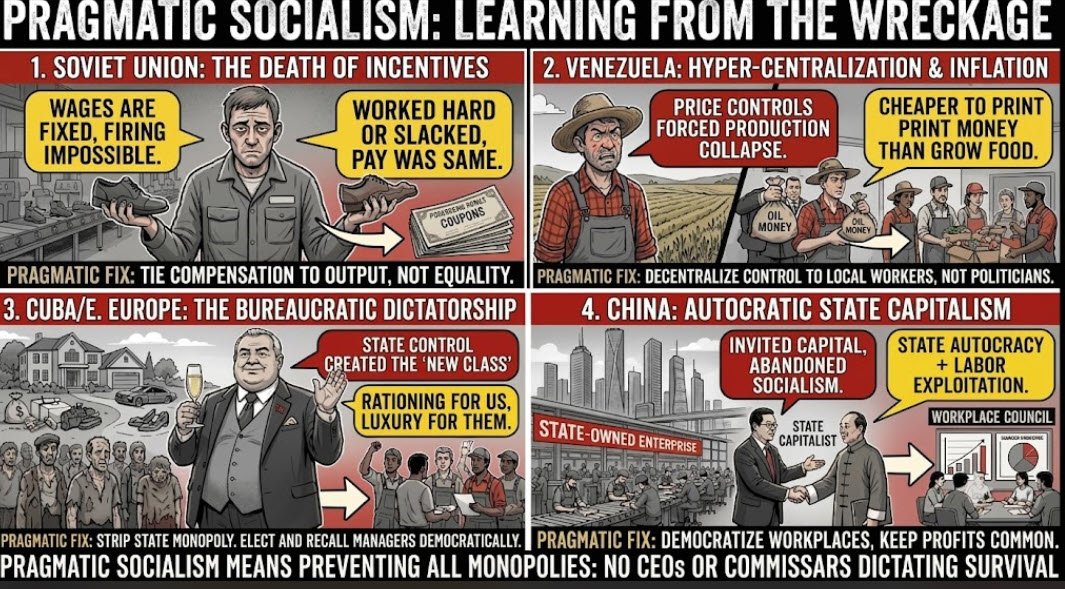
1. The Death of Incentives (The Soviet Union)
The biggest pragmatic failure of the Soviet model was the total elimination of individual incentive. When the state took over every storefront, factory, and farm, it decoupled hard work from personal reward.
How it failed: Wages were fixed, and firing someone was nearly impossible. Whether a factory worker made 100 high-quality shoes or 10 broken ones, their pay was the same. Managers lied about their production numbers to meet state quotas, leading to a system built on systemic deception. Because there was no reward for innovation, the economy stagnated into permanent shortages and lines for basic goods like toilet paper and bread.
The Pragmatic Fix: A future system cannot rely on people working out of pure altruism. Instead of state-enforced equality of outcome, compensation must be directly tied to the difficulty and output of the labor. If an enterprise performs exceptionally well or a worker takes on a hazardous job, their purchasing power must reflect that. The goal is eliminating the exploitation of labor by a billionaire class, not eliminating the reward for hard work.
2. Hyper-Centralization and Hyper-Inflation (Venezuela)
Venezuela’s current economic crisis is a textbook example of a government trying to control an economy by decree rather than managing actual logistics.
How it is failing: The government nationalized major industries (especially oil) and placed loyal political cronies—rather than industry experts—in charge of managing them. To curb inflation, they set artificial price controls on basic goods. Pragmatically, this made it more expensive for local farmers to grow food than the price they were legally allowed to sell it for. Production collapsed, goods vanished into the black market, and the government resorted to printing worthless money, causing hyperinflation.
The Pragmatic Fix: Price controls by government decree do not work. A viable system requires decentralization. Decisions about agriculture, manufacturing, and supply chains must be made by the local workers and consumers who actually understand the day-to-day operations—not by politicians sitting in a capital city thousands of miles away.
3. The Bureaucratic Dictatorship (The "New Class")
In virtually every historical socialist state—from Cuba to Eastern Europe—a massive paradox emerged: a system built on creating a classless society instead created a powerful, elite class of state bureaucrats (what political scientists call the Nomenklatura).
How they failed/are failing: When you give the state total control over the distribution of housing, food, and jobs, the people running the state departments become the new aristocracy. In Cuba, while the general population faced severe rationing and blackouts, high-ranking party officials enjoyed private estates, luxury imports, and specialized healthcare. The system became a dictatorship of the bureaucrat.
The Pragmatic Fix: The state must be stripped of monopolistic control. Economic governance must rely on a two-tier system of democratic oversight: managers are elected by the workforce, earn the same baseline pay as the workers, and are subject to immediate recall via a majority vote if they become corrupt or incompetent. If you cannot vote your boss out of office, it isn't socialism; it’s just state-run capitalism.
4. The Autocratic Shift to State Capitalism (China)
China recognized the logistical failure of the old Soviet model in the late 1970s, but their solution abandoned the core tenant of socialism entirely.
How it shifted: To fix stagnation, the ruling party invited global capital in, creating a hybrid system of "state capitalism." While the state retains ownership of major banks and heavy industry, workers have virtually no democratic rights, independent labor unions are banned, and wealth inequality is massive. It kept the authoritarian political control of the past but adopted the labor exploitation of the present.
The Pragmatic Fix: Economic growth means nothing if the wealth concentrates in the hands of billionaires or state autocrats. The bottom-line metric of success must be workplace democracy—ensuring that the profits generated by an enterprise are held in common and distributed transparently by the people who did the actual work.
The Bottom Line: Pragmatically, past socialist systems failed because they replaced a corporate monopoly with a state monopoly. Both models strip the everyday worker of control and concentrate power at the top. A future model only works if it prevents both corporate CEOs and government commissars from dictating the terms of human survival.