
Save America Act - Will It Happen?
Segment #961
Strategy and Reality
Donald Trump has invested massive political capital into the SAVE America Act, viewing strict citizenship verification as a vital defense against potential midterm election interference. To bypass the certain Democratic filibuster in the Senate, House leadership has attempted to salvage the bill by restructuring it as a "grant incentive" program tucked into the Reconciliation 3.0 budget package. However, this strategy is highly unviable. The Senate Parliamentarian is expected to strike down the provision under the Byrd Rule for being an incidental policy change rather than a strict budgetary item, and four key Senate Republicans have already broken ranks to vote with Democrats against similar maneuvers.
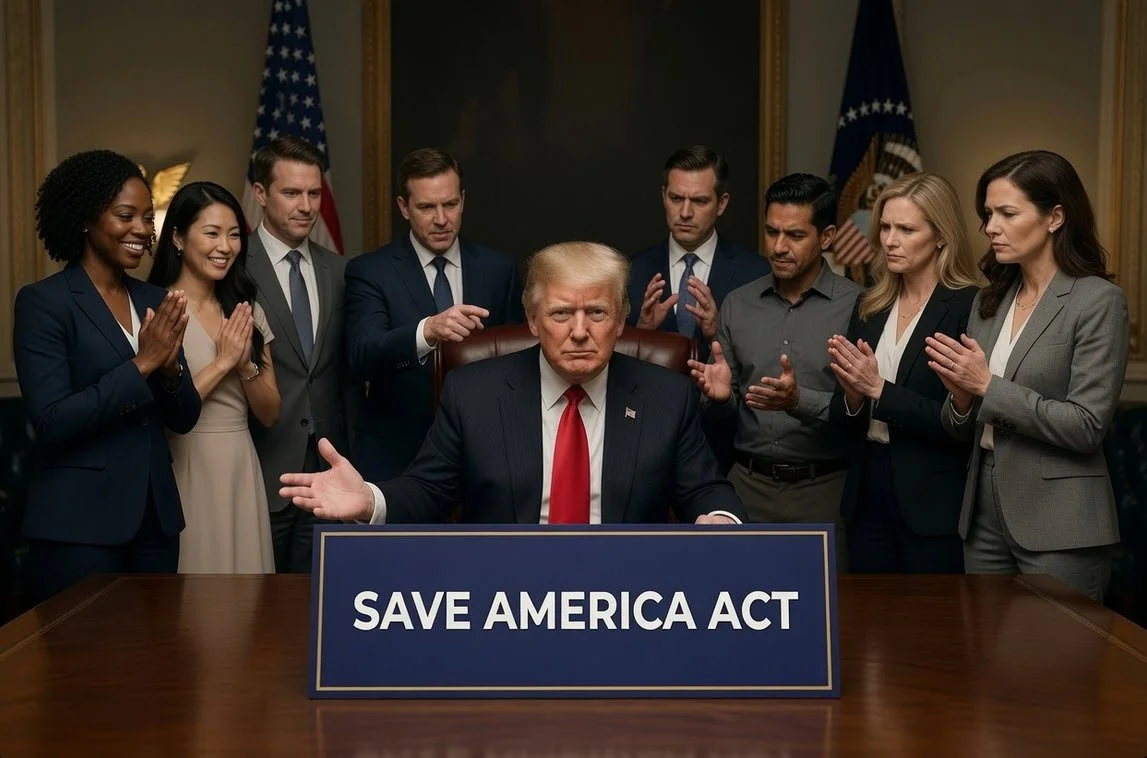
With institutional resistance stalling a third consecutive reconciliation process right before the midterms, the legislation faces a dead end in Washington. Consequently, the battle is shifting away from Congress and into the political arena. Republicans are turning the stalled bill into a high-leverage campaign issue to pressure vulnerable Democrats in swing states, while conservative governors aggressively push state-level "copycat" bills. By shifting the battlefield to local statehouses and campaign advertisements, the party aims to reshape voter registration infrastructure region-by-region while weaponizing the issue for the upcoming elections.
The Byrd Rule Deficit (The Senate Parliamentarian)
Budget reconciliation is strictly reserved for policies that have a direct, non-accidental impact on federal spending or revenue. Under the Senate's Byrd Rule, any provision where the policy change is "merely incidental" to the budgetary impact is stripped out.
The Strategy: Republicans want to structure it as a financial incentive: "Here is $50 million in federal grants for states to update their REAL ID systems—but you only get the money if you mandate proof-of-citizenship checks at the polls."
The Reality: The Senate Parliamentarian is almost certain to rule that the true intent of the bill is to alter federal election law (a policy change), and the funding is just a vehicle to sneak it in. If the Parliamentarian issues a "Byrd Bath" strike, it takes 60 votes to overrule them—putting Republicans right back where they started.
Senate GOP Math (The 4-Vote Deficit)
Even if it survives the Parliamentarian, the math inside the Republican caucus doesn't add up. Because reconciliation allows passing a bill with a simple majority (50 votes plus the Vice President), leadership can only afford to lose a couple of senators.
We already have proof that the votes aren't there. When Senator Lindsey Graham and Senator John Kennedy recently tried to attach the SAVE Act to the Reconciliation 2.0 package, four Senate Republicans broke ranks and voted with Democrats to kill it:
Mitch McConnell (KY)
Susan Collins (ME)
Lisa Murkowski (AK)
Thom Tillis (NC)
These senators have expressed deep discomfort with using a fast-track budget mechanism to bypass committee hearings and upend election infrastructure. Unless leadership can flip at least three of them, any version of the SAVE Act inside a reconciliation bill is dead on arrival.
Burnout on "Reconciliation Fatigue"
There is massive institutional resistance in the Senate to launching a third consecutive reconciliation process. Majority Leader John Thune has been highly non-committal about greenlighting Reconciliation 3.0, stating that any future budget package needs to be strictly focused on defense funding hikes. Meanwhile, influential appropriators like Susan Collins have explicitly warned that attempting a third budget package is a "risky expectation" that will jam up the legislative calendar and trigger a bruising, hours-long amendment gauntlet ("vote-a-rama") right before the midterms.
The Takeaway: The "off-ramp" is a brilliant rhetorical tool. It allows House leadership to signal to the base and Donald Trump that they are still aggressively fighting for the SAVE Act, while quietly shifting the blame to the Senate rules and the Parliamentarian when it inevitably stalls out.
Trump Factor
While it seems logical that an issue with 80% public support (like basic voter ID) would give a president ultimate leverage, the political reality in Washington is causing Donald Trump’s hardball tactics to hit a brick wall. The strategy of leveraging that broad popularity is running into structural and tactical problems.
The Disconnect: Concept vs. The Fine Print
The biggest obstacle Trump faces is that while 80% of Americans support the concept of showing an ID to vote, the SAVE America Act goes far beyond standard voter ID laws.
The bill mandates showing physical documentary proof of citizenship (like a passport or a certified birth certificate) just to register, and it seeks to ban mail-in voting entirely. When pollsters dig into the specific mechanisms—like requiring a passport, which half of Americans do not own, or eliminating mail-in options—public support drops off significantly.
Because the bill includes these more restrictive measures, Democrats are entirely comfortable maintaining a 100% unified wall of opposition, confident that their base supports blocking it.
Who is Trump Playing Hardball Against?
In a typical legislative battle, a president uses public pressure to squeeze vulnerable members of the opposing party. But right now, Trump’s hardball tactics are primarily squeezing his own party leadership in the Senate.
Trump has taken an aggressive approach: He recently threatened to tank the heavily bipartisan housing affordability bill (21st Century ROAD to Housing Act), refusing to sign it unless the Senate passed the SAVE Act. He has held up critical national security items, like the warrantless surveillance authority reauthorization, over the same issue.This "hostage-taking" strategy of withholding signatures on highly popular, unrelated bills frustrates Senate Majority Leader John Thune and pragmatic Republicans. They are the ones being put in the crosshairs, even though they already agree with the bill's intent.
The Senate's Structural Immunity to Polling
Even if national polling were at 95%, the Senate is structurally insulated from it due to the 60-vote filibuster threshold. To pass the bill under regular order, Republicans need to flip at least seven Democrats. Because those Democrats represent solid-blue states where the base views the SAVE Act as voter suppression, broad national polling matters very little to them. They answer to their state electorates, not national averages.Furthermore, Thune has explicitly stated that the votes do not exist within the Republican caucus to "nuke the filibuster" (change the Senate rules to a simple 50-vote majority). Institutionalist Republicans like Mitch McConnell and Susan Collins view the filibuster as a vital shield for when Republicans inevitably return to the minority. They will not destroy it for a single legislative victory.
The Bottom Line: Trump can—and is—playing hardball by freezing the legislative calendar. But because the institutional rules of the Senate require 60 votes, and because key Senate Republicans refuse to blow up those rules, his leverage is causing a massive gridlock within his own coalition rather than forcing Democrats to break.
So What Will Happen
Given the current gridlock and the recent high-profile failures of the bill in the Senate, we are staring down a classic Washington standoff. Neither side is going to blink, which means the battle over the SAVE America Act will shift from a legislative fight to a political tool. The endgame for this bill is already playing out across a few distinct paths:
The Bill Dies in Congress (The Legislative Reality)
As a standalone federal law, the SAVE America Act is functionally dead for this session.
The Vote Failure: The Senate officially killed the bill as an amendment to the Department of Homeland Security (DHS) funding bill in June 2026. Four key Republican institutionalists (McConnell, Collins, Murkowski, and Tillis) voted with Democrats to block it.
The Stand-Off: Former President Trump's attempt to force the Senate's hand by holding up popular, bipartisan legislation—like his recent decision to cancel the signing of the massive 21st Century Road to Housing Act until the SAVE Act passes—has failed to move the needle. Senate Democrats are entirely comfortable using the 60-vote filibuster to block it, knowing their base stands firmly behind them.
It Becomes the Defining Midterm Campaign Issue
Because it cannot pass legislatively, Republican leadership is shifting to Plan B: weaponizing the bill for the upcoming 2026 midterm elections.
Majority Leader John Thune and Senate sponsors have already signaled that the floor failure will be a primary talking point on the campaign trail. The strategy will be straightforward: Republicans will point to the 100% Democratic opposition and argue that Democrats are actively blocking election security. They will use that 80% public support metric for general voter ID to pressure vulnerable Democrats in swing states, attempting to win a larger Senate majority in November that could theoretically alter the rules in 2027.
The Battlefield Shifts to Red State "Copycat" Bills
While the federal bill is stalled, the real-world impact is rapidly shifting to the state level.
Because the US Constitution gives states the primary authority over how they run elections, conservative governors and state legislatures aren't waiting for Washington. A wave of state-level versions of the SAVE Act is moving through red states. These local bills mirror the federal requirements—restricting acceptable IDs to documents that explicitly show citizenship (like passports or birth certificates) and accelerating voter roll purges.
The Court Battle Over Executive Orders
Trump attempted to bypass Congress entirely by signing an Executive Order to mandate these stricter DHS verification checks. However, federal courts have already stepped in. A federal district judge issued a permanent injunction blocking the order, ruling that the president lacks the constitutional authority to single-handedly rewrite state election infrastructure. This legal battle is now heading to the appellate courts.
The Bottom Line: You will not see the SAVE America Act become federal law before the elections. Instead, expect to see it featured heavily in campaign commercials, while the actual mechanics of voter registration continue to be fought out state-by-state and in the federal courts.