Segment #715
For decades the US has watched foreign countries seize their assets without repercussions. There are options in international courts to try to resolve these seizures. It rarely amounts to anything; however, it is still worth noting this to understand what President Trump is rejecting. Certainly there is a great deal more involved in the Venezuela conflict that undoubtedly involves bot Russia and China. I don’t worry about Trump will do. It terrifies me thinking of what all our enemies were doing while Biden and the Dems were sleeping at the switch.
Legal Recourse for Seizure of US Oil Companies' Assets
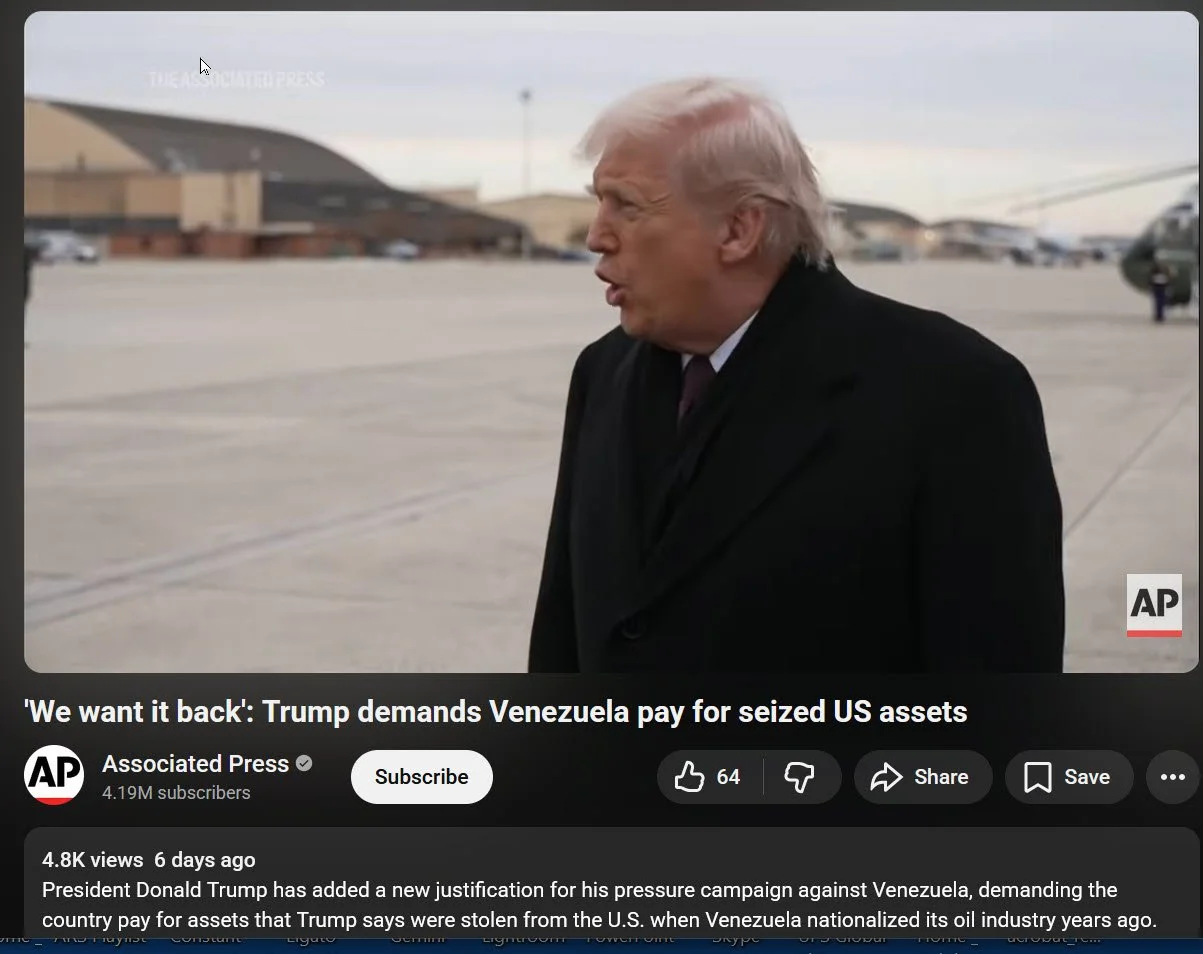
When a foreign government like Venezuela seizes or nationalizes assets belonging to US oil companies (e.g., through expropriation), US companies and the government have several legal and diplomatic avenues under international and domestic law. This is based on historical precedents, such as Venezuela's 2007 nationalization of oil fields under Hugo Chávez, which affected companies like ExxonMobil and ConocoPhillips. Note that the US does not have a bilateral investment treaty (BIT) directly with Venezuela, so recourse often relies on other mechanisms, including structuring investments through countries with BITs (e.g., the Netherlands-Venezuela BIT). Here's a breakdown:
International Arbitration:
Companies can file claims with bodies like the International Centre for Settlement of Investment Disputes (ICSID, part of the World Bank) or the International Chamber of Commerce (ICC) if their investment contracts or treaties allow it. For example, ExxonMobil won a $1.6 billion award against Venezuela in 2014 via ICSID for expropriated assets, while ConocoPhillips secured an $8.7 billion award in 2019. These awards can be enforced globally under the New York Convention on the Recognition and Enforcement of Foreign Arbitral Awards.
Enforcement involves seizing Venezuelan assets abroad. The US Treasury has authorized companies like ConocoPhillips to pursue Venezuelan assets worldwide, including PDVSA (Venezuela's state oil company) holdings like tankers or refineries (e.g., Citgo in the US). Recent US actions, such as intercepting Venezuelan oil tankers off the coast, have been tied to demands for compensation for past seizures.
US Domestic Courts:
Under the Foreign Sovereign Immunities Act (FSIA), US courts can hear cases against foreign states for expropriation if it violates international law (e.g., no prompt, adequate compensation). Companies can sue Venezuela or PDVSA in US federal courts to attach assets like bank accounts or property in the US. For instance, creditors have targeted Citgo shares held by PDVSA in US courts.
The US government can support these efforts through the Office of Foreign Assets Control (OFAC), which administers sanctions that freeze Venezuelan assets and enable seizures.
Diplomatic and Governmental Actions:
The US can espouse claims on behalf of its companies through diplomatic channels or international forums like the Organization of American States (OAS).
Sanctions under laws like the International Emergency Economic Powers Act (IEEPA) can target Venezuela's oil sector, as seen in US sanctions since 2019. Recent escalations, including blockades of sanctioned tankers, have been framed as responses to uncompensated seizures. However, under international law, the US cannot claim ownership of Venezuelan oil itself—only compensation for expropriated assets.
Challenges: Enforcement is difficult because Venezuela may ignore awards, and its assets are limited. Political tensions can lead to retaliatory actions, and blockades raise questions of legality under international law (e.g., potential violations of freedom of navigation).
Legal Recourse for Seizure/Detention of US Oil Company Leaders
If Venezuela detains US oil executives (assuming they are US citizens or residents), this could be treated as wrongful detention, arbitrary arrest, or even hostage-taking. Historical examples include the "Citgo 6"—six US-based Citgo executives detained in Venezuela from 2017 to 2022 on corruption charges, which the US deemed politically motivated. Recourse is more diplomatic than purely legal due to limited jurisdiction over foreign sovereign acts:
Diplomatic Interventions:
The US State Department can declare individuals "wrongfully detained" under the Levinson Act, triggering special envoy involvement for negotiations or prisoner swaps. In the Citgo 6 case, diplomacy and swaps (e.g., exchanging for Venezuelan nationals held in the US) led to their release.
Pressure through sanctions targeting Venezuelan officials responsible for detentions, as authorized by the Magnitsky Act or executive orders.
International Human Rights Mechanisms:
File petitions with the Inter-American Commission on Human Rights (IACHR) or the UN Working Group on Arbitrary Detention, arguing violations of treaties like the American Convention on Human Rights or the International Covenant on Civil and Political Rights.
In extreme cases, the US could bring a case to the International Court of Justice (ICJ) if Venezuela consents to jurisdiction, though this is rare.
US Courts and Domestic Actions:
Families or companies can sue under the Alien Tort Statute (ATS) or Torture Victim Protection Act (TVPA) if torture or extrajudicial acts are involved, but sovereign immunity often blocks suits against the state itself.
Habeas corpus petitions in US courts are unlikely to succeed directly, as they require custody within US jurisdiction.
Governmental Escalation:
The US has used military posturing or enhanced sanctions in response to detentions, as seen in broader Venezuela policy. Recent military buildups near Venezuela have included concerns over detained Americans, though not explicitly tied to oil executives in current reports.
In both scenarios, outcomes depend on US-Venezuela relations, which are highly tense as of December 2025, with ongoing US blockades and seizures escalating the situation. Companies and individuals should consult international lawyers specializing in investment disputes or human rights for case-specific advice.
Monroe Doctrine
What is the Monroe Doctrine?The Monroe Doctrine is a foundational U.S. foreign policy statement articulated by President James Monroe in his seventh annual message to Congress on December 2, 1823. It established the Western Hemisphere (the Americas) as a U.S. sphere of influence, warning European powers against further colonization or intervention in the region.
Key Principles
The doctrine's core ideas, largely drafted by Secretary of State John Quincy Adams, included:
Non-colonization — The Americas were no longer open to future European colonization.
Non-intervention — European powers should not interfere in the affairs of independent nations in the Western Hemisphere.
Separate spheres — The U.S. would not interfere in European affairs or existing colonies.
Any European attempt to extend its system to the Americas would be viewed as a threat to U.S. peace and safety.
It responded to concerns over potential European (especially Russian, Spanish, or French) efforts to reclaim lost colonies in Latin America amid independence movements, as well as Russian claims in the Pacific Northwest.Historical ImpactInitially, the doctrine had limited enforcement power—the young U.S. relied indirectly on British naval dominance to deter Europe, as British interests aligned against rivals like Spain or France. Over time, as U.S. power grew:
It justified U.S. expansion and interventions (e.g., in Mexico, the Caribbean).
The 1904 Roosevelt Corollary expanded it, asserting U.S. right to intervene in Latin America to maintain stability (leading to occupations in Haiti, Dominican Republic, Nicaragua).
Invoked during the Cold War, such as the 1962 Cuban Missile Crisis.
In Latin America, it was often seen as justifying U.S. imperialism rather than protection.
mometrix.com
nitishastra.substack.com
Relevance Today (as of December 2025)The doctrine faded in prominence post-World War II with the rise of multilateralism (e.g., Organization of American States). However, in late 2025, the second Trump administration revived it prominently in its National Security Strategy and a presidential message on the doctrine's anniversary (December 2, 2025).Key developments:
The strategy pledges to "reassert and enforce the Monroe Doctrine" to restore U.S. preeminence in the Western Hemisphere.
Introduces a "Trump Corollary," focusing on countering "hostile foreign incursion" (especially from China), migration, narcotics, and external influences (e.g., requiring divestment of strategic assets).
Emphasizes the hemisphere as a U.S. security priority, with measures like naval patrols and incentives for aligned governments.
This revival has sparked debate: supporters view it as pragmatic realism to counter China and secure borders; critics call it outdated imperialism risking tensions or misreading modern Latin America.The Monroe Doctrine remains a symbol of U.S. hemispheric dominance, evolving from anti-colonial warning to tool for regional influence.