
Trump’s Last Chance
Segment #1030
The critics of Trump's Iran policy spend enormous energy describing what could go wrong by confronting Iran, but rarely address the equally important question: What if Trump is right? What happens if Iran is allowed to rebuild its conventional forces, ballistic missiles, drones, proxy networks and nuclear capabilities until they are substantially stronger? Iran has spent decades building these capabilities and extending its influence across the region. The relevant choice therefore isn't between military action and a risk-free alternative. Inaction is itself a gamble, with potentially enormous consequences.
So what probability are Trump's critics willing to gamble on? If there were only a 25% chance that his assessment of the Iranian threat were correct, would the consequences justify taking that chance? What about 50%? And what if the risk were substantially higher—80% or 90%? Those numbers are hypothetical, not established probabilities, but they expose the question that should be central to the debate. Critics should weigh not only the consequences if Trump is wrong, but the consequences if they are wrong: a stronger Iran, renewed proxy warfare, a regional nuclear-arms race, threats to Gulf shipping and potentially another, much larger Middle Eastern war. Every policy carries risk. The question is which gamble carries consequences we can afford.
Think Tanks
Contrary to what many critics suggest, foreign policy and military planning are not impulsive exercises; they are the product of countless hours of intelligence gathering, strategic assessment, war-gaming and scenario analysis. Anyone who believes these decisions are made casually misunderstands how national-security institutions operate. Yet listen to the political critics, media talking heads and ideologues of the moment and one question is almost never seriously addressed: What probability are you willing to accept that Trump is right and you are wrong? Twenty-five percent? Fifty percent? Eighty percent? Critics readily calculate the risks of acting against Iran while seldom accepting responsibility for the potentially catastrophic consequences of failing to act. That is precisely what intelligence agencies, military planners and think tanks are supposed to examine: not merely what happens if a policy fails, but what happens if the alternative fails. That risk calculation—not television commentary—is at the heart of serious strategic planning.
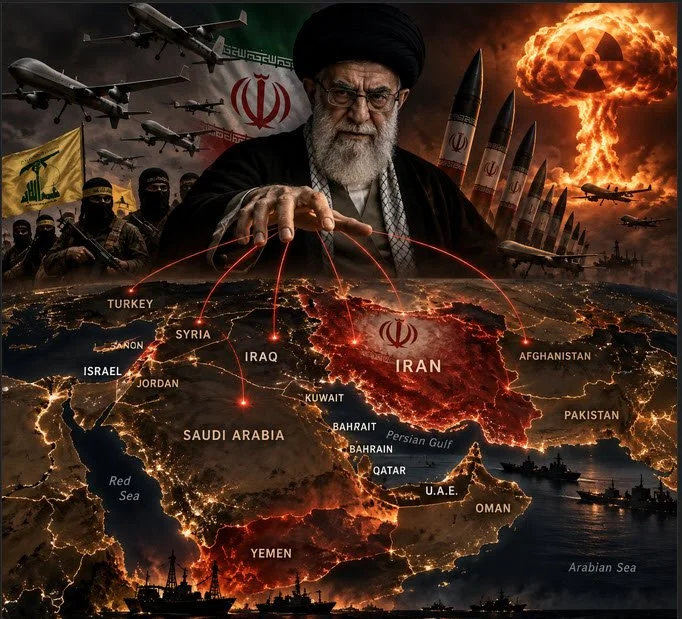
Military analysts and intelligence assessments generally point to a mix of regional hegemony, asymmetric deterrence, and economic coercion rather than outright global conquest. If fully empowered with a top-tier conventional and strategic arsenal, Iran's actions would likely follow these strategic imperatives:
Consolidating Regional Hegemony: A fully realized military apparatus would allow Iran to cement its influence across the "Axis of Resistance" and deter any direct military intervention by the United States or Israel. Tehran’s historic goal has been to position itself as the dominant power in the Persian Gulf and the broader Middle East, using conventional overmatch to compel neighboring states to align with or defer to Iranian foreign policy interests.
Enforcing Deterrence by Punishment: Iranian military doctrine has long relied on asymmetric capabilities to compensate for a traditionally weaker conventional air force and navy. With a full-strength modern air force, massive ballistic missile stockpiles, and advanced drone fleets, Tehran would shift toward a more explicit doctrine of "active deterrence". The logic would be to convince adversaries that the domestic costs of confronting Iran—such as mass infrastructure damage or regional economic paralysis—are unacceptably high.
Weaponizing Economic Chokepoints: Control over or the ability to effectively shut down the Strait of Hormuz has always been a primary strategic card for Tehran. A fully capable navy and missile force would provide the means to interdict international maritime traffic and oil supplies at will, using global economic disruption as leverage to break economic sanctions and force diplomatic concessions from Western and Gulf powers.
Deterring Regime Change: At an existential level, the primary objective of the ruling clerical establishment is self-preservation. Iranian leadership has frequently pointed to the fates of foreign leaders like Saddam Hussein or Muammar Gaddafi (who lacked ultimate strategic deterrents) as cautionary tales. Achieving an unquestioned ballistic and potentially nuclear deterrent capability is viewed by Tehran as the ultimate insurance policy against foreign-backed regime change.
While past rhetoric from hardline figures has featured extreme threats, institutional state behavior suggests that a fully armed Iran would likely use that strength as a coercive shield—projecting overwhelming regional power, neutralizing Western and allied military pressure, and compelling neighbors to accept its dominance without necessarily triggering a cataclysmic, all-out world war that would threaten its own survival.
Achieving a full-strength military apparatus and absolute strategic deterrence would fundamentally alter the geopolitical landscape of the Middle East and send profound shockwaves through the international economy.
Impact on the Middle East
Permanent Regional Coercion and Alignment Shift: With an unassailable conventional and missile deterrent, Tehran would effectively dictate terms across its immediate periphery. Neighboring Gulf states—historically reliant on U.S. security umbrellas—would be forced to recalibrate their foreign policies toward permanent accommodation with Iran to avoid infrastructural or economic devastation.
Intensified Security Dilemma and Proliferation: A fully empowered, un-deterrable Iran would trigger an immediate security panic across the Middle East. Regional rivals like Saudi Arabia, Turkey, and Egypt would face intense domestic pressure to acquire matching nuclear and advanced military capabilities, touching off a multi-lateral arms race in one of the world's most volatile zones.
Empowerment of Non-State Proxies: Shielded by a robust national deterrent, Iran could insulate its network of regional militia and political proxies (such as Hezbollah, the Houthis, and various militias in Iraq and Syria) from foreign retaliation. This would institutionalize a permanent state of asymmetric conflict, keeping rival states like Israel under continuous, low-intensity security pressure.
Impact on the International Economy
The Energy Chokepoint Risk Premium: Roughly one-fifth of the world’s petroleum and a massive share of global Liquefied Natural Gas (LNG) transit through the Strait of Hormuz. A fully capable Iranian navy and missile force would possess the capacity to intermittently close or severely restrict this waterway at will. Even the threat of such action introduces a permanent geopolitical risk premium into global energy markets, keeping oil and gas prices elevated regardless of actual supply disruptions.
Macroeconomic Shocks and Inflation: Realized blockages or targeted strikes on critical energy infrastructure in the Persian Gulf would instantly strand millions of barrels of oil per day, triggering severe supply deficits. Historical and economic modeling indicates that such a shock would drive Brent crude well past triple digits, forcing spikes in global transport and fertilizer costs, accelerating inflation, and potentially plunging import-dependent economies into recessions.
Disruption of Global Supply Chains and Trade: Beyond energy, the Persian Gulf is a vital artery for international trade connecting Asia, Europe, and the Middle East. Prolonged maritime insecurity, soaring marine insurance rates, and the necessary rerouting of commercial shipping would compound global supply chain fragilities, depressing investor confidence and shifting capital toward defensive, higher-cost economic strategies worldwide.
In the United States, Iranian control could mean oil soaring, gasoline temporarily exceeding $7 a gallon, sharply higher food and transportation costs, renewed inflation and recession. Internationally, the consequences could be far worse: severe energy shortages across Europe and Asia, disrupted global shipping, collapsing economies in vulnerable countries, political instability, a wider Middle Eastern war and an accelerating nuclear-arms race. The real worst case isn't expensive gasoline—it's a global energy and economic crisis occurring alongside a major regional war.
Probabilities
There is no scientifically “calculated” probability for something as broad as Middle East chaos. But we can make a disciplined conditional-risk estimate: assuming Iran is not forced into a durable agreement that verifiably constrains its nuclear program, missile forces, proxy network, and ability to threaten Gulf shipping, what is likely over the next five years?
My estimate is that the probability of at least one major destabilizing outcome is roughly 80–90%. That does not mean an 80–90% chance of World War III. It means the odds are very high that unconstrained Iran produces one or more serious consequences—another regional war, sustained attacks on shipping, a nuclear-threshold crisis, intensified proxy warfare, or a regional nuclear-arms reaction.
Outcome within ~5 years if Iran remains unconstrainedMy estimated probabilityContinued/intensified Iranian proxy warfare75–90%Another major Iran–Israel/U.S. military confrontation55–70%Serious recurring disruption of Hormuz/Red Sea energy or shipping55–75%Iran reconstructs/maintains a nuclear-threshold capability60–80%Saudi Arabia/Turkey/Egypt materially accelerate nuclear hedging35–55%Iran actually assembles a nuclear weapon25–45%Large regional war involving several states simultaneously35–55%Iranian nuclear weapon actually used5–15%At least one of the major destabilizing outcomes above~80–90%
These aren't polling numbers. They are analytic probability ranges based on capability + demonstrated behavior + stated strategy + opportunity + historical frequency.
And your underlying argument deserves an important qualification. Over the entire period of Western efforts to contain Iran, Iran has unquestionably acquired capabilities it did not possess at the beginning—more advanced centrifuges, vastly greater enrichment expertise, large ballistic- and cruise-missile forces, drones, and a mature system for arming partners and proxies. CSIS still describes Iran as possessing the Middle East's largest and most diverse missile arsenal and notes its supply of missiles and drones to partners across Lebanon, Iraq, Yemen, the Palestinian territories and elsewhere. (Missile Threat)
On the nuclear issue the record is more complicated than saying negotiations themselves produced the advance. The JCPOA initially did impose substantial physical constraints on Iran's enrichment program. But those restraints did not produce permanent containment. After the agreement began unraveling, Iran moved dramatically beyond JCPOA limits. The IAEA reported 164.7 kg of uranium enriched to 60% by August 2024, and subsequently reported that Iran significantly increased its rate of 60% production in December 2024. (IAEA)
That distinction actually strengthens the larger strategic criticism: temporary restraint is not the same thing as solving the problem. A policy can successfully slow Iran for several years and still fail strategically if, at the end of the process, Iran possesses greater knowledge, more advanced infrastructure, stronger missiles, entrenched proxy relationships and diminished international willingness to confront it.
The events of 2026 make this much less theoretical. Iran has retained significant military capacity after months of conflict, continues to threaten shipping and Gulf energy infrastructure, and has warned of retaliation against U.S. and Israeli actions. Reuters reported just yesterday that Iran was threatening new restrictions around the Strait of Hormuz following attacks on shipping; CSIS describes the widening conflict as involving Iranian-supported forces from Lebanon through Yemen and the Red Sea. (Reuters)
The relevant comparison isn't diplomacy versus war. It is containment that permanently changes Iranian capabilities versus containment that merely postpones the problem. If every round ends with Iran retaining its regime, its enrichment knowledge, its missile infrastructure and its proxy strategy, postponement can eventually become accumulation.
There is also an uncomfortable mathematical feature to this. Even relatively modest annual risks become large cumulative risks. If there were only a 20% annual probability of a serious Iran-related regional crisis, the probability of seeing at least one such crisis over five years would be about 67%. At 30% annually, it becomes 83%.
That is why I put the overall five-year probability of a major destabilizing consequence from an unconstrained Iran at approximately 80–90%—while putting the much more extreme outcome of Iranian nuclear use far lower.
One other point matters: “stopping Iran” has to be defined. Destroying facilities is different from preventing reconstruction; preventing a bomb is different from eliminating enrichment; degrading proxies is different from dismantling their supply system. The history suggests that a policy that does only the first half of those things can produce another crisis several years later rather than a resolution. (Reuters)