
Midterms 2026 - Open Borders
Segment #1030
It is so easy and in some circles very popular to say I believe in this or I believe in that without any followup from the interviewer. Obviously there are real consequences with the implementation of policy. So what are they? Make your argument.
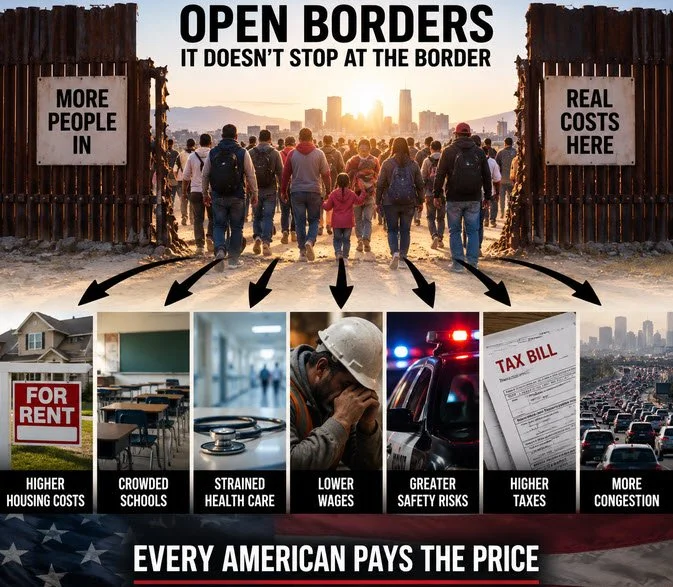
A recurring weakness in political debate is the tendency to sell policies by emphasizing their intentions while minimizing their consequences. The real test is what happens after a policy becomes permanent: how it changes incentives, transfers power, affects public order, strains institutions and imposes costs that may never appear on a federal spreadsheet. Government estimates are useful reference points, not guarantees. The important question is what happens when the assumptions are wrong—and whether the consequences can be reversed.
The Effectively Open Border: The Costs Don't Stop at the Border
The central issue is not whether immigration is good or bad. America has benefited enormously from legal immigration. The issue is whether Americans control immigration or whether the sheer ability to reach the United States increasingly determines who gets to remain here.
Sovereignty. A border is where a nation exercises its right to decide who enters, how many enter and who must leave. When millions can enter or remain while an overwhelmed system takes years to resolve their status, that authority is weakened. Immigration policy begins to be driven less by deliberate national choices and more by who succeeds in reaching American territory.
The incentive to come. Border policy changes behavior. If reaching the United States creates a realistic prospect of living and working here for years before a final decision, that prospect becomes an incentive for additional migration. The resulting backlog can become self-reinforcing: more arrivals create longer delays; longer delays make settlement more permanent; permanent settlement makes eventual removal more difficult.
Taxpayers. Claims that additional immigration improves the federal balance sheet tell only part of the story. CBO found that the recent immigration surge increased state and local revenue by $10.1 billion in 2023 but increased direct spending by $19.3 billion—a $9.2 billion net direct cost. Education, shelter and related services, and border security accounted for more than half the additional spending.
The hidden federal bill. CBO's headline federal projections did not include all future discretionary spending. It estimated that if affected discretionary programs grew proportionately with the additional population, appropriations could be roughly $200 billion higher over 2024–2034.
Housing. New residents need homes whether they entered legally or illegally. Supply cannot instantly respond. CBO found that the immigration surge increased housing demand, rents and property values. For a young American competing for an apartment or trying to buy a first home, that is a real cost even though it never appears as an immigration expenditure in the federal budget.
Wages. A larger labor force can increase total GDP without benefiting every worker equally. CBO projected that the recent surge initially slowed wage growth among Americans with twelve or fewer years of education. The people most exposed to additional low-skilled labor competition are therefore not necessarily affluent Americans but workers already near the bottom of the economic ladder.
Schools. Children must be educated regardless of their parents' immigration status. More students require teachers, classrooms and services. If government does not immediately increase spending, the cost does not disappear—it can appear as larger classes and crowded facilities. CBO explicitly recognizes crowding in public schools as a real nonbudgetary consequence.
Health care and social services. Additional population increases demand for hospitals, emergency care, housing assistance and other services. CBO identifies education, health care, housing and infrastructure among the areas facing additional fiscal pressure from increased immigration.
Infrastructure. Roads, transit systems, water, sewers and other public infrastructure have capacity limits. Population can increase far faster than communities can construct new infrastructure. Again, the cost may appear not as an immigration line item but as congestion, crowding, higher local taxes or services stretched more thinly.
Public safety. It is inaccurate to claim that immigrants generally are more criminal than native-born Americans. The border-security issue is different: a government should know whom it is admitting. Even if dangerous entrants constitute a tiny minority, inadequate screening creates risks that a controlled system is specifically intended to reduce.
The opportunity cost. Immigration courts, Border Patrol agents, asylum officers, shelters, schools and local governments have finite resources. Every dollar and employee consumed managing an overwhelmed system is unavailable for another public purpose. Moving the cost between federal, state and local governments does not make it disappear.
The burden is unequal. This may be the most important point. The benefits and costs of mass immigration do not necessarily go to the same Americans. Employers may gain workers. Businesses gain customers. Consumers may gain lower-cost services. The federal government gains additional payroll and income-tax revenue. At the same time, lower-skilled workers may face greater labor competition, renters greater housing competition, and particular cities and school districts higher service costs. CBO itself finds this split: the surge improves its projected federal fiscal balance while imposing net costs on state and local governments.
The bottom line. Immigration can enlarge the American economy while an uncontrolled immigration system still imposes substantial costs on particular Americans. GDP is not the same thing as individual prosperity, and federal revenue is not the same thing as national well-being. The question is not whether America should welcome immigrants. It is whether Americans should decide whom America welcomes, in what numbers, under what rules and at a pace the country can successfully absorb.