
Trump vs. Reagan, A Comparison
Segment #971
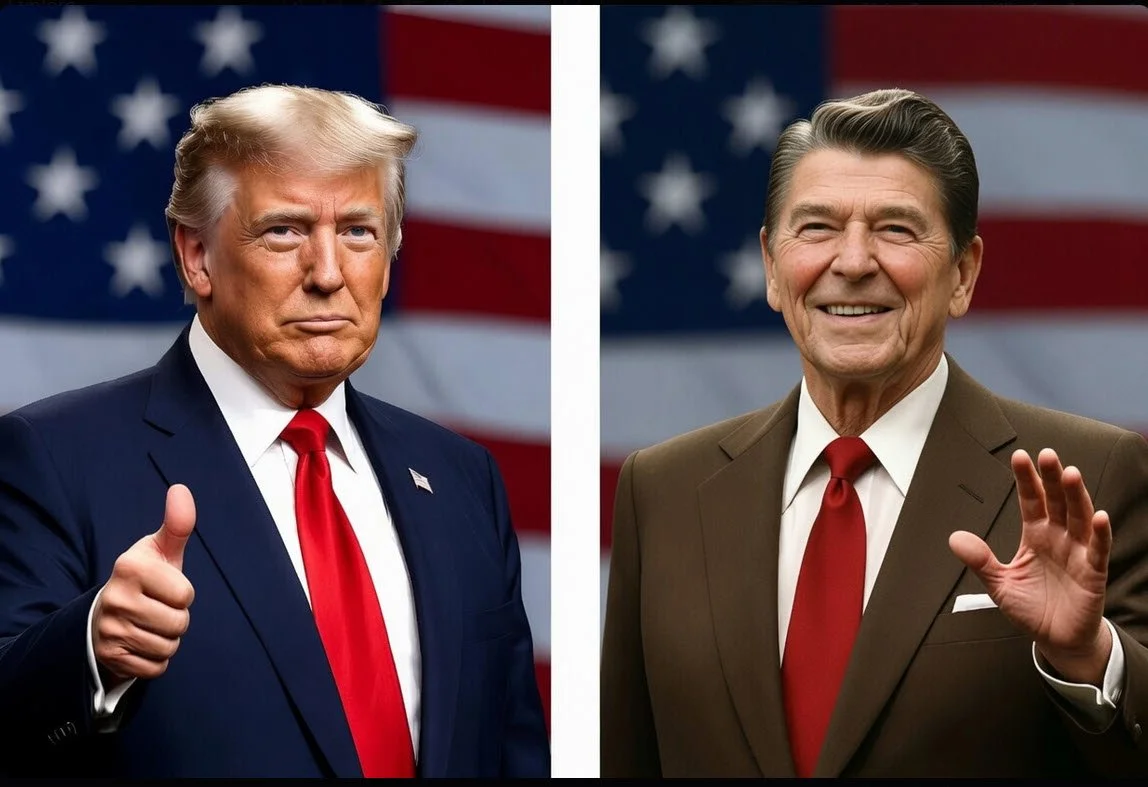
Comparing Ronald Reagan and Donald Trump requires looking past standard media tropes and focusing on their actual economic, legislative, and geopolitical records. Both men reshaped the Republican Party, shattered the existing consensus in Washington, and brought backgrounds outside of career politics (entertainment and business) to the Oval Office.
Yet, while their core goals of American renewal were deeply aligned, their underlying philosophies, political styles, and strategies differed substantially.
Core Economic Frameworks
Both administrations achieved major growth via tax cuts and deregulation, but their fundamental economic models were built on distinct principles.
Ronald Reagan: Supply-Side Conservatism
Reagan’s economic engine (**Reaganomics**) was fueled by supply-side theory: slash marginal income tax rates and corporate taxes to incentivize investment, boost production, and lift all boats.
Victories: The Economic Recovery Tax Act of 1981 dropped the top individual tax rate from 70% to 50%, and the 1986 Tax Reform Act further simplified the code, bringing the top rate down to 28%. These cuts, combined with Federal Reserve Chair Paul Volcker's tight monetary policy, tamed the ruinous stagflation of the 1970s and launched a massive, multi-decade economic expansion.
Challenges/Downs: The immediate result of the high interest rates needed to break inflation was a sharp, painful recession from 1981 to 1982. Additionally, because spending cuts did not match the scale of the tax cuts, the national debt nearly tripled during his two terms.
Donald Trump: Populist Economic Nationalism
Trump shifted the party away from globalist free-market orthodoxy toward economic nationalism, combining classic conservative tax reform with aggressive protectionism to defend domestic manufacturing.
Victories: The Tax Cuts and Jobs Act of 2017 delivered a major structural victory by permanently slashing the corporate tax rate from 35% to 21% and lowering individual rates. This kicked off a high-growth, low-inflation economy with record-low unemployment across multiple demographics. Trump also successfully renegotiated NAFTA into the USMCA, modernizing trade terms to benefit American workers.
Challenges/Downs: The use of sweeping tariffs (particularly against China and steel/aluminum exporters) protected certain domestic sectors but injected friction into global supply chains and strained relationships with traditional trading partners. Like Reagan's era, pre-pandemic spending outpaced revenues, and the subsequent necessary emergency spending during the 2020 COVID-19 pandemic caused the national debt to spike significantly.
Foreign Policy & National Defense
Both presidents rejected the foreign policy status quo of their eras, choosing to project strength from a position of renewed American power.
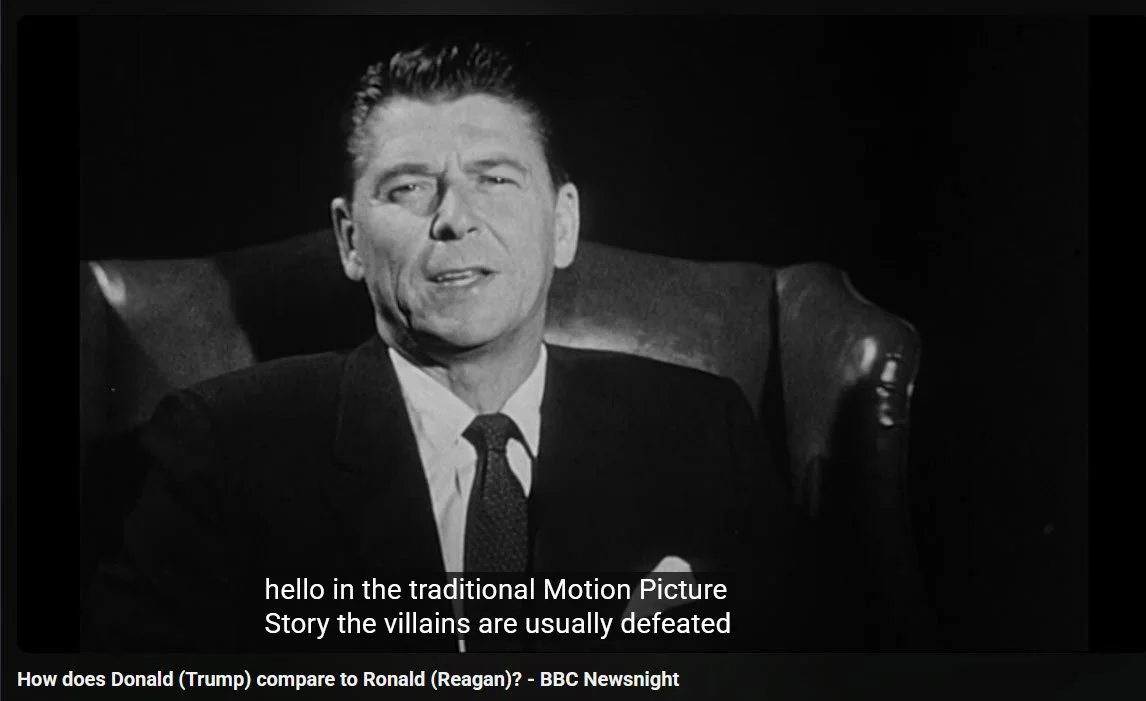
BBC view: Documentary maker Michael Cockerell filmed with Reagan at the time and looks at the similarities - and differences - between Ronald Reagan and Donald Trump. Newsnight is the BBC's flagship news and current affairs TV programme - with analysis, debate, exclusives, and robust interviews.
Reagan: "Peace Through Strength
Reagan faced a global, bipolar Cold War against the Soviet Union. His strategy was to dramatically outspend and out-innovate the Soviets to force them to the negotiating table.
Victories: He launched a historic peacetime military buildup, including the Strategic Defense Initiative (SDI). By arming anti-communist freedom fighters worldwide (The Reagan Doctrine) and standing firm on deployment of intermediate-range missiles in Europe, he broke the Soviet economy's capacity to compete. This eventually forced Mikhail Gorbachev to sign the INF Treaty (1987), paving the way for the peaceful collapse of the Soviet Union.
Challenges/Downs: The Iran-Contra Affair—where administration officials secretly sold arms to Iran to fund Nicaraguan Contras despite a congressional ban—became a severe political crisis that threatened his presidency in his second term.
Trump: "America First" & Realism
Trump operated in a multipolar world characterized by asymmetric threats and the rise of China. He viewed international agreements through a transactional lens, demanding that allies pay their fair share and avoiding protracted foreign interventions.
Victories: His administration fundamentally shifted the Western consensus on China, identifying it as a strategic competitor and hitting it with severe trade enforcement. He successfully decimated ISIS's territorial caliphate, authorized the elimination of high-value targets like Qasem Soleimani, and brokered the historic Abraham Accords, which normalized relations between Israel and several Arab nations without entangling the U.S. in new foreign conflicts. He also successfully pressured NATO allies to significantly increase their defense spending.
Challenges/Downs: His open skepticism of traditional alliances like NATO and withdrawal from multilateral pacts (such as the Paris Climate Accord and the Iran Nuclear Deal) created constant, intense diplomatic friction. It also sparked ongoing tension with the permanent Washington foreign policy establishment.
Judicial Legacies
For many conservatives, the transformation of the federal judiciary stands as the most enduring victory of both presidencies.
Reagan’s Legacy: He sought to re-anchor the courts in constitutional textualism and judicial restraint. He appointed Antonin Scalia, who became the intellectual anchor of originalism for decades, alongside Anthony Kennedy and Sandra Day O'Connor (the first woman on the Supreme Court). However, his nomination of Robert Bork resulted in a bruising, highly politicized defeat in the Senate that permanently altered judicial confirmation battles.
Trump’s Legacy: Working in close lockstep with Senate Majority Leader Mitch McConnell, Trump achieved an unprecedented pace of judicial appointments. He successfully placed three constitutional conservatives on the Supreme Court—**Neil Gorsuch, Brett Kavanaugh, and Amy Coney Barrett**—which flipped the court's balance and led to historic jurisprudential shifts, most notably the return of abortion regulation to the states via the Dobbs decision. He also filled federal appeals courts with young, strict-constructionist judges.
Communication and Party Realignment
The two men utilized vastly different toolkits to mobilize their bases and reshape the political landscape. While both Ronald Reagan and Donald Trump fundamentally reshaped the American conservative movement, they did so
Donald Trump took a vastly different approach as "The Disruptor." His style was raw, direct, and overtly combative, characterized by a strategy that deliberately bypassed traditional media in favor of communicating directly with the public through social media. This approach anchored a populist realignment of the Republican base, shifting the party's center of gravity toward working-class, blue-collar voters, particularly across the Rust Belt. Trump: Trump rejected standard political polish in favor of a raw, authentic, and highly combative communication style. Recognizing deep-seated public distrust in institutional media, he bypassed traditional channels entirely to speak directly to his base via social media and massive rallies. This approach built an intensely loyal, populist movement that fundamentally realigned the Republican base, turning the party into a champion for working-class voters and the Rust Belt, while shifting corporate-aligned and highly educated suburban voters out of the traditional coalition.
Reagan: Known as "The Great Communicator," Reagan used television, polished rhetoric, and a warm, optimistic disposition to win over the public. He excelled at using folksy humor to disarm opponents and de-escalate partisan tension. His coalition united fiscal conservatives, national security hawks, and social conservatives, drawing a massive wave of blue-collar "Reagan Democrats" into the tent. relied on a polished, optimistic, and humorous rhetorical style. He worked primarily through standard, mainstream media channels to broadcast his message. His political coalition—often referred to as the "Reagan Democrats"—was built on a foundation of suburban voters, the emerging Christian Right, and traditional fiscal conservatives.