
Segment #1047
This process seems almost absurd when you consider the illegal aliens that poured across our border under the Biden Aminstration. But this is the law. Our policy appears now to be enter illegally → remain long enough → automatically qualify for citizenship. Our law below is very different.
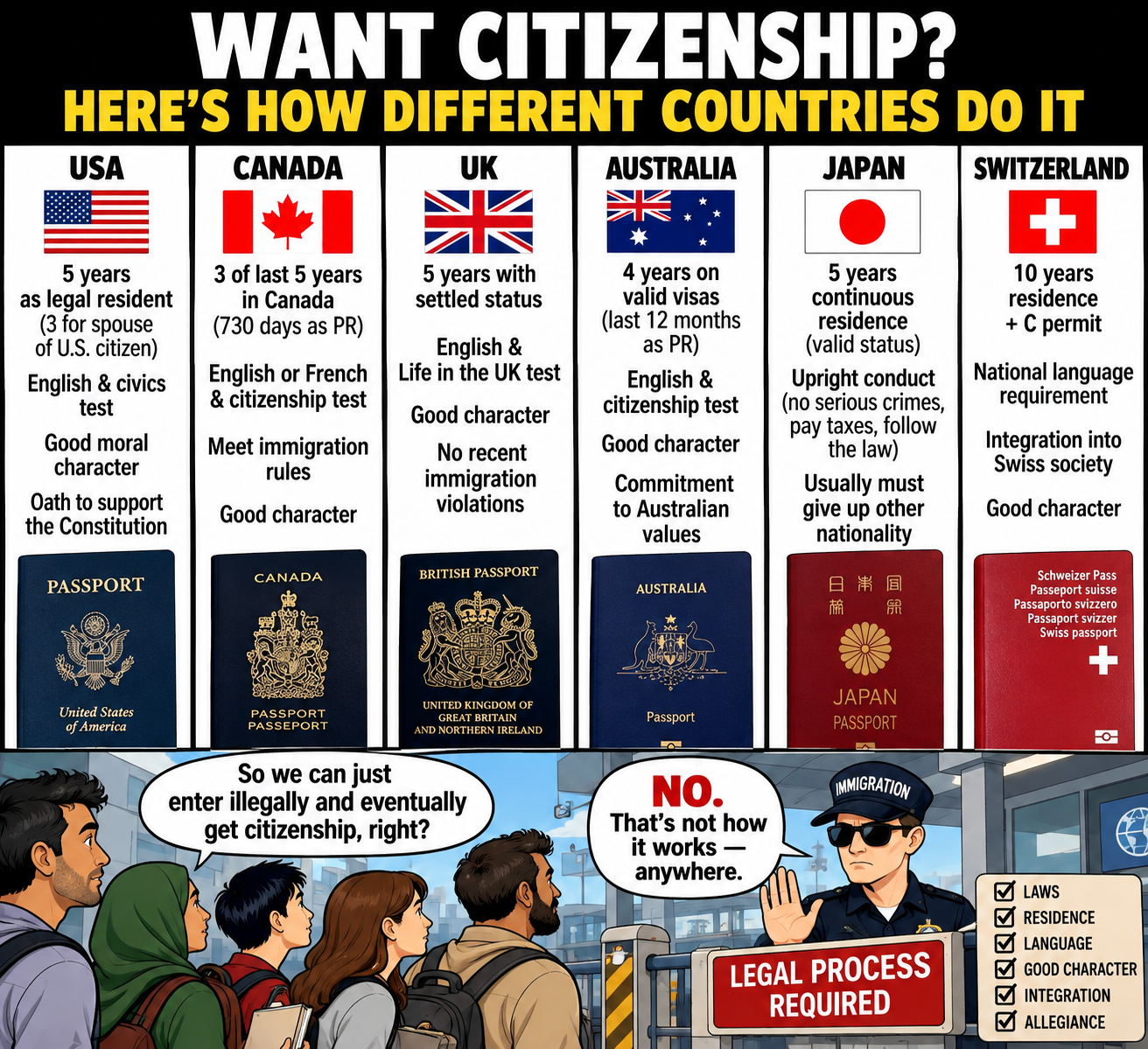
To Qualify for Citizenship in the U.S.
Be 18 or older.
Be a lawful permanent resident (Green Card holder), normally for at least 5 years. Certain spouses of U.S. citizens can qualify after 3 years.
Maintain the required continuous U.S. residence and physical presence.
Demonstrate good moral character.
Demonstrate basic ability to read, write, and speak English, subject to statutory exceptions.
Pass a civics test covering U.S. history and government.
Demonstrate attachment to the principles and ideals of the U.S. Constitution.
Complete the naturalization interview and application process.
Finally, take the Oath of Allegiance. Citizenship through naturalization is not complete until the oath is taken.
Oath of Allegiance
The oath is particularly relevant to your earlier question. USCIS explains that by taking it, the new citizen promises, among other things, to give up prior foreign allegiance, support and defend the Constitution and laws of the United States, obey U.S. law, perform qualifying national service when required, and be loyal to the United States.
The Oath of Allegiance taken by most people becoming naturalized U.S. citizens reads:
“I hereby declare, on oath, that I absolutely and entirely renounce and abjure all allegiance and fidelity to any foreign prince, potentate, state, or sovereignty, of whom or which I have heretofore been a subject or citizen;
that I will support and defend the Constitution and laws of the United States of America against all enemies, foreign and domestic;
that I will bear true faith and allegiance to the same;
that I will bear arms on behalf of the United States when required by the law;
that I will perform noncombatant service in the Armed Forces of the United States when required by the law;
that I will perform work of national importance under civilian direction when required by the law;
and that I take this obligation freely, without any mental reservation or purpose of evasion; so help me God.”
Denaturalization
Denaturalization is the legal process by which the federal government revokes citizenship that a person obtained through naturalization. It is quite different from simply deporting a noncitizen.
Under 8 U.S.C. § 1451(a), the government can bring a civil denaturalization case when citizenship was “illegally procured” or obtained through “concealment of a material fact or by willful misrepresentation.” The Department of Justice currently handles these cases through federal court. Department of Justice
The basic process is:
Investigation/referral. Federal authorities develop evidence suggesting that the person was not legally entitled to naturalization or obtained it through material concealment or misrepresentation.
DOJ files a civil lawsuit in U.S. District Court. Citizenship isn't simply canceled administratively; denaturalization requires a judicial order. Department of Justice
The citizen can contest the government's allegations in federal court.
In a civil case, the government faces a demanding evidentiary standard historically described by the Supreme Court as “clear, unequivocal, and convincing” evidence. Department of Justice
If the government succeeds, the federal court revokes the order of naturalization and cancels the naturalization certificate.
Losing citizenship does not automatically mean immediate deportation. Once the person is no longer a citizen, their immigration status and whether they are removable have to be determined under immigration law.
There is also a criminal route. A person convicted under 18 U.S.C. § 1425 of knowingly procuring naturalization contrary to law is subject to mandatory revocation of naturalization under 8 U.S.C. § 1451(e). Department of Justice
The important distinction about violating the citizenship oath
A naturalized citizen cannot ordinarily be denaturalized simply because, years later, he violates the law, expresses views hostile to the United States, changes his political or religious beliefs, or fails to live up to the spirit of the Oath of Allegiance.
The crucial question is usually what was true when citizenship was obtained.
For example, suppose an applicant swore:
“I will support and defend the Constitution and laws of the United States…”
but evidence subsequently established that at the time of naturalization the applicant deliberately concealed a material fact or made a willful material misrepresentation that affected eligibility. That can potentially support denaturalization. DOJ's current guidance specifically identifies illegal procurement and material concealment or willful misrepresentation as §1451 grounds. Department of Justice
That's materially different from someone sincerely taking the oath, becoming a citizen, and later developing beliefs or engaging in conduct inconsistent with it. The later conduct can potentially result in criminal prosecution, but it doesn't by itself retroactively make the naturalization fraudulent.
And this isn't merely theoretical. Denaturalization enforcement has expanded substantially in 2026. DOJ reported on August 3 that it had filed 123 civil denaturalization complaints since January 20, 2025, including cases alleging concealed violent crimes, sexual offenses, fraudulent identities and other disqualifying facts. Department of JusticA
Citizenship for Illegal Aliens
The terminology matters: someone who entered or remains in the United States unlawfully is not automatically eligible to apply directly for citizenship. Naturalization normally comes only after the person first obtains lawful permanent resident (LPR/Green Card) status through a legally available route. USCIS says an applicant generally must have been lawfully admitted for permanent residence and then satisfy the applicable residence period and other naturalization requirements. USCIS
That creates several distinct questions that are sometimes blurred together:
How did the person enter? Entering without inspection is legally different from entering lawfully and subsequently overstaying a visa.
How did the person obtain a Green Card? Some people who were previously unlawfully present can eventually obtain LPR status through particular statutory mechanisms, waivers, asylum-related routes, family provisions, or other immigration provisions. Prior unlawful presence doesn't necessarily create a lifetime prohibition.
Was the Green Card lawfully obtained? This is crucial for eventual citizenship. USCIS says a naturalization applicant must establish that the initial admission or adjustment to permanent-resident status was lawful. USCIS
Did the applicant tell the truth? Fraud or concealment of a material fact in obtaining permanent residence or citizenship can have consequences well beyond simply denying the N-400. USCIS's denaturalization guidance specifically addresses situations in which an underlying permanent residence was unlawful because of previously undisclosed disqualifying facts. USCIS
Then comes naturalization. The applicant must establish good moral character, constitutional attachment, English/civics requirements (subject to exceptions), and willingness to take the Oath of Allegiance. USCIS
So there is an important distinction: having once been unlawfully present in the United States does not necessarily prevent someone from ever becoming a citizen. But an individual generally cannot go directly from unlawful status to naturalization. There must normally be a legally valid transition to permanent-resident status first, followed by satisfaction of the naturalization requirements.
And this connects directly to the issue we were discussing about denaturalization: if the government later discovers that the person's underlying Green Card was never lawfully obtained, that can potentially undermine the subsequent naturalization itself. USCIS expressly recognizes that principle