
Why We Should Not Complain About Gas Prices
Segment #1047
.But one proposition still cannot be converted from a serious risk into a fact: we cannot know that Iran would have used a nuclear weapon or attempted to destroy Israel or the United States. What we can evaluate is whether Iran's record made that possibility sufficiently dangerous that waiting for proof of intent was itself an unacceptable gamble.
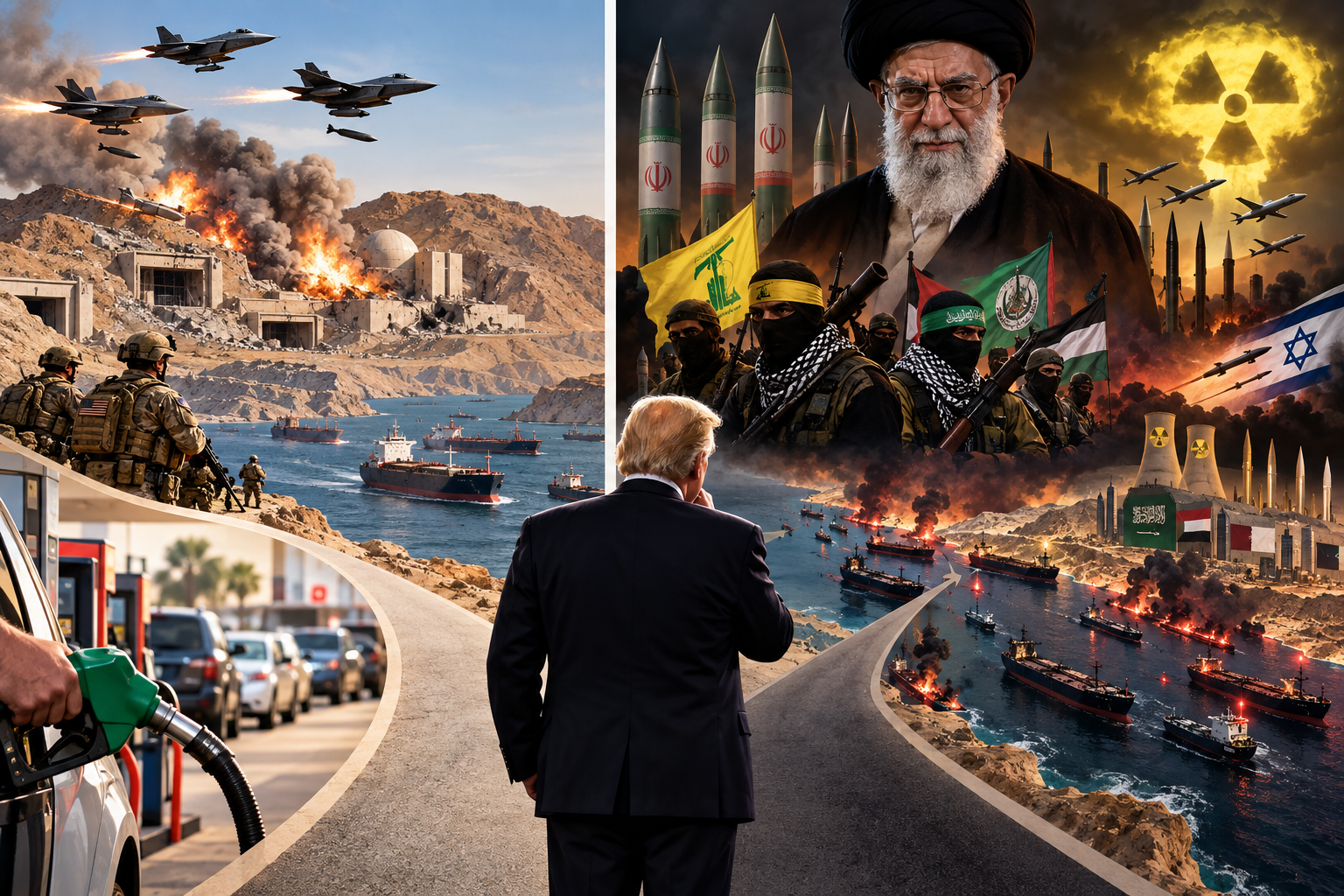
And Iran's record was not hypothetical. The United States has designated Iran a state sponsor of terrorism since 1984. Successive U.S. administrations documented Iranian financing, arming and training of Hezbollah, Hamas, Palestinian Islamic Jihad and other armed groups. The U.S. government attributed at least 603 American military deaths in Iraq alone to Iran and Iranian-supported forces. U.S. Department of State
That history matters enormously when evaluating an approaching nuclear threshold. The decision-maker was not looking at a peaceful state that happened to possess an enrichment program. He was looking at a government with a decades-long record of using proxies and military force to pursue regional objectives while developing missiles, drones and an increasingly advanced nuclear capability.
The risk is asymmetric
Imagine that the intelligence assessment were only 70–80% convincing that Iran was approaching the dangerous nuclear capability Trump described. That does not mean a president should automatically accept the remaining 20–30% uncertainty and wait.
The consequences on the two sides aren't remotely symmetrical.
If the assessment proved too pessimistic, military action could impose enormous costs: casualties, Iranian retaliation, regional war, higher oil prices and disruption of Hormuz. Those are exactly the kinds of consequences that have occurred.
Extremis is the point at which if you fail to take action the outcome is certain regardless of any further action.
There is also a crucial economic dimension that sometimes gets lost in arguments about today's gasoline price.
Hormuz isn't just another shipping lane. Before the conflict, approximately 20.9 million barrels of petroleum per day—about 20% of world petroleum consumption and roughly one-quarter of seaborne oil trade—passed through the Strait. Existing pipelines could bypass only a fraction of that volume. U.S. Energy Information Administration
We now have an extraordinary real-world demonstration of the vulnerability. Iran's March 2026 closure drove Middle Eastern tanker rates to their highest recorded levels in more than two decades. EIA says Hormuz disruptions subsequently contributed to sharply higher and more volatile crude prices; Brent reached $118 per barrel during the second quarter. U.S. Energy Information Administration
So I would state the economic argument considerably more forcefully than I did previously:
Today's higher gasoline prices are a real cost of the decision to confront Iran. But treating them as the economic measure of whether the decision was justified is incomplete. The appropriate comparison is the present cost against the expected cost of the alternative—including the possibility that Iran became much harder to deter or disarm while retaining missiles, drones, proxies and leverage over an energy artery carrying roughly one-fifth of the world's petroleum.
A president confronting a potentially catastrophic threat doesn't necessarily have the option of waiting until intent is proven beyond doubt. Capability can cross a threshold after which the available military options become less effective or dramatically more dangerous. At that point, additional intelligence certainty can actually have declining value: by the time you know exactly what the adversary intends to do, your ability to prevent it may have disappeared.
Where reasonable people can disagree is where that threshold was in Iran's case and whether diplomacy, sanctions, deterrence and inspections still offered an acceptable alternative. That's the central policy dispute.