Segment #1048
What Solomon's new job actually is
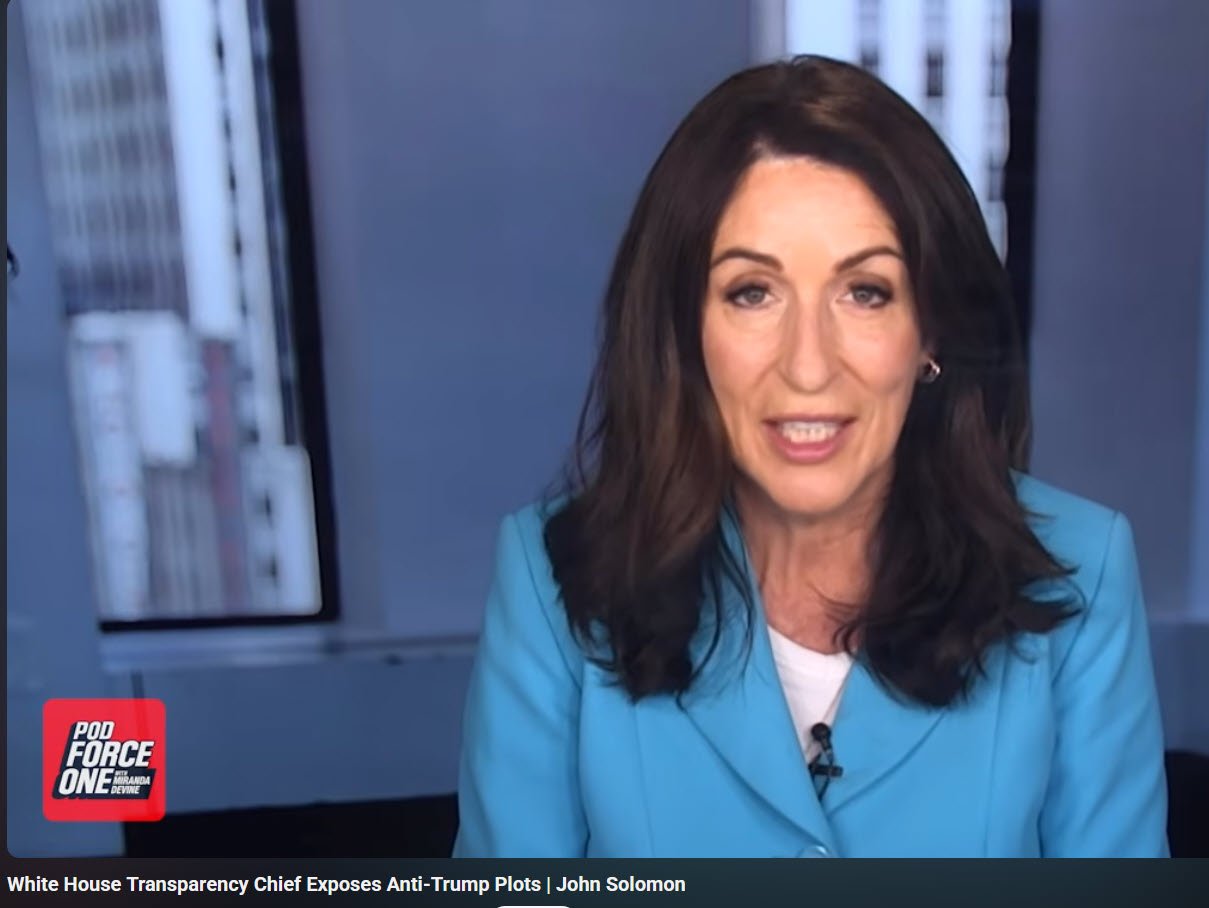
Solomon is serving as an unpaid Special Government Employee and chairman of the White House Government Transparency Task Force. The task force is looking for previously withheld or classified records involving election security, alleged government "weaponization," intelligence activities, and politically sensitive investigations. Solomon says he doesn't personally control declassification: intelligence personnel identify/review material and the president or appropriate authorities make the declassification decisions. The Washington Post
That distinction matters. Calling him simply Trump's "head of transparency" makes the position sound broader than it apparently is. He isn't an inspector general or an independent government-wide transparency czar. He's heading a White House-created task force with a defined investigative/declassification mission.
The arrangement is nevertheless extraordinary. A journalist who spent years trying to obtain these records is now being given government access to help find the records he previously sought from outside.
What I think is most important in this interview
Strip away Devine's and Solomon's rhetoric about the "Deep State," and there are two different layers in the interview that shouldn't be confused.
The first consists of actual documents that now exist and can be examined. Some are genuinely significant.
For example, the previously classified Durham annex confirms that U.S. intelligence obtained information in 2016 concerning a possible Clinton campaign effort to associate Trump with Russia. Durham found that some of the underlying purported emails were probably composites derived from Russian intelligence hacking, but also concluded that other communications lent "at least some credence" to the existence of such a political plan. The intelligence was important enough that CIA Director John Brennan briefed Obama, Biden, Comey, Clapper and others on August 3, 2016. Senate Judiciary Committee
That's substantially more nuanced than either "the Clinton plan was completely invented" or "the documents prove the entire Russia investigation was a Clinton conspiracy."
There is also an important chronological point that cuts against one simplified version of Solomon's argument: Crossfire Hurricane was opened after the FBI received the Australian information concerning George Papadopoulos, and before the FBI received Steele's reporting. Durham strongly criticized how the FBI handled the investigation, but the Steele dossier wasn't literally what opened Crossfire Hurricane. House Intelligence Democrats
Where Solomon appears to have uncovered genuinely new material
One of the more interesting releases is Oxferd Comma—and, strangely, that really is how the FBI spelled the code name.
Newly declassified FBI documents show that after Trump fired James Comey in May 2017, the FBI opened an investigation examining whether Trump's action could have been connected to Russia. This isn't merely Solomon's characterization; CBS independently reported on the declassified records. The White House
That makes the Solomon project worth watching regardless of one's politics. Previously unknown FBI investigative files are actually becoming public.
The White House transparency site is also publishing records under headings including Round River, March Toll and election-security matters. The White House
And Arctic Frost isn't something Solomon invented. Senate Judiciary has released substantial records concerning the investigation, including subpoenas involving congressional phone records. The political interpretation of those actions is sharply disputed, but the underlying subpoenas and investigative records are real. Senate Judiciary Committee
For example, the documents may establish that an investigation occurred, that information wasn't disclosed, that officials received particular intelligence, or that phone records were subpoenaed. Establishing why officials did those things—and whether they constituted legitimate investigation, bureaucratic misconduct, political bias or a coordinated political scheme—requires considerably more evidence.
The interview doesn't always maintain that distinction.
The China/2020-election section particularly needs that caution. Solomon has publicly acknowledged that the task force had found "zero evidence" that a foreign power changed votes in the 2020, 2022 or 2024 elections. Reuters also reported that the intelligence being considered for declassification did not establish that China manipulated the 2020 vote outcome. Washington Examiner
Foreign attempts to obtain voter data or probe election systems can therefore be extremely serious without demonstrating that the 2020 presidential result was altered.
The really unusual part: Solomon himself
This may ultimately be as historically interesting as the documents.
Solomon is simultaneously:
document hunter → government official → declassification advocate → interpreter of the documents → media personality discussing their meaning.
The Washington Post reports that he remains active in media while on leave as editor-in-chief of Just the News. The White House says he has consulted ethics officials and is complying with Special Government Employee requirements. Critics argue that the arrangement nevertheless creates at least the appearance of a conflict because Solomon's media organization benefits from stories generated by a government process he helps conduct. The Washington Post
That doesn't make the documents false. It means the documents should be separated from Solomon's interpretation of them.
Bombshell Categories
Document exists - Strongest level. Verify the original government record.
Document establishes government action - Often strong: investigation opened, briefing occurred, subpoena issued, etc.
Document suggests misconduct - Requires context, contemporaneous rules and competing evidence.
Document proves coordinated political conspiracy - Highest evidentiary hurdle; usually much harder to establish.
Why Solomon's appointment nevertheless matters
This is the part I think could become genuinely consequential.
For years the argument over Russia, the FBI, Hunter Biden, election intelligence and the Trump investigations has largely consisted of one side's narrative versus the other side's narrative, with enormous amounts of relevant material classified, redacted or buried in government systems.
Solomon's task force potentially changes that equation because it can convert arguments about secret records into arguments about public records that everyone can inspect.
If the task force releases complete files—including documents that undermine its preferred interpretation—that could materially improve the historical record.
If it selectively releases documents supporting one narrative while withholding contrary material, then "transparency" becomes another form of political messaging.
That is the test I would use to judge Solomon's new job: not whether the documents embarrass Democrats, Republicans, the FBI, CIA or anyone else, but whether the government releases enough of the underlying record for outsiders to independently determine what happened.
And there is enough genuinely new documentary material emerging that I would not dismiss this as simply another political-media exercise.
Solomon’s Important Mandate _ what is already proven with documents
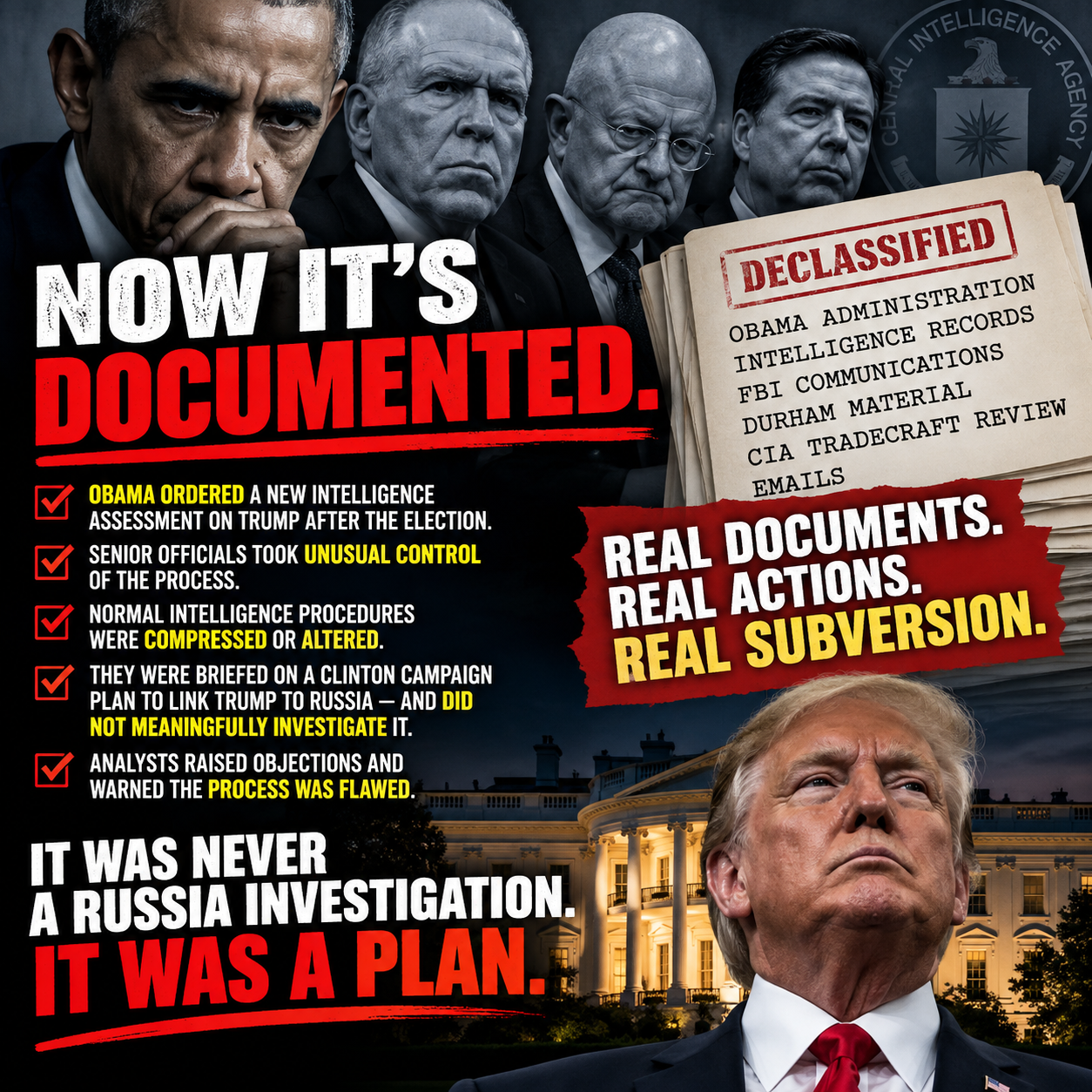
This is no longer a debate based solely on partisan accusations. Declassified government records now establish that senior officials in the Obama administration took a series of extraordinary actions involving Donald Trump before and during the transition to his presidency.
The record shows that CIA Director John Brennan briefed President Obama and other senior officials in 2016 on intelligence concerning a purported Clinton campaign plan to connect Trump to Russia. The Durham investigation later concluded that communications it examined lent “at least some credence” to the proposition that such a political plan existed. Yet the FBI did not meaningfully investigate that intelligence.
After Trump won the election, President Obama personally ordered a new intelligence assessment of Russian election activity. Recently declassified records show that the resulting process was highly unusual: a compressed deadline, unusually heavy involvement by agency leadership, limited participation, departures from normal procedures, and disputes over intelligence that was included. A 2025 CIA lessons-learned review by career professionals specifically identified “multiple procedural anomalies,” including excessive involvement by agency heads and marginalization of the National Intelligence Council.
We now also have the December 2016 emails. NSA Director Mike Rogers warned that his agency had not had sufficient access or time to be fully confident in the assessment. DNI James Clapper responded that “more time is not negotiable” and acknowledged that normal procedures might have to be compromised.
None of this proves that Russian interference in the 2016 election was imaginary. It wasn't. The bipartisan Senate Intelligence Committee subsequently concluded that Russia conducted an extensive influence operation, and its earlier review found the 2017 Intelligence Community Assessment broadly supported by the intelligence available to it.
But that fact does not erase the separate question of what senior U.S. officials did with the intelligence.
The newly released record provides documentary grounds for investigating whether senior Obama-administration officials politicized intelligence and used extraordinary government processes in ways that undermined an incoming president. ODNI has gone considerably further, officially characterizing the evidence as showing an effort to “subvert” Trump's presidency; that is the current administration's conclusion and remains politically and historically disputed.
The strongest case therefore does not require exaggeration. Obama ordered the post-election assessment. Brennan and other senior officials exercised unusual control over its production. Normal intelligence procedures were compressed or altered. Contrary intelligence and analytical objections existed. And senior officials had previously been informed of intelligence suggesting that Trump's opponent was attempting to associate him politically with Russia. Those points are now matters of documentary record.
Call the ultimate purpose what you will. But Americans are entitled to ask whether the enormous powers of the intelligence and law-enforcement apparatus were used objectively during a presidential transition—or whether political considerations influenced actions that damaged and constrained the incoming administration.
That question can no longer reasonably be dismissed simply by saying there is “no evidence.” There is evidence. There are documents. There are emails. There are intelligence records. There are sworn accounts. The legitimate argument now is over what those records prove about intent, responsibility and the conduct of the officials involved.