
“Don’t Cry Because It’s Over; Smile Because It Happened”
The awareness that a clock is ticking down on every single human experience is not a shadow; it is the light by which the world becomes vibrant. Across geography and generations, humanity has repeatedly stumbled upon this same arresting truth: there is a final chapter to every ordinary rhythm, and realizing it is the ultimate catalyst for gratitude. When we accept that there is a definitive last time for everything—the last time a parent lifts a child, the last time an artist picks up a brush, the last time friends sit around a specific table—the present moment stops being a stepping stone to tomorrow. It becomes a destination in itself. To look across the globe is to see a beautiful, collective effort to capture this fleeting magic through different cultural lenses, expressed purely through the stories and languages we carry.
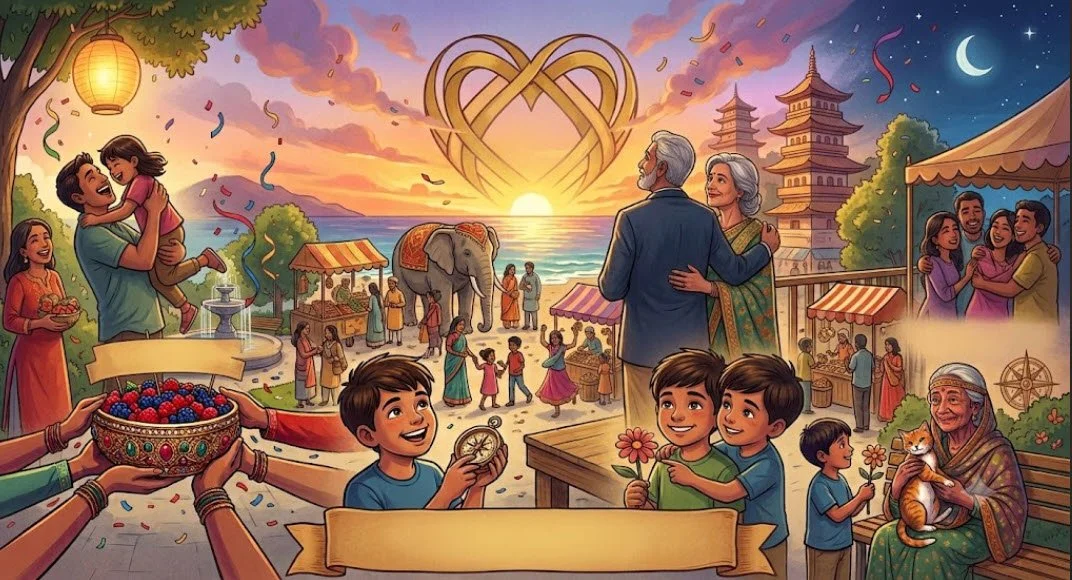
In Japan, the tea masters of the sixteenth century refined a concept that directly addresses this razor-sharp awareness of the final moment: Ichigo ichie. Translated as "one time, one meeting," it demands that a host and guest interact with the heavy, beautiful understanding that even if they gather again next week, this exact encounter can never be replicated. The light will be different, the seasons will have shifted, and the people will have aged. It transforms a simple cup of tea into a sacred, unrepeatable event, urging us to look into the eyes of whoever is across from us and listen as if it were the only conversation that mattered. This is closely paired with Wabi-Sabi, which turns that same gaze toward the physical world. It is the active appreciation of impermanence and imperfection, finding immense beauty in a cracked ceramic bowl, a weathered wooden pillar, or the deeply lined face of an elder. It reminds us to be grateful for things exactly as they are right now, because their vulnerability to time is precisely what makes them precious.
A parallel sentiment echoes through Spanish and Latin American culture through the phrase "La última vez," meaning the last time. It is a theme woven tightly into the fabric of daily life, particularly in the slow, deliberate rituals of the evening paseo—the twilight stroll through a town square. Elders sit on benches, watching the youth run by, deeply aware of the cyclical, fleeting nature of time. There is a profound gratitude in those quiet observations, an unspoken understanding that every shared laugh in the plaza is a luxury borrowed from a finite ledger. This ties intimately into the Spanish concept of Duende, a mysterious, visceral force that enters an artist when they become acutely aware of death and impermanence. A flamenco dancer or a singer performs with a fierce, breathtaking urgency precisely because they know the music must end, transforming the performance into an act of defiant gratitude.
Moving into the Arabic-speaking world, this total surrender to a fleeting instant manifests as Tarab. Often described in the context of classical music and poetry, Tarab is that rare, breathless crest of an experience where the past and future utterly vanish. It is the moment a listener is so captivated by a singer’s cadence that the boundary between the self and the art completely dissolves. To experience Tarab is to acknowledge that this specific emotional peak is a transient gift that cannot be held onto or forced to stay, demanding that we consume it entirely while it is here.
In the ancient Sanskrit tradition of India, the antidote to the constant human yearning for "more" is found in Santosha, the practice of intentional contentment. Santosha is not a passive surrender, but a radical, active choice of gratitude. It is the decision to look at your current life, your current possessions, and your current relationships, and declare that what you have in this exact moment is entirely enough. It cuts through the anxiety of accumulation by reminding us that if we cannot find peace with what we hold in our hands today, we will never find it in what we chase tomorrow.
When we look to the harsh, shifting climates of Scandinavia, the Nordic philosophy of Friluftsliv, or "open-air life," anchors this gratitude in the natural landscape. It is a deep, spiritual connection to the earth centered on simply being in nature without the need to conquer a peak or achieve a goal. A crisp morning or a sudden burst of summer sun is treated with immense reverence because winter is always on the horizon. Sitting on a weathered rock, looking out at a fjord, there is only a deep, quiet thankfulness for the air in one's lungs and the land beneath one's feet.
Similarly, the indigenous Māori culture of New Zealand speaks of Kaitiakitanga, a concept deeply rooted in guardianship and a profound respect for the environment and ancestry. It fosters an awareness that we do not own the land or the moments we inhabit; we are merely minding them for a short season. Every breath taken in the shadow of a mountain or by the sea is practiced with an awareness of the ancestors who came before and the generations who will follow, turning existence into a shared, treasured stewardship.
In the West African philosophy of Ubuntu, often summarized as "I am because we are," gratitude and presence are found in human interconnectedness. It reminds us that our individual lives are validated only through our relationships with others. Because human life is fragile and tracking toward an inevitable conclusion, the moments we spend supporting, listening to, and celebrating one another become the highest form of living. An dynamic conversation, a shared meal, or a communal celebration is approached with the understanding that the bond itself is the reward.
Ultimately, this global tapestry of thought reveals a singular truth: the realization that everything has a last time is not meant to paralyze us with grief, but to shock us into awareness. It is the friction against mortality that gives life its warmth. When we stop treating our days as infinite, we finally begin to live them. We taste the coffee, we hear the music, we feel the wind, and we look at the people we love with a profound, aching gratitude—knowing that this moment, right now, is a beautiful, fleeting masterpiece that will never happen again.
Summation
Regardless of who first said, “Don’t cry because it’s over; smile because it happened,” there is a powerful message in this simple phrase that is worth taking a closer look at. Though it may seem straightforward and practically childish, this phrase really does point to important stoic ideas that we can incorporate into our lives.
Amor Fati
We talk about the Latin phrase amor fati a lot here, which translates to “love of one’s fate.”
The idea here is that we can embrace our experiences and the things we go through, even when we see them as negative. Though it might sound a bit odd to love the worst things that happen to you, there is a perspective you can take where even the roughest spots in life were learning experiences that led to our personal growth and fulfillment of our potential.
In short, Stoicism teaches the acceptance of things we cannot control, including the impermanent nature of life and experiences. The quote in question embodies this principle by suggesting that instead of lamenting the end of a situation or relationship, one should appreciate that it occurred in the first place.
Focus on the Present
However, the more we focus on the present, the more we’re able to appreciate what we have while we have it and accept change and loss when it occurs.