
Jubilee Media—founded by Jason Y. Lee with the explicit mission to "provoke understanding and create human connection"—historically made its name through empathetic, highly structured formats like Middle Ground and Spectrum. Those older formats focused heavily on finding the common denominators between deeply opposed groups (like cops and ex-felons, or pro-choice and pro-life advocates).
However, the launch of the "Surrounded" series on September 8, 2024, marked a major tactical pivot for the network. It explicitly traded slow, deliberative consensus-seeking for high-stakes, fast-paced political combat. It has since become a viral juggernaut, pulling in hundreds of millions of views by pitting "the many against the mighty."
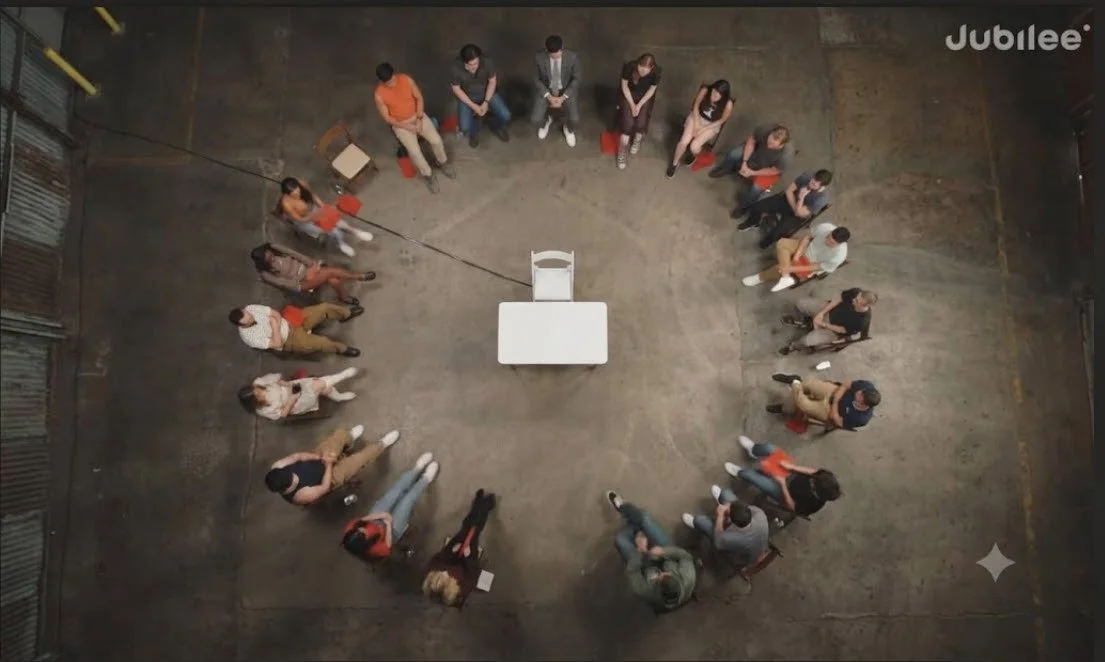
1. The Architectural Mechanics of "Surrounded"
The show functions as a highly engineered rhetorical pressure cooker, relying on a strict set of gamified rules:
The Power Dynamic: One prominent, deeply entrenched "champion" (an experienced political debater, commentator, or activist) sits alone in the center of a circle. They are surrounded by 20 to 25 participants who radically disagree with their worldview.
The Claims-Driven Clock: The central figure brings 4 to 5 predetermined, highly provocative claims to the table. Each claim initiates a countdown clock (usually around 20 minutes total).
The Hot Seat Dash: When a new claim drops, the surrounding participants literally have to sprint or rush to a single center chair to engage the debater one-on-one.
The Red Flag Guillotine: The participant in the hot seat operates on borrowed time. The remaining members of the circle hold red flags. If a simple majority (over half the circle) raises their flags—usually because they feel their representative is losing the point, repeating arguments, or being outmaneuvered—the speaker is instantly voted out, and someone else must rush to the chair.
2. A Critical Breakdown: Where the Format Fails and Succeeds
Media critics, academics, and viewers are highly split on Surrounded. It sits on a razor's edge between genuine civic engagement and algorithmic "ragebait."
The Flaws: Built-In Impediments to Deep Deliberation
The "Win-or-Lose" Adversarial Incentive: Because participants are terrified of being "red-flagged" out of the chair by their peers, they naturally tend to rush their points, interrupt, or rely on snappy, combative soundbites. There is zero structural incentive to pause, actively listen, or concede a point.
Unequal Representation: The physical requirement to sprint to the center chair means the loudest, most aggressive, or most camera-confident participants dominate the screen time. In almost every episode, several more introverted or contemplative participants spend the entire two hours sitting in the outer circle without ever speaking.
Anecdotes vs. Systematic Data: Outer-circle participants frequently rely heavily on highly specific personal anecdotes to counter data-driven debaters. While emotionally resonant, these individual stories often fail to form solid structural arguments, leaving them vulnerable to being easily deconstructed by seasoned media figures.
The "Memefication" of Politics: The series is built entirely for the modern internet lifecycle. It functions as a factory for high-yield, short-form clips (TikToks, Shorts, Reels) titled "X Eviscerates Y" or "Woke Advocate Claps Back." Critics argue this reduces complex socioeconomic realities into consumable internet theater.
The Merits: Why It Still Carries Cultural Weight
Raw Realism: Unlike highly manicured cable news segments where talking heads repeat sterile, pre-approved party lines, Surrounded brings raw, unscripted grassroots perspectives directly face-to-face with prominent elite figures. It exposes viewers to the exact language, emotional realities, and talking points being used on the ground.
Testing the "Mighty": It forces high-profile commentators out of their carefully curated echo chambers. Media figures who usually control the microphone on their own podcasts or networks are forced to face an immediate, visceral human check on their rhetoric.
The 10-Minute Uncapped Finale: At the very end of the episode, the rules change. The central figure selects one participant from the outer circle for an un-editable, un-flagged 10-minute deep dive. Free from the threat of the sudden red flag guillotine, this final segment frequently produces the most nuanced, respectful, and genuinely intellectual exchanges of the entire production.
3. Key Milestone Episodes
The series has featured major ideological heavyweights from across the entire cultural spectrum, routinely shifting the center seat's political alignment:
Central DebaterOpposing CircleCultural Legacy / ImpactCharlie Kirk (Sept 2024)25 Liberal College StudentsThe premiere episode that established the "many vs. mighty" format and immediately went viral across social platforms.Dean Withers (Sept 2024)20 Trump SupportersThe rapid-fire counter-episode that launched Withers into a viral progressive political persona, eventually earning him an invite to the White House.Ben Shapiro (Oct 2024)25 Kamala Harris VotersA highly tense, fast-paced evaluation of abortion, foreign policy, and economic equity, featuring the memorable "dying violinist" bodily autonomy debate.Destiny (Oct 2024)25 Trump VotersA highly combative episode focusing heavily on institutional trust, the 2020 election, and economic policy metrics.Alex O'Connor (Jan 2025)25 ChristiansShifting away from pure politics, this episode featured a highly academic, philosophical, and text-based debate regarding theism and biblical interpretation.Dr. K / Alok Kanojia (May 2026)20 Depressed PeopleA powerful structural shift into mental health, using the format to unpack systemic trauma, success, and the mechanics of hopelessness.
Ultimately, Surrounded works because it accurately mirrors the fractured, hyper-partisan reality of modern public discourse. It doesn't always mend the divide, but it forces both sides into the same physical room—making it impossible for either side to completely ignore the humanity of the other.
Here is the contextually integrated history of the network to place right before your breakdown of the Surrounded series. It charts Jason Y. Lee's original vision, the network's corporate evolution, and how the shifting political landscape incrementally pulled them away from pure empathy toward viral friction.
Origin and Evolution: From Subway Busking to Digital Empire
The foundation of Jubilee Media belongs to an unconventional corporate pivot. In 2010, Jason Y. Lee—then a Wharton School alumnus working a six-figure consulting job at Bain & Company—quit his corporate path following a life-changing volunteer trip to Haiti after its devastating earthquake. Seeking a way to leverage digital media for social good, Lee began by filming himself busking in a New York subway station to raise relief funds. This grassroots project birthed the "Jubilee Project," which originally operated as a shoestring non-profit editing simple videos on iMovie, explicitly greeting viewers as "good humans."
For its first seven years, the platform focused on non-contentious, uplifting human interest stories. However, following the deep societal polarization of the 2016 U.S. presidential election, Lee saw an opportunity to scale. In 2017, the network raised $650,000 from investors (facing 83 rejections from traditional venture capitalists who doubted the profitability of "empathy") and restructured into a for-profit digital studio: Jubilee Media.
[2010] Founded as Non-Profit ──> [2017] $650K Venture Pivot ──> [2018-2023] The "Middle Ground" Era ──> [2024-Present] The "Surrounded" Combat Era
During this transitional era, Jubilee established its algorithmic footprint with flagship series like Odd One Out, Spectrum, and most notably, Middle Ground. The early iterations of Middle Ground were slow, intimate, and highly curated. Opposing factions—such as undocumented immigrants and staunch Trump voters—sat across a minimalist table, stepping forward only when they agreed with written prompts. The ultimate goal was to strip away political theatricality and force participants to look at their ideological adversaries as complex human beings. Lee famously stated that his benchmark for balanced, neutral content was achieving an "equal amount of canceling from both sides."
The Shift to Polarization and High-Stakes Friction
As the creator economy evolved into the 2020s, the financial incentives of the YouTube ecosystem dramatically shifted toward high-retention, high-friction programming. Media critics from outlets like Vox and The New York University Review noted that Jubilee increasingly began trading quiet nuance for viral flashpoints. The casting shifted away from everyday citizens toward hyper-articulate internet commentators on one side, and highly ideological, un-vetted contrarians on the other.
By the time Jubilee signed with the Hollywood powerhouse talent agency WME and crossed 10 million subscribers, the "empathy" model had fundamentally hybridized with the fast-paced, confrontational formatting of legacy tabloid talk shows like Jerry Springer or Dr. Phil. The network faced intense pushback from progressive media critics for inadvertently legitimizing extremist rhetoric by framing radical viewpoints as simply "the other side" of a mainstream debate.
It was against this backdrop of ideological fatigue and short-form video dominance that Jubilee abandoned the quiet boardroom table entirely. On September 8, 2024, they launched Surrounded—a format that didn't just acknowledge the modern political arena's hostility, but actively gamified it.
(You can now seamlessly transition into your existing text: 1. The Architectural Mechanics of "Surrounded")