
Segment #1094
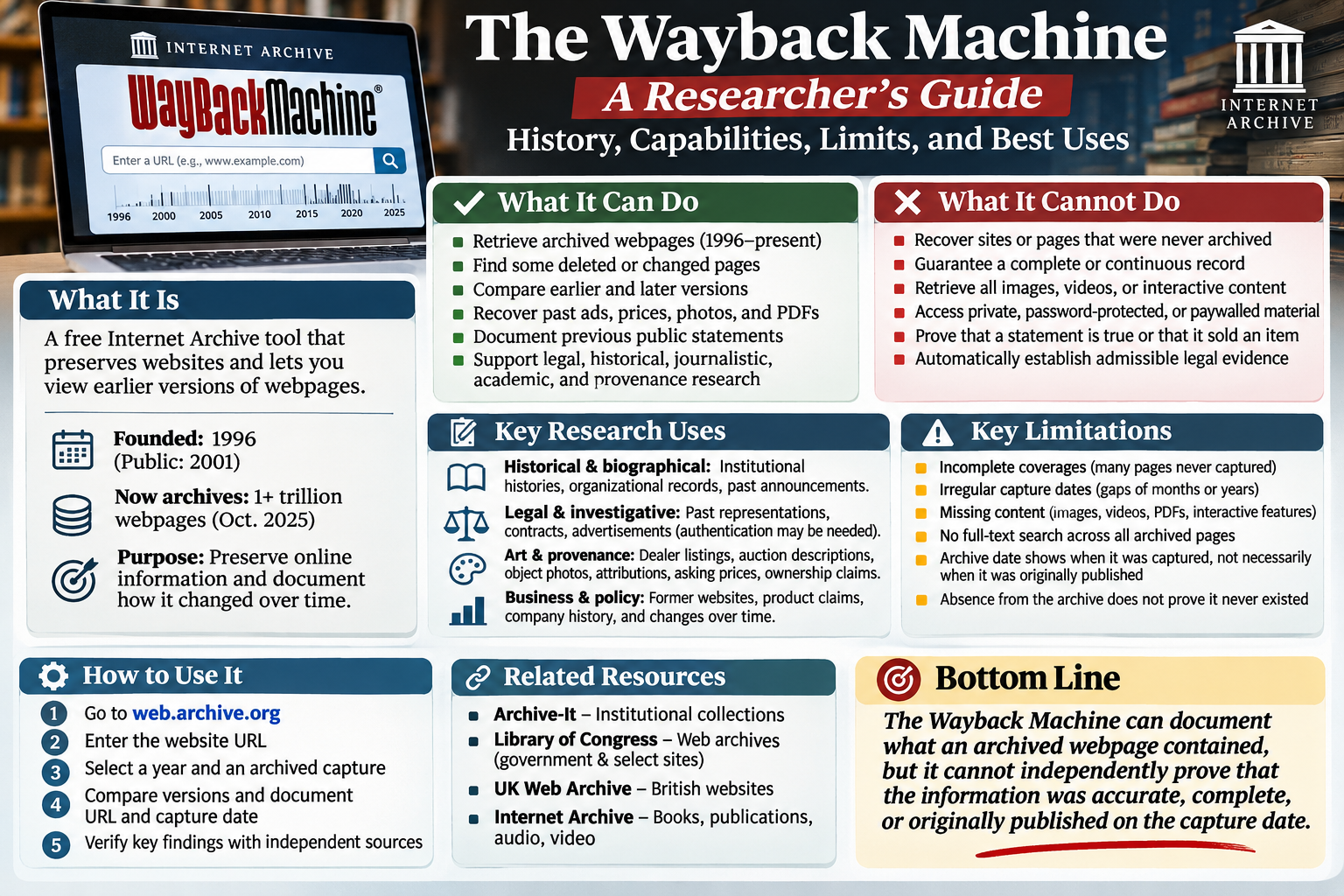
The Wayback Machine: A Researcher's Guide
History, Capabilities, Limitations, and Research Applications
November 22, 2026
History and Purpose
The Wayback Machine, operated by the nonprofit Internet Archive, was founded by Brewster Kahle in 1996 and made publicly available in 2001.
By October 2025, it had archived more than one trillion webpages, making it one of the world's largest collections of historical internet content.
Its purpose is to preserve websites and allow researchers to examine information that may have been changed, removed, or lost.
Website: https://web.archive.org/
What It Can and Cannot Do
Can Do - Cannot Do -
Retrieve archived websites dating to 1996 - Recover websites never archived
Find some deleted webpages - Recover every deleted webpage
Compare historical website versions - Establish exact dates of every change
Retrieve old advertisements and prices - Prove an advertised item sold
Recover some historical photographs and PDFs - Guarantee recovery of missing files
Document previous public statements - Establish that statements were truthful
Investigate former businesses and organizations - Access private accounts or emails
Support legal and historical investigations - Automatically establish admissible evidence
Preserve publicly accessible webpages - Guarantee complete or permanent preservation
Identify archived URLs and capture dates - Search the full text of every archived webpage
Important: A webpage's archive date establishes when it was captured, not necessarily when its contents were originally published.
Principal Research Applications
Historical and biographical research: Recover institutional histories, biographies, organizational records, and historical announcements.
Journalism and political research: Compare statements, campaign promises, government policies, and information subsequently changed or removed.
Legal investigations: Document historical representations, advertisements, contractual language, and other potentially relevant evidence. Formal authentication may be required.
Art history and provenance: Recover dealer listings, auction descriptions, object photographs, published attributions, asking prices, and ownership claims.
Business investigations: Examine former websites, company representations, product descriptions, and changes in commercial practices.
Academic research: Study historical websites, institutional policies, scientific communications, and changes in publicly available information.
Major Limitations
The Wayback Machine is not a complete record of the internet.
Incomplete coverage: Many websites and pages were never captured.
Irregular dates: Months or years may separate archived versions.
Missing content: Images, videos, PDFs, and interactive features may be unavailable.
Limited searching: There is no comprehensive public full-text search across all archived pages.
Restricted access: Private, password-protected, and some paywalled material is generally unavailable.
Unverified information: Archived statements may be inaccurate or misleading.
Legal limitations: Archived records may require authentication and corroboration before being used as evidence.
Absence from the archive does not prove that information never existed.
How Researchers Should Use It
Enter a website address at https://web.archive.org/.
Select a year and an available archived capture.
Compare versions before and after the period being investigated.
Examine archived subpages, photographs, and documents.
Record the original URL, archived URL, and capture date.
Verify significant findings against independent sources.
Preserve copies and document any gaps or uncertainties.
The Wayback Machine also provides a Save Page Now feature for requesting preservation of currently accessible webpages.
For advanced research, its CDX index and availability API can assist with identifying archived URLs and historical captures.
Value as Legal and Historical Evidence
Archived webpages can help establish what information appeared online at a particular time.
However, three distinctions are essential:
Publication: A statement appeared in an archived webpage.
Accuracy: The statement was factually correct.
Authentication: The archived record has been sufficiently verified for its intended use.
These are separate questions. The Internet Archive can provide authentication assistance in appropriate circumstances, but an authenticated capture does not automatically prove the truth of its contents.
Complementary Research Resources
Researchers should supplement the Wayback Machine with original documents, contemporary publications, government records, library collections, and specialized databases.
Additional web-archiving resources include:
Archive-It: Institutional web-archiving collections.
Library of Congress Web Archives: Selected historical and government websites.
UK Web Archive: Preserved British websites, with access restrictions.
Internet Archive: Digitized books, publications, audio, and video.
Conclusion
The Wayback Machine is an indispensable resource for investigating the history of information published on the internet.
Its greatest value is recovering and documenting historical material that may no longer be publicly accessible.
Its principal weakness is incomplete coverage.
The fundamental rule for researchers: The Wayback Machine can document what an archived webpage contained, but it cannot independently prove that the information was accurate, complete, or originally published on the capture date.
Used with independent verification, it is a powerful tool for historical, legal, academic, journalistic, commercial, and provenance research.
Condense the guide into a shorter versionCombine overlapping sections and applications