
Segment #1093
An accountability review | November 21, 2026
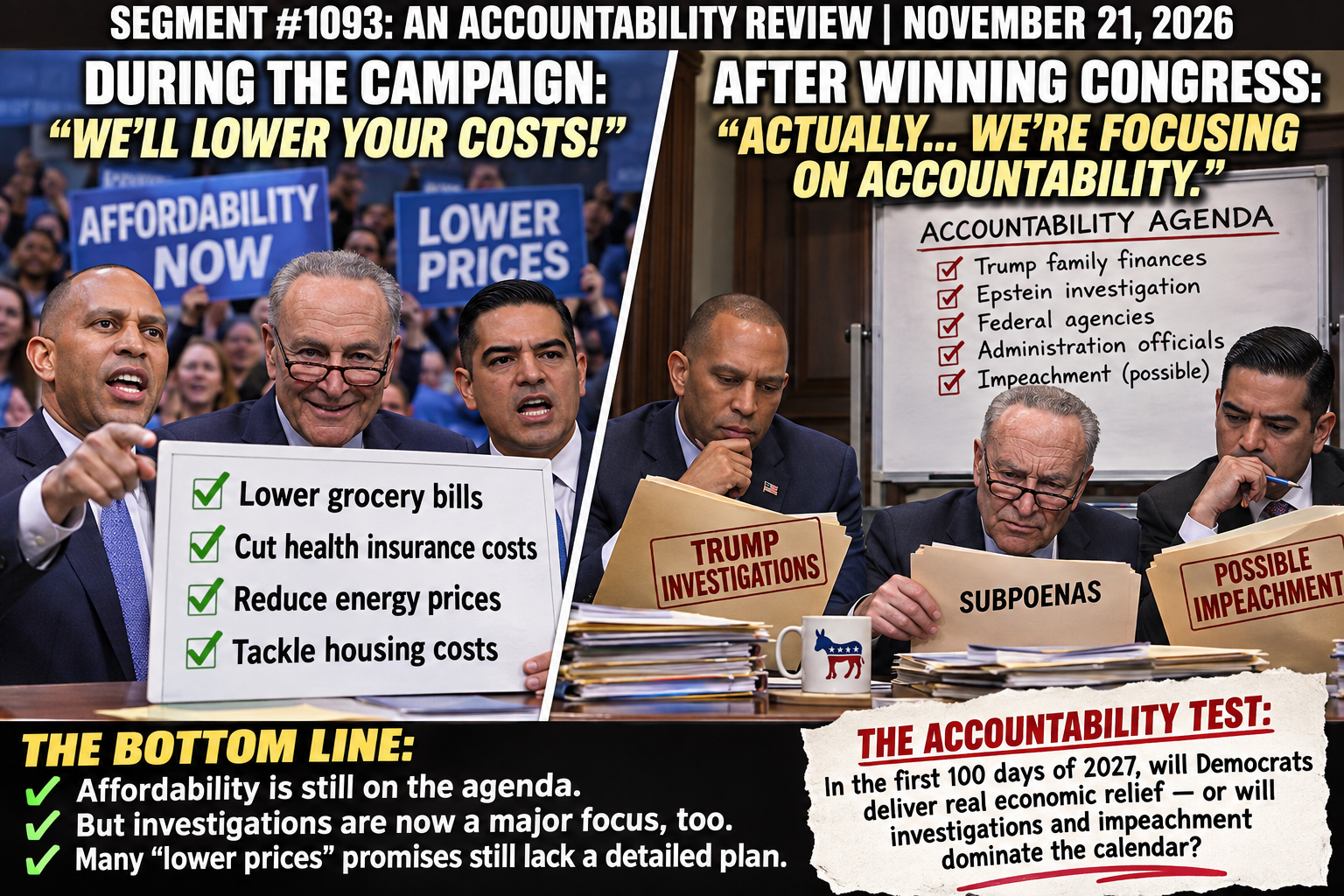
The strongest documented criticism is that Democrats campaigned on lowering Americans' living expenses, but immediately after winning Congress, much of their public discussion shifted toward investigations, subpoenas, and holding Donald Trump accountable.
There is a meaningful difference between a reversal of a campaign promise and a change in emphasis. The evidence establishes several changes in emphasis, but not yet a clear case of Democratic leaders explicitly repudiating their affordability commitments.
Hakeem Jeffries: From lowering prices to investigating Trump
During the campaign — October 14
Campaign promise
Jeffries promised Democrats would concentrate relentlessly on affordability, citing health insurance, groceries, energy prices, and tariffs. He outlined immediate action on ACA subsidies and Medicaid cuts.
Congressman Hakeem Jeffries
After the election — November 5
Expanded emphasis
Jeffries described a broad accountability agenda targeting alleged Trump administration corruption. Democrats were preparing investigations into Trump family finances, federal agencies, and administration officials, while leaving open the possibility of impeachment.
The Washington Post
The discrepancy: The campaign emphasized tangible economic relief. The post-election agenda gives substantial attention to investigations that may not directly reduce household expenses.
Important qualification: Jeffries has continued advocating affordability legislation. This is a competing-priorities issue, not a documented reversal.
Robert Garcia: From economic accountability to subpoenas
Robert Garcia, the leading Democrat on the House Oversight Committee, became one of the clearest examples of the party's post-election investigative emphasis.
Campaign context: Democratic candidates promoted the idea of government accountability as a way to protect taxpayers and ordinary families from corruption and special interests.
November 3: As Democrats won control of Congress, Garcia publicly warned potential investigation targets:
Lawyer up.
His outlined investigative priorities include Trump family business dealings, the Epstein investigation, and immigration enforcement.
ABC News+1
The discrepancy: Garcia's immediate public message focused on legal accountability, not on a specific plan to lower grocery bills, insurance premiums, or housing costs.
This does not establish that Garcia personally promised to abandon investigations during the campaign. It illustrates the difference between the party's economic messaging and the Oversight Committee's anticipated work.
Chuck Schumer: Affordability versus an expansive investigative agenda
Schumer and other Democratic leaders emphasized the financial pressure facing households during the election.
After the election, Schumer endorsed investigations into alleged Trump administration corruption, arguing that financial self-dealing and the cost-of-living crisis are connected.
He also insisted that Democrats could pursue affordability legislation and investigations simultaneously.
The Washington Post
The discrepancy: Voters who understood the campaign promise as prioritizing immediate financial relief may reasonably question how much legislative time will instead be devoted to investigations.
But Schumer has not publicly abandoned the affordability agenda.
The broader Democratic caucus: Promising lower prices without explaining how
This is where the evidence becomes especially revealing.
On November 11, The Washington Post published an analysis of 2,381 post-election social-media posts and podcasts involving 274 winning congressional Democrats.
What Democrats said after winning
Over 75%
Promised to cut costs
About 67%
Of affordability pledges gave no specific method
0%25%50%75%100%No specific methodSpecified a method
Source: The Washington Post, November 11, 2026. Percentages rounded.
These percentages describe affordability pledges, not the percentage of all Democratic lawmakers.
The study found that most of the pledges that did identify specific actions focused on ending the Iran war, reversing tariffs, or restoring health care funding.
The Washington Post
The accountability issue: Promising to lower prices is not equivalent to explaining which legislation will accomplish it, how much consumers might save, or when they will see the benefits.
Democrats themselves are warning against the shift
Two Democrats or former Democratic leaders have explicitly raised concerns about the party's focus.
Sen. Peter Welch of Vermont, speaking after the election, cautioned that investigations should not become a political retaliation campaign. He said Democrats must be careful and judicious and earn voters' trust.
The Washington Post
Former Democratic congressional campaign chairman Steve Israel, speaking before the election, warned about the danger of allowing opposition to Trump to overwhelm the affordability message.
The Washington Post
These warnings matter because the concern is not confined to Republican critics.
6. Jamie Raskin: The cost of impeachment proceedings
Raskin, who is positioned to chair the House Judiciary Committee, has discussed impeachment as a possible constitutional remedy.
He has also acknowledged that impeachment proceedings consume substantial political energy and attention.
ABC News
That creates a concrete test: If Democrats initiate impeachment proceedings in 2027, what happens to the legislative calendar for housing, health insurance, groceries, and utilities?
The decision to investigate potential misconduct can be justified independently. The question is whether Democratic leaders will allocate sufficient resources to both commitments.
The central finding
The evidence does not support saying Democrats have completely reversed their campaign promises. In fact, the November 11 analysis found affordability remained the dominant topic in their immediate post-election messaging.
But it does support three pointed criticisms:
Specificity: Many Democratic affordability promises still lack detailed plans for achieving lower household costs.
Competing priorities: Party leaders are preparing extensive investigations at the same time they promise rapid economic relief.
Accountability: Voters have not yet seen whether affordability legislation will receive more attention than political investigations once Democrats take office.
The most useful measure will be the first 100 days beginning in January 2027: bills introduced, committee hearings held, votes scheduled, legislation passed, and measurable effects on household costs.
A final complication is that Trump retains veto power and Senate procedural rules can prevent legislation from advancing. Democratic control of Congress does not guarantee that their bills become law.
The central question remains: Will Democrats use their new congressional majority to deliver specific economic relief, or will investigations dominate the time and attention they promised to devote to affordability?
That is a fair accountability test. The answer will depend on their actions, not their campaign rhetoric.