
Segmemt #1086
Virtual Reality and Artificial Intelligence
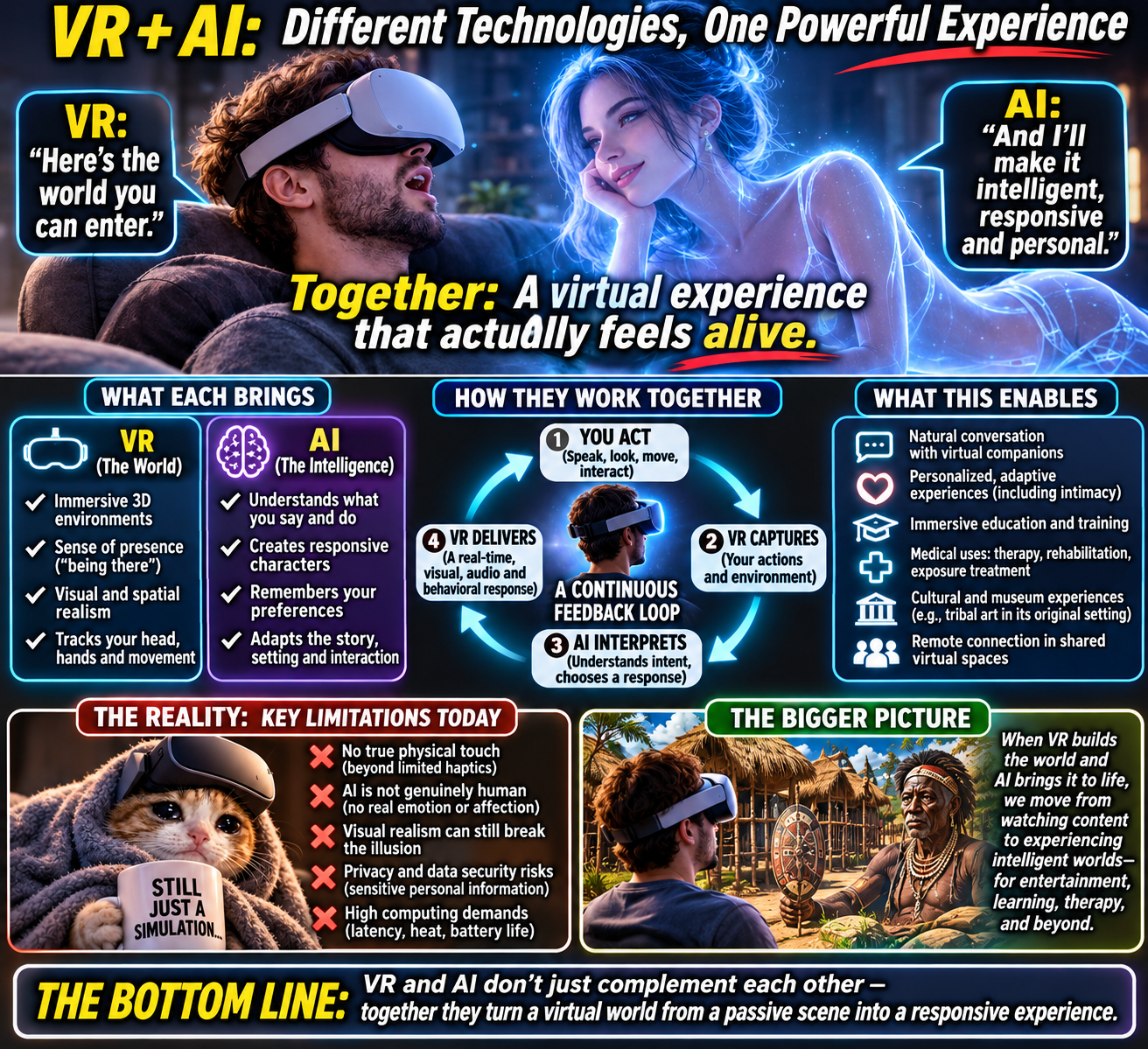
VR creates the world. AI makes that world intelligent, responsive, and increasingly believable.
They are separate technologies, but their convergence is what could transform virtual reality from an entertainment medium into a convincing simulation of human experience.
1. What each technology contributes
Virtual Reality (VR)
Artificial Intelligence (AI)
Creates immersive 3D environments
Generates and modifies those environments
Tracks head, hand and body movements
Interprets movements and intentions
Displays virtual people
Gives virtual people conversation, memory and behavior
Provides spatial audio and visual immersion
Produces context-sensitive speech and reactions
Creates the sensation of being somewhere
Makes that environment respond intelligently
VR supplies the sensory experience. AI supplies much of the intelligence behind the experience.
2. How the technologies work together
Human user
Voice, gaze, gestures, body movement
VR system
Displays the world, tracks the user, delivers sound
AI system
Interprets behavior, makes decisions, generates responses
Responsive virtual experience
Characters and surroundings change in response to the user
This creates a continuous feedback loop. The person acts, sensors capture the action, AI interprets it, and VR presents the response.
The faster and more accurately this happens, the more convincing the experience becomes.
3. Why AI could be the breakthrough VR has needed
Traditional VR has three major weaknesses.
First, virtual worlds are largely predetermined. Developers must create environments, characters and possible interactions in advance. Generative AI can help create new content dynamically, although rendering complex scenes reliably in real time remains challenging.
Second, virtual characters have historically been unintelligent. AI allows them to converse, remember previous interactions, respond to questions and adapt their behavior.
Third, interaction is often unnatural. Instead of manipulating menus and controllers, users can increasingly communicate through speech, gestures and ordinary human behavior.
The result could be a shift from visiting a programmed virtual world to participating in an intelligent virtual world.
4. Erotic VR illustrates the relationship particularly well
Consider a virtual intimate companion.
Without advanced AI, the experience is largely a prerecorded scene or a character responding to a limited set of programmed actions.
With AI, a virtual companion could potentially:
Recognize spoken language and respond conversationally.
Remember previous conversations and stated preferences.
Adapt facial expressions, tone and gestures.
Respond to eye contact and movements detected by sensors.
Modify the virtual environment in response to requests.
The crucial advance is not simply more realistic imagery. It is the illusion of interacting with another responsive individual rather than watching a recording.
However, these capabilities vary considerably between systems. AI responsiveness does not imply consciousness, genuine affection or complete physical realism.
5. Are VR and AI actually dependent on each other?
No. Their relationship is powerful but not mutually essential.
VR can operate without AI, as demonstrated by conventional VR films, games and training simulations.
AI can operate without VR, as demonstrated by ChatGPT, medical image analysis, autonomous systems and scientific research.
But their combination addresses weaknesses in both technologies.
Problem
How the other technology helps
VR environments feel empty or scripted
AI creates more adaptive characters and interactions
AI conversations lack physical presence
VR provides an embodied, spatial experience
VR content is expensive to create
AI can accelerate content production
AI struggles to interpret physical context
VR sensors provide structured information about movement and spatial relationships
Virtual interaction feels mechanical
AI can make responses more flexible and personalized
6. The most important limitation: Computing power
Combining VR and AI creates substantial technical demands.
VR needs extremely low-latency tracking and image rendering to avoid discomfort. AI requires computing resources for speech recognition, reasoning, animation and response generation.
A convincing experience must coordinate all these operations almost instantaneously.
Cloud computing can handle complex AI tasks, but network delays can interrupt the illusion. Local processing reduces that dependence but is constrained by headset battery life, heat and processor performance.
This is one reason why the technology has not yet delivered the fully responsive virtual experiences frequently depicted in science fiction.
7. Where this could lead over the next decade
The convergence has implications far beyond entertainment:
Medicine: AI-guided rehabilitation, exposure therapy and simulated clinical training.
Education: Immersive instruction with AI tutors who respond to individual students.
Business: Virtual workplaces, product design and interactive training.
Companionship: Personalized AI characters with persistent identities and conversational histories.
Museums: Historically reconstructed environments with AI-driven interpretation of objects and cultures.
The last example is particularly interesting for tribal art. Imagine entering a reconstructed nineteenth-century African village, examining an object in its original cultural setting, and questioning an AI guide about its function, symbolism and history. Such a system could be educationally valuable, provided it clearly distinguishes documented evidence from speculative reconstruction.
The fundamental conclusion
VR and AI are not technologically dependent on each other to function. They become much more powerful when integrated.
VR addresses the question: Where am I, and what am I experiencing?
AI addresses the question: What understands me, and how does it respond?
Together, they create the possibility of environments that are not merely seen but experienced as responsive.
The most consequential development may not be better VR headsets. It may be AI becoming sufficiently capable that the virtual world seems populated by intelligent beings rather than computer-generated characters.