
Segment #1079
Presidential Decision-Making Is a Mathematical Problem
The President of the United States cannot wait for certainty when the consequences of being wrong could be catastrophic. He must evaluate the probability of a threat, its potential consequences, and, critically, how much more dangerous the situation could become by waiting. While this sounds like Monday morning quarterbacking. The Midterms are over. It is not because we still have the problem and the same arguments, assessments, and decisions are relevant.
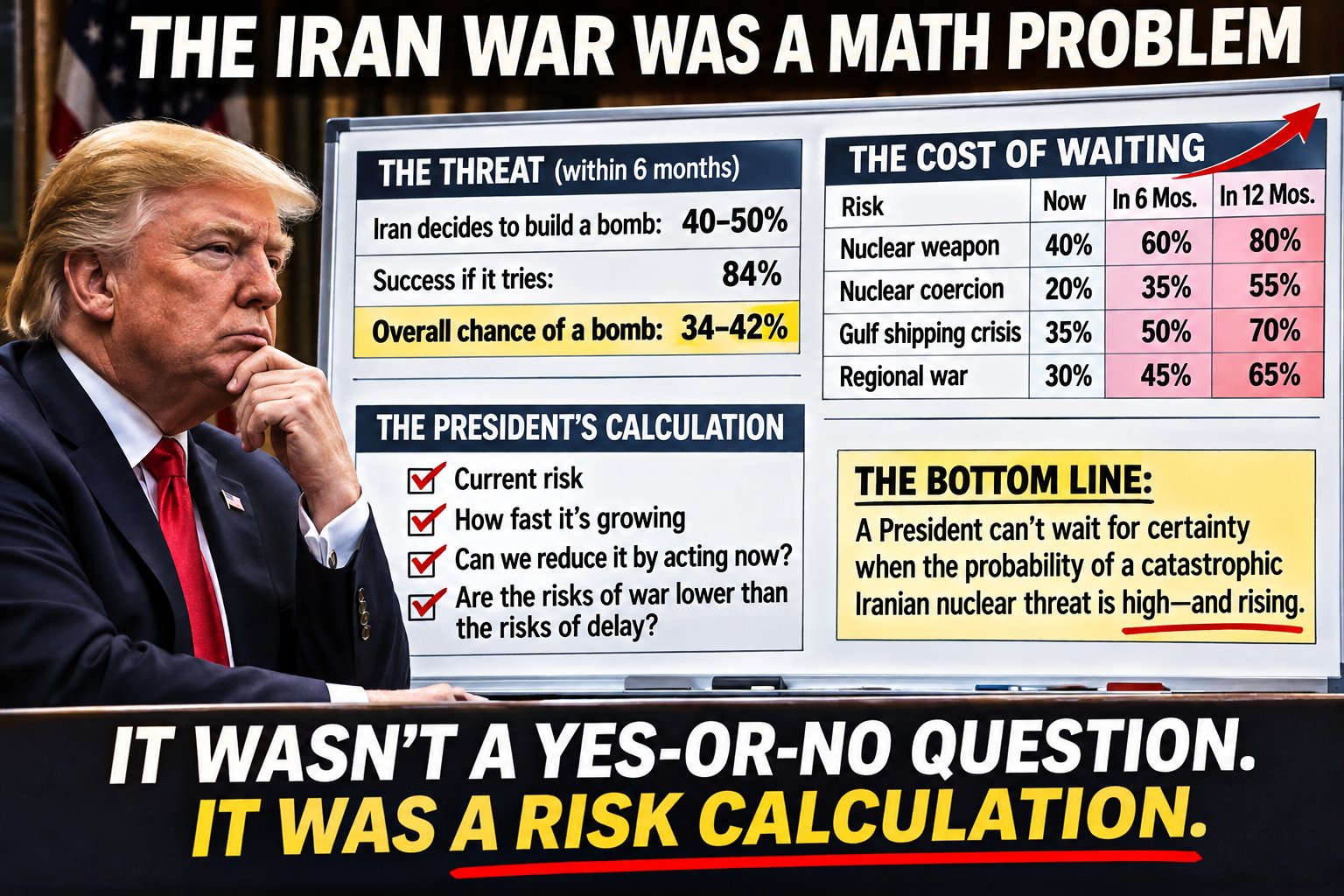
The public debate over Iran largely failed to explain this fundamental responsibility.
The Nuclear Risk
A February 2026 independent assessment estimated:
40–50% probability Iran would decide to build nuclear weapons.
84% probability of successful weapon production within six months, conditional on that decision.
34–42% combined probability of producing a nuclear weapon within six months.
These estimates did not establish that Iran would use a nuclear weapon against Israel.
The President also had access to classified American intelligence and Israeli intelligence unavailable to the public. That information could have indicated substantially higher probabilities, although no such classified percentages have been verified.
The Increasing Danger of Waiting
Probabilities are not static. They change as intelligence improves, technology advances, and strategic opportunities disappear.
The following illustrates how risks might escalate if Iran continued advancing its nuclear and military capabilities without effective constraints.
Potential threat Initial risk - 6 months - 12 months
Nuclear weapon production - 40% - 60% - 80%
Nuclear coercion of neighboring states - 20% - 35% - 55%
Serious disruption of Gulf shipping - 35% - 50% - 70%
Major regional confrontation - 30% - 45% - 65%
These are hypothetical scenarios, not government intelligence estimates. The risks could also decrease through successful diplomacy, inspections, or other interventions.
The central issue is that delaying action might allow Iran to develop nuclear weapons, strengthen its missile defenses, disperse its nuclear facilities, threaten Israel, and gain greater leverage over the Strait of Hormuz.
Waiting could make subsequent military intervention both more dangerous and less effective.
The Presidential Calculation
The President must weigh four questions:
What is the probability Iran will acquire nuclear weapons?
What is the probability Iran will use nuclear capability to threaten Israel, dominate its neighbors, or disrupt international energy supplies?
How much will those probabilities change if the United States waits?
Will military intervention reduce the expected danger more effectively than diplomacy, sanctions, and deterrence, after accounting for the costs of war?
The Argument Americans Should Have Heard
The administration could have explained: