
Segment # 1078
Europe is confronting a profound political and cultural crisis. France, Britain, Germany, and other European nations face mounting tensions over immigration, national identity, economic stagnation, political extremism, and declining confidence in government. Traditional political parties are losing support, nationalist movements are gaining influence in several countries, and disagreements over integration, free speech, and national sovereignty are increasingly dividing their populations.
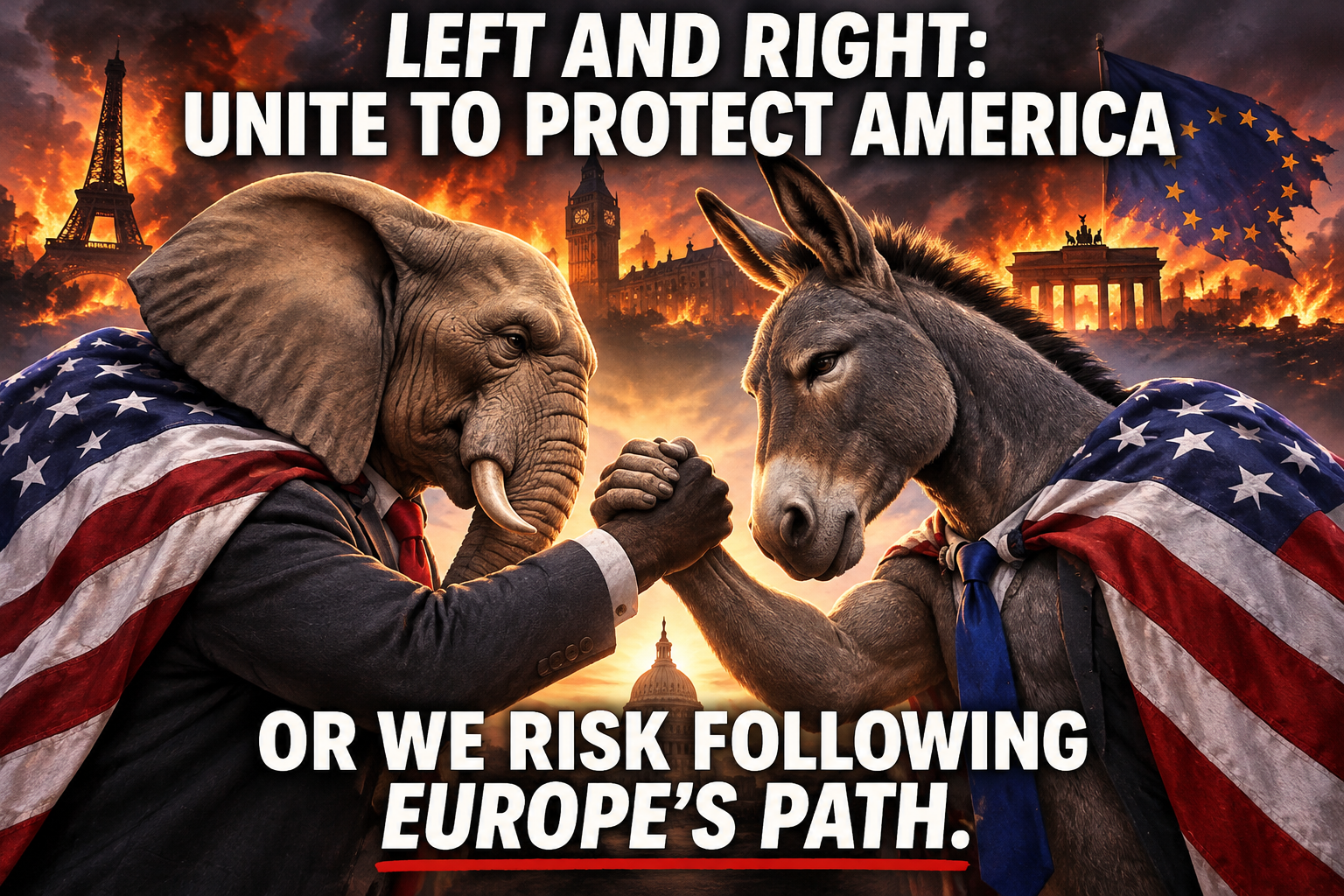
The warning for America is unmistakable: When a nation loses its shared sense of identity and its citizens begin treating political opponents as enemies, the institutions holding society together come under increasing strain. If the Democrats and Republicans that love America don’t unite, then this country is lost.
This is not simply a conservative or liberal argument. Across podcasts, YouTube, and network television, commentators with sharply different political perspectives are raising concerns about the direction of Western democracies.
Douglas Murray, author of The Strange Death of Europe, argues that mass immigration, failed integration, and Europe's declining confidence in its own cultural traditions threaten national cohesion.
Fareed Zakaria, on CNN, has examined how immigration, globalization, and public dissatisfaction have destabilized Europe's traditional political parties.
Robert Putnam, interviewed on PBS NewsHour, identifies declining civic participation, weakened communities, and the erosion of social trust as fundamental threats to American democracy.
Jonathan Haidt, psychologist and author, explains how moral and ideological divisions increasingly prevent citizens from understanding one another.
Judy Woodruff, through PBS's America at a Crossroads, documents America's deepening political divisions and efforts to restore cooperation.
Their explanations differ, but together they illuminate a common danger: A society that loses the ability to resolve its disagreements peacefully risks weakening the very institutions that sustain it.
Europe's difficulties are serious, although they vary considerably by country. France faces political fragmentation and fiscal pressures. Britain continues to struggle with immigration, public services, and economic growth. Germany faces economic challenges and the rise of the Alternative for Germany (AfD). These developments do not establish that Europe is collapsing, but they demonstrate the pressures that can accumulate when governments lose public confidence.
America is not immune. We are increasingly divided by politics, culture, religion, immigration, and competing visions of our national identity. Too often, disagreement has become contempt, and political victory has become more important than preserving the institutions that allow us to govern ourselves.
The central issue is no longer simply left versus right. It is whether Americans across the political spectrum who believe in their country can unite around the Constitution, the rule of law, freedom of speech, equal citizenship, and the peaceful transfer of power.
Patriotism is not the exclusive property of either political party. Americans can disagree passionately about government policy while sharing a commitment to the nation's founding principles. The real danger comes from those, regardless of political affiliation, who reject those principles, justify political violence, or seek to deny constitutional protections to their opponents.
The Choice Before America
Europe provides a warning, not an inevitable prediction of America's future. Its experience illustrates how economic frustration, cultural conflict, political polarization, and institutional distrust can reinforce one another.
If patriotic Americans on the left and right cannot put aside enough of their differences to defend the constitutional foundations of this country, we risk following Europe's most troubling trajectory.
We do not need to agree on every issue. We do need to agree that preserving the American constitutional system is more important than defeating one another.
The question is whether we recognize that common responsibility before our divisions become too deep to bridge.
Selected Sources
Douglas Murray, The Strange Death of Europe (2017); interviews on UnHerd and YouTube.
Fareed Zakaria, Fareed Zakaria GPS, CNN, November 23, 2025.
Robert Putnam, PBS NewsHour interview, February 19, 2025.
Jonathan Haidt, Democracy Works podcast, July 1, 2024.
Judy Woodruff, America at a Crossroads, PBS NewsHour, 2025.
Ipsos, State of Democracy 2025, November 14, 2025.
Make the argument more balancedClarify Europe’s specific warning