
Segment #1080
That is a legitimate question, particularly considering Paxton's history of winning statewide elections.. It is illogical to dump this loss completely at the feet of John Cornyn; however, it is also obviously true that the vitriolic primary and subsequent refusal to bring the party together was a devastating blow to the Republicans statewide. Had Cornyn campaigned for Paxton in the big cities and in the valley the Hispanic vote would not have been lost to the extent it was. 10 million people voted. 19 million are registered to vote. Over 30 million live in the state of Texas. If this border is reopened, the new governor goes after business, or if there are new pushes in DEI, boys in girls sports, and cutting police and ICE, we will then see how blue Texas really is.
Paxton's election record
2014 Attorney General - 2,742,646 - Won
2018 Attorney General - 4,173,538 - Won
2022 Attorney General - 4,278,986 - Won
2026 U.S. Senate - 4,249,373 - Lost
2026 figures are reported results as of November 4, not final certified totals.
Here is the remarkable fact: Paxton received only 29,613 fewer votes in 2026 than in his successful 2022 election.
His Republican vote total barely changed. What changed dramatically was the Democratic vote.
The Democratic vote explosion
2022 Attorney General - Rochelle Garza - 3,497,267
2026 U.S. Senate - James Talarico - 5,444,982
Increase
1,947,715
That is a 55.7% increase in Democratic votes compared with the 2022 attorney general race.
Paxton's defeat therefore cannot be explained simply by his previous supporters abandoning him. His vote total was nearly identical to 2022, while Talarico received almost two million more votes than Paxton's previous Democratic opponent.
Was Paxton singled out, or did something happen statewide?
This is where the numbers become particularly revealing.
Greg Abbott, Governor - 4,524,527
Dan Patrick, Lieutenant Governor - 4,484,652
Ken Paxton, U.S. Senate - 4,249,373
Mayes Middleton, Attorney General - 4,502,442
Tuesday, November 3, 2026
Paxton received 275,154 fewer votes than Abbott on the same election day. That suggests some combination of ticket splitting, voters skipping the Senate contest, and differences in candidate support. The statewide totals alone cannot distinguish among those explanations.
More significantly, Democrats won the other major statewide races as well. This was not an isolated defeat of Paxton.
Tuesday, November 3, 2026+1
The questions that still need answers
The crucial investigation is not merely whether Talarico won, but whether the increase in Democratic participation can be independently reconciled.
How many of Talarico's voters participated in 2022, 2024, or neither election?
Which counties produced the greatest increases in Democratic votes?
How many of the additional votes were cast early, by mail, or on Election Day?
Do county voter-history records and ballot reconciliation reports support the reported totals?
Were there confirmed ineligible voters or ballot-counting discrepancies, and how many ballots were affected?
Conclusion
Paxton's own vote total was remarkably stable between 2022 and 2026. The Democratic vote increased by nearly two million.
That does not establish election fraud. It establishes a large change that warrants a detailed, county-by-county explanation.
The strongest next step is to reconcile the nearly two million additional Democratic votes against actual voter participation records, rather than rely on campaign explanations or allegations.
The official source for the 2026 figures is the
Texas Secretary of State election results.
The Cornyn Question
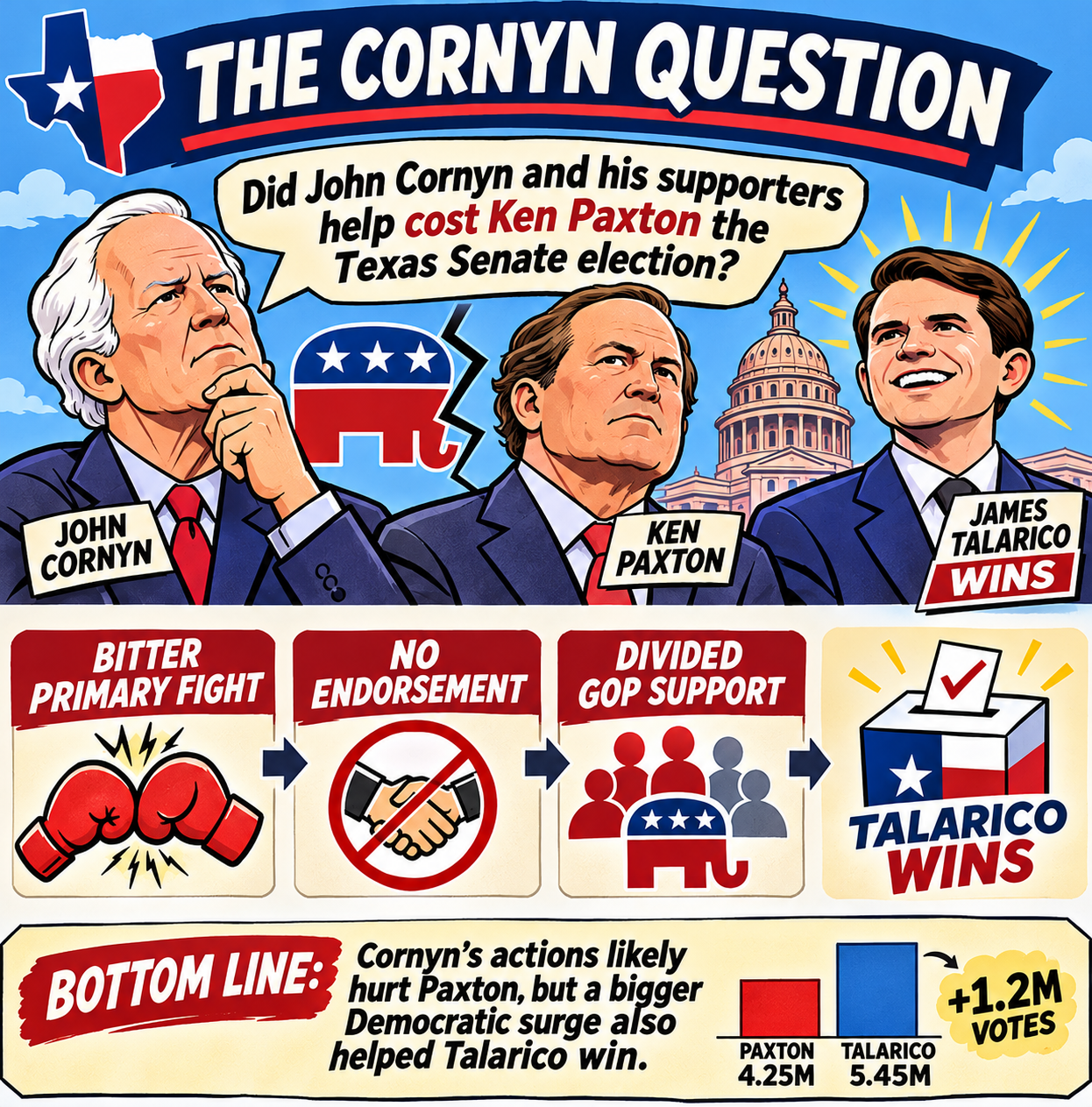
Did John Cornyn and his supporters help cost Ken Paxton the Texas Senate election?
There is substantial evidence that the bitter Cornyn–Paxton primary damaged Republican unity and made Paxton's general-election campaign more difficult. What has not been established is exactly how many Cornyn supporters voted for James Talarico, stayed home, or declined to vote in the Senate race.
Cornyn's actions had consequences
A $135 million primary battle: Cornyn and his allies spent heavily attacking Paxton's character, finances and personal controversies. The prolonged campaign exposed Paxton to months of Republican-funded negative advertising. The Texas Tribune
No endorsement: After losing the Republican runoff, Cornyn declined to endorse Paxton and continued publicly questioning his ability to win. KPRC
Divided Republican voters: October polling showed Paxton having considerably more difficulty consolidating Republican support than Talarico had consolidating Democratic support. The Texas Tribune
A delayed general-election campaign: Paxton struggled with fundraising during the summer, allowing Talarico to establish his campaign message before major Republican advertising began. The Texas Tribune
What do the vote totals tell us?
Using the preliminary totals discussed earlier:
Abbott, 2026 - 4,524,527
Paxton, 2026 - 4,249,373
Paxton's deficit to Abbott - 275,154
Talarico's lead over Paxton - 1,195,609
The 275,154-vote difference is significant. It suggests that Paxton attracted less support than Abbott, but it does not establish how many of those voters were Cornyn supporters.
Even if all 275,154 additional Abbott voters had supported Paxton, that alone would not have overcome Talarico's reported margin.