
Segment #904
Dr. Gad Saad’s book Suicidal Empathy: Dying to Be Kind explores the intersection of evolutionary psychology, political commentary, and cultural criticism. The text expands upon the themes of ideological subversion he introduced in his 2020 bestseller, The Parasitic Mind.
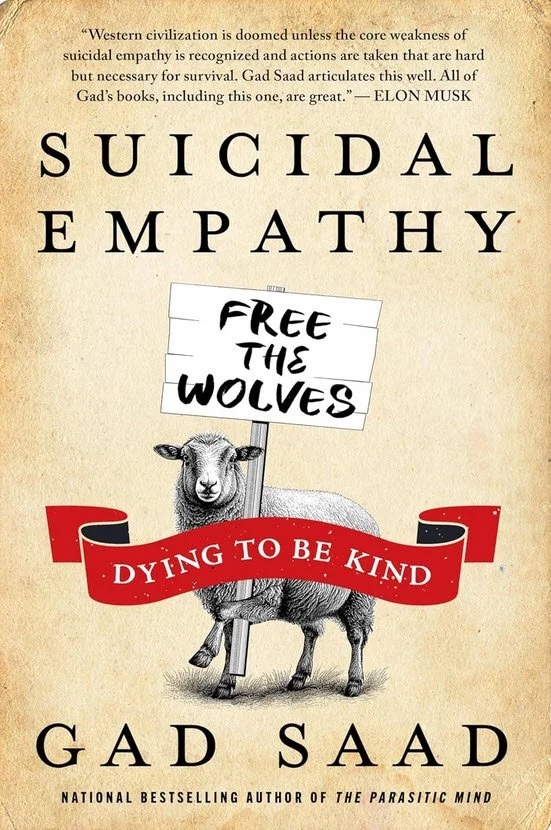
Author Biography: Dr. Gad Saad
To understand the framework of the book, it helps to look at Saad's dual identity as a rigorous scientist and a highly vocal public intellectual:
The Academic Background: Saad is a Lebanese-Canadian evolutionary behavioral scientist and a professor of marketing at Concordia University in Montreal. He is a pioneer in applying Darwinian evolutionary principles to consumer behavior and marketing, possessing a robust record of peer-reviewed scientific publications.
The Personal History: Born into a Jewish family in Lebanon, Saad and his family fled the Lebanese Civil War in the mid-1970s to seek asylum in Canada. This firsthand experience with civilizational collapse, sectarian violence, and the loss of a stable society heavily informs his worldview regarding security, borders, and Western values.
The Public Persona: Outside academia, Saad is a prominent figure in the "anti-woke" and classical liberal intellectual spheres. He hosts the long-running podcast The Saad Truth and frequently collaborates with other high-profile media figures, utilizing a signature blend of academic theory, evolutionary frameworks, and sharp, caustic satire.
The Core Message: Analyzing "Suicidal Empathy"
Saad’s central thesis is that empathy, while an evolutionary virtue meant to foster social cohesion, has been weaponized and miscalibrated by modern progressive culture to the point of civilizational self-destruction. He argues that Western society has developed a "maladaptively irrational altruism" that prioritizes the feelings and demands of specific groups over reason, self-preservation, and common sense. The core message breaks down into several key analytical pillars:
Evolutionary Miscalibration
From a Darwinian perspective, empathy and altruism evolved to be deployed strategically—primarily toward kin (to ensure genetic survival) and immediate tribal allies (reciprocal altruism). Saad argues that human biology did not evolve to extend boundless, uncritical empathy to the entire global population at the expense of one's own immediate community. When a society forces itself to do so, its survival instincts are effectively turned off.
The "Inverse Morality" System
Saad asserts that the modern West has elevated victimhood to the highest virtue. In doing so, he claims the culture has instituted an inverted moral framework where: The feelings of ostensibly marginalized groups or rule-breakers are prioritized over objective truth. Criminals, illegal immigrants, or squatters are granted more institutional sympathy and systemic protection than victims, legal citizens, veterans, or property owners. Ideological conformity (being "kind") supersedes the enforcement of boundaries and the rule of law.
Real-World Manifestations
The book applies this "suicidal empathy" lens to several highly polarized contemporary issues:
Immigration & Border Security: Arguing that opening borders to unvetted populations out of "compassion" compromises national security and native cultural values.
Criminal Justice: Criticizing progressive judicial policies that focus heavily on the rehabilitation or systemic disadvantages of violent offenders, which he argues leaves communities vulnerable.
The Gender Debate: Pointing to instances where protecting the emotional validation of transgender women (biological males) results in the displacement of biological women in sports or protected single-sex spaces.
The Source of the "Pathogen"
Consistent with his previous work, Saad points to the university ecosystem as the incubator for these ideas. He argues that insulated academic theories (postmodernism, cultural relativism) have successfully hijacked the "empathy module" of the progressive elite, who then implement these policies through media, corporate HR, and governance.
Summary Analysis
Ultimately, Suicidal Empathy is a warning call rooted in behavioral science. Saad’s message is that a society cannot survive if its baseline defense mechanisms and boundaries are entirely dissolved by a psychological compulsion to appear unconditionally kind. While critics often view the concept as a right-wing rhetorical buzzword used to dismiss genuine social justice and humanitarian concerns, Saad presents it as an essential evolutionary defense of the foundational principles of Western civilization.
Gad Saad Bio
Dr. Gad Saad (born October 13, 1964) is a prominent Lebanese-Canadian evolutionary behavioral scientist, author, and professor of marketing at the John Molson School of Business at Concordia University in Montreal, Canada. He is widely recognized for pioneering the application of evolutionary psychology to consumer behavior and marketing.
Early Life and Education
Born in Beirut, Lebanon, Saad grew up in a Lebanese Jewish family. In October 1975, his family fled the outbreak of the Lebanese Civil War and resettled in Montreal, Quebec. He pursued his higher education at McGill University, where he earned a Bachelor of Science (B.Sc.) in Mathematics and Computer Science, followed by an MBA in Marketing. He then attended Cornell University, obtaining his Master of Science (M.S.) and his Doctorate (Ph.D.) in Management in 1994, focusing his doctoral thesis on adaptive consumer choice.
Academic Career & Research
Saad has spent much of his academic career at Concordia University, where he held the Concordia University Research Chair in Evolutionary Behavioral Sciences and Darwinian Consumption from 2008 to 2018. His research focuses on "Darwinian consumption"—the idea that modern consumer choices, preferences, and behaviors are heavily influenced by evolved biological mechanisms and human nature. He explores how fundamental evolutionary drives (such as mating, survival, and status-seeking) manifest in the modern marketplace.
Media Presence and Public Commentary
Beyond his academic papers, Saad is a well-known public intellectual and media figure:
The Saad Truth: He hosts a popular YouTube channel and podcast where he discusses evolutionary psychology, politics, culture, and current events.
Psychology Today: He has long contributed a popular blog titled Homo Consumericus, exploring human behavior through a Darwinian lens.
Public Intellectualism: Saad is a vocal critic of postmodernism, political correctness, and what he characterizes as ideological "idea pathogens" that compromise free speech and scientific truth in academia.
Selected Bibliography
Saad has authored several academic texts and mainstream bestsellers, including:
The Evolutionary Bases of Consumption (2007)
The Consuming Instinct: What Juicy Burgers, Ferraris, Pornography, and Gift Giving Reveal About Human Nature (2011)
The Parasitic Mind: How Infectious Ideas Are Killing Common Sense (2020)
The Saad Truth about Happiness: 8 Secrets for Leading the Good Life (2023)