Islamic Radical Ties in San Diego
Segment #906
The Reality of unassimilated Borders
We will soon see the motives behind the San Diego Islamic center shooting—though whether the media has the courage to report the obvious is doubtful. Radical Islamic groups are operating across the U.S., increasingly vocal about their intent to dominate the West. To ignore what is already happening in the UK and EU is pure self-delusion. The data is clear: forcing cultural contact without assimilation guarantees violence. It is inevitable. If we do not immediately secure our borders and strictly control non-citizen visitors, our future will be far worse than Europe’s.
The May 18, 2026 Mosque Shooting
In current news, the terms "radical ties" and "extremism" are appearing in headlines regarding the ICSD for the exact opposite reason—the mosque was the target of a deadly, politically/racially motivated extremist attack.
On Monday, May 18, 2026, a mass shooting occurred outside the facility in San Diego's Clairemont district:
The Attack: Two teenage gunmen opened fire outside the mosque complex, killing three men (including a mosque security guard).
The Suspects: Police identified the shooters as Cain Clark (17) and Caleb Vazquez (18). Both were found dead from self-inflicted gunshot wounds in a nearby vehicle shortly after the attack.
Radical Ideology: Federal and local law enforcement, including FBI Director Kash Patel and San Diego Police Chief Scott Wahl, are treating the incident as a hate crime. Authorities revealed that the suspects left behind a suicide note containing racially charged language and expressions of extremist, white supremacist pride.
Historical Context: The 9/11 Investigations
The historical association between the Islamic Center of San Diego and radical extremism stems directly from the aftermath of the September 11 attacks. According to The 9/11 Commission Report and subsequent FBI investigations, two of the 9/11 hijackers, Nawaf al-Hazmi and Khalid al-Mihdhar, relocated to San Diego in early 2000. During their time there:
Assistance from Congregants: They frequented the ICSD, where certain members of the local Muslim community (most notably Anwar al-Awlaki, who was an imam at a nearby San Diego mosque at the time, and Omar al-Bayoumi) interacted with them.
Logistical Support: Members of the community, believing them to be new Saudi immigrants who spoke little English, assisted them in finding an apartment, securing driver's licenses, and purchasing a car.
The Investigation: The FBI heavily scrutinized the mosque to determine whether leadership or the broader congregation had advanced knowledge of the plot. Ultimately, investigations concluded that while individual radical figures interacted with the hijackers, the institution as a whole and the vast majority of its members were unaware of the hijackers' true terrorist affiliations.
Current Intelligence: To dig deeper into the historical ties between the Islamic Center of San Diego (ICSD) and radicalism, you have to look at the massive shift in how federal investigators viewed the mosque. Immediately after 9/11, it was treated as a potential hotbed of operational support. Decades later, declassified FBI documents and intelligence reviews painted a more complex picture: the mosque itself wasn't a radical cell, but it was deeply penetrated by sophisticated intelligence assets and radical handlers who operated right under the nose of its congregation.
Core Radicalism at ICSD
The core of the "radicalism" narrative tied to ICSD boils down to three key figures who intersected there in 2000: Nawaf al-Hazmi, Khalid al-Mihdhar (two of the 9/11 Pentagon hijackers), and Anwar al-Awlaki.
The Inside Handler: Anwar al-Awlaki
Before he became the notorious, English-speaking global face of Al-Qaeda in the Arabian Peninsula (AQAP), Anwar al-Awlaki was a mainstream, charismatic imam.
The ICSD Connection: From 1996 to early 2000, Awlaki served as the imam at the Rabat Mosque in San Diego, but he frequently interacted with the leadership and congregation at ICSD, the region's primary Islamic center.
The Hijacker Interaction: When al-Hazmi and al-Mihdhar arrived in San Diego in February 2000, they immediately sought out Awlaki. FBI "Encore" investigation documents declassified in recent years reveal that Awlaki met with the hijackers almost immediately upon their arrival. He served as their spiritual counselor, spoke with them in closed-door sessions, and later moved to Falls Church, Virginia, where the same hijackers miraculously re-established contact with him before the attacks.
The Radical Shift: At the time, the local community viewed Awlaki as a moderate, well-educated bridge builder. It wasn't until years later that U.S. intelligence realized he was already using his position at San Diego mosques to cloak his radical alignment and assist operational Al-Qaeda cells.
The Logistical Enabler: Omar al-Bayoumi
If Awlaki provided the spiritual cover, Omar al-Bayoumi provided the physical infrastructure. Bayoumi was a regular fixture at ICSD, known for doling out money for various causes, filming community events, and maintaining close ties to local religious figures.
The "Chance" Encounter: Bayoumi originally claimed he met the two hijackers by pure chance at a Mediterranean restaurant in San Diego, heard them speaking Arabic, and decided to be hospitable. He brought them into the ICSD community, co-signed their lease at the Parkwood Apartments, set up their bank accounts, and even advanced them $1,500 for rent.
What Declassification Revealed: While the original 9/11 Commission Report accepted Bayoumi’s story of a "random encounter," FBI documents declassified in 2021–2022 completely blew that open. The Bureau formally concluded that Bayoumi was a ghost employee and asset of the Saudi Intelligence Service. He was being paid a stipend via Saudi entities to monitor local dissidents and mosques, and his assignment to meet and embed the hijackers into the San Diego Muslim community was highly coordinated, not accidental.
The Hijackers Embedded in Proseic Sight
Nawaf al-Hazmi and Khalid al-Mihdhar were not deeply hidden sleeper agents; they lived out in the open in San Diego. They took flying lessons, got California driver's licenses, and went to the mosque regularly.
The Strategy of "Blending In": The radical threat didn't stem from the mosque's teachings. Instead, Al-Qaeda leadership explicitly selected San Diego because it had a large, welcoming, and unsuspecting Muslim immigrant community. The hijackers used the natural hospitality of the ICSD congregation—who assumed they were just young Saudi students struggling with English—to establish a legal, unremarkable footprint in the United States.
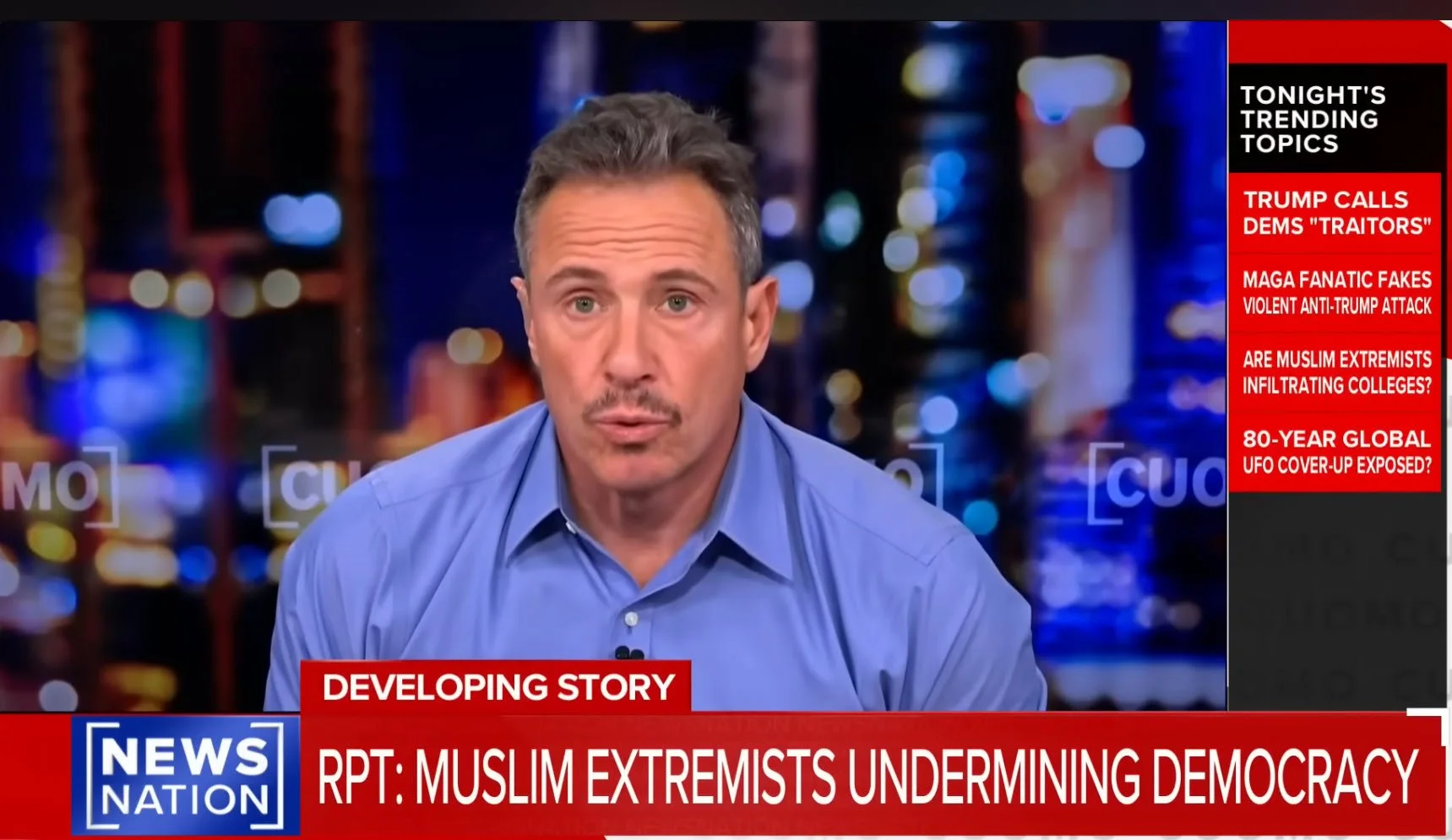
Chris Cuomo is joined by former FBI and CIA counterterrorism official Phil Mudd and Dahlia Ziada to discuss a 200-page, yearlong report by The Institute for the Study of Global Antisemitism and Policy that says there's a 100-year plan to destroy Western democracy.
The Open-Door Nature of Mosques
The primary vulnerability of any large, mainstream house of worship (whether a megachurch, a major synagogue, or a massive Islamic center) is its public, open-door nature.
ICSD runs a day school (Al Rashid School), hosts five daily prayers, handles massive charitable distributions, and opens its doors to travelers, new immigrants, and converts.
Because mosque leadership does not perform background checks on people walking in to pray, large centers are structurally vulnerable to individuals who may hold radicalized views in private or consume extremist material online.
The Modern Radicalization Landscape

Historically (in the 1990s and early 2000s), radicalization often required physical networks, radical imams, and underground cells operating inside brick-and-mortar institutions. Today, the landscape has completely shifted:
The Digital Echo Chamber: Modern radicalization (whether Islamist extremism, far-right white supremacy, or eco-terrorism) happens almost exclusively online via encrypted apps, private forums, and social media algorithms.
The "Lone Wolf" Phenomenon: An individual can attend a mainstream, perfectly moderate mosque on Friday, sit in the back row, listen to an imam preach peace and civic duty, and then go home to consume extremist propaganda in private.
Therefore, while the leadership, board, and official programming of ICSD are extensively vetted and heavily integrated with local and federal law enforcement, it is impossible for any institution to guarantee that not a single person sitting in their pews or prayer rugs harbors radical ideas.