Show Me The Money
Segment #1025
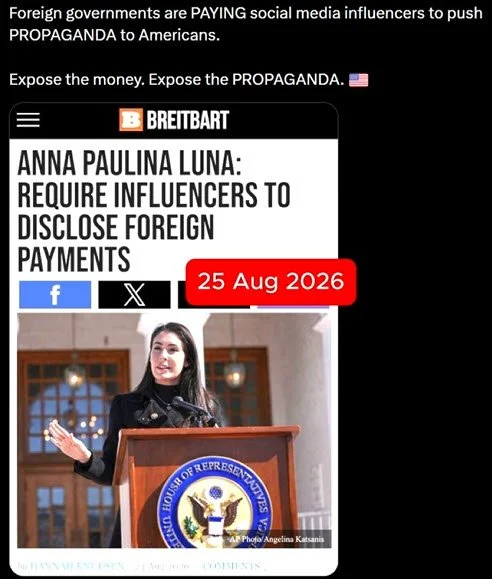
Rep. Anna Paulina Luna (R-Fla.) and the Foreign Propaganda Disclosure Act, introduced in late August 2026. There is an investigative component behind it, but an important distinction is that Luna has not publicly named the influencers she says are receiving foreign money. Luna says she has spoken with government agencies and people inside the influencer industry and has seen evidence of foreign governments or foreign-linked entities paying American social-media personalities to promote political narratives. She told reporters that she knows of “a number” of individuals but does not believe it is her role to publicly identify them. She also said she has seen contracts worth millions of dollars.
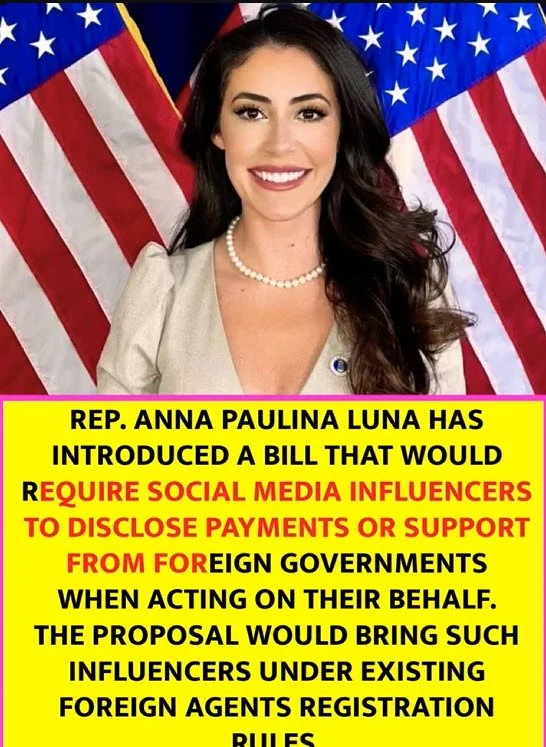
Her legislation is H.R. 10166, the Foreign Propaganda Disclosure Act. It would amend the Foreign Agents Registration Act, or FARA, specifically to include a “social media influencer” as a type of publicity agent. In practical terms, an influencer who is acting on behalf of a foreign government or other qualifying foreign principal to influence American political opinion could be required to disclose that relationship. The bill has bipartisan sponsorship; early co-sponsors included Democrats Jared Moskowitz and Vicente Gonzalez and Republican Derrick Van Orden.
What makes the story particularly interesting is that Luna says this isn't confined to either political camp. On September 2 she said the activity is occurring “on both the left and the right” and argued that foreign governments are deliberately amplifying divisive issues in order to influence American voters and elected officials, particularly on questions involving wars and U.S. foreign policy.
There is also a separate but related claim coming from people around the Trump political operation. Alex Bruesewitz said his team was tracking foreign influencer campaigns, intermediary companies receiving money as pass-throughs, and influencers allegedly failing to disclose compensation. Luna publicly responded that she had confirmed the problem and that there were “receipts.”
Who is suspected?
This is where we need to be very careful. Luna herself has not accused named influencers of taking illegal foreign payments. Some media reports have mentioned C.J. Pearson, Rob Smith, Arynne Wexler, Emily Wilson and Ryan Fournier in the broader controversy over alleged foreign or lobbying influence, but being mentioned in those reports does not establish that any of them were secretly paid by a foreign government or violated FARA.
There is a more concrete example involving Brad Parscale, Trump's former campaign manager. Parscale has engaged in work connected to Israel and has been reported as a registered foreign agent, which is fundamentally different because registration and disclosure are precisely what FARA requires. That example demonstrates the distinction Luna is trying to draw: foreign-sponsored advocacy isn't necessarily unlawful—the concern is undisclosed foreign-sponsored advocacy disguised as independent American political commentary.
Why I think this could become a substantial story
The most consequential part isn't merely whether an influencer received a check from, say, China, Qatar, Israel, Russia or another government. The much harder question is the money trail:
foreign government → public-relations firm → U.S. consulting company → influencer-management company → influencer
If the ultimate foreign principal disappears from public view somewhere in that chain, an audience can reasonably believe it is hearing an influencer's spontaneous political opinion when it may actually be part of a professionally financed influence campaign.
And Luna's phrase “contracts into the millions” is potentially the most significant allegation she has made. If congressional investigators eventually subpoena those contracts, bank records, PR firms and intermediary companies, this could move from a disclosure-policy debate into a much larger investigation of the American political-influencer industry. For now, however, the public evidence does not justify identifying particular influencers as secretly working for foreign governments merely because their names have circulated online.
Governments Involved
China: China has an enormous documented influence and intelligence apparatus in the United States, but the evidence I have found so far is less cleanly analogous to Russia's Tenet-style payment of recognizable online commentators. DOJ has prosecuted Americans for secretly acting at the direction of Chinese authorities and has alleged schemes involving the covert recruitment and payment of influential Americans. For example, the Gal Luft indictment alleged a scheme to covertly recruit and pay a former high-ranking U.S. official to publicly advocate China-friendly policies without FARA disclosure. And just this year, Thomas Pauken pleaded guilty to acting at the direction of people associated with China's Ministry of State Security; DOJ says he received at least $100,000. That was intelligence work rather than an influencer-marketing contract, however, so I would not lump the two together.
Qatar: Qatar unquestionably spends heavily on lobbying, public relations and U.S. influence activity. Its Embassy is currently represented by registered FARA firms, including Cornerstone Government Affairs. But the much more interesting question you are asking is narrower: which identifiable American media personalities or influencers received Qatar-origin money? I haven't yet established enough primary-source evidence to put particular names in that category. Qatar is even more instructive Qatar has paid American lobbying and communications firms substantial sums and those firms have arranged media appearances and access. But in the Carlson example, the evidence currently looks like: Qatar → registered PR/communications intermediary → interview facilitation → Tucker Carlson rather than: Qatar → money → Tucker Carlson. The latter remains unproven, and Carlson says it never happened. (Factually)
Turkey: similarly, Turkey has long retained American lobbying, legal and communications firms and has had extensive FARA activity. But I would distinguish that from proving direct government payment to individual U.S. commentators. That requires tracing the subcontractors and disbursements.
Saudi Arabia and the UAE, because both have spent very substantial amounts on U.S. public relations, lobbying, reputation management and media-related activity. Again, however, “the government spent millions influencing U.S. opinion” is a much easier proposition to prove than “Person X was paid by that government.”
Taking money from a foreign government should not automatically make every journalist a “foreign agent.” But taking that money in return for producing, promoting, suppressing, or shaping political content on that government's behalf is exactly the sort of relationship for which disclosure makes sense.
In fact, FARA already goes a considerable distance in that direction. It can require registration when someone acts at the request, direction, or control of a foreign principal and engages in U.S. political activity, PR, publicity, political consulting, or information dissemination. Registration requires disclosure of the foreign principal, agreements, activities, and money received.
There is a journalistic exemption, but it isn't a blanket "I'm a journalist, therefore FARA doesn't apply" exemption. A qualifying American news organization conducting bona fide journalism can be exempt, provided among other things that it isn't owned, directed, controlled, subsidized, or financed by a foreign principal.
Where I think your point becomes especially important is today's media environment. The traditional categories of journalist, commentator, podcaster, YouTuber, X personality and influencer have blurred. Someone with five million followers can potentially influence American public opinion more effectively than a newspaper.
A sensible rule would therefore be: If a foreign government—or an intermediary acting for it—compensates a U.S. media personality to communicate political or public-policy messages, the financial relationship and ultimate foreign source should be publicly disclosed.
That shouldn't prohibit the speech. In fact, DOJ specifically says FARA does not regulate what a registered foreign agent may say. It requires transparency about who is behind the message. And I'd make the rule apply to indirect payments as well. Otherwise it is too easy to structure: Foreign government → PR firm → consulting company → media company → influencer and claim that the influencer was paid by an American corporation rather than the foreign government.
Influencers
Yes. I checked the public record with a deliberately high standard: government filing, DOJ allegation supported by money transfers, contract, or credible reporting identifying the intermediary. On that basis, the picture is considerably narrower than the rhetoric suggests.
Tim PoolRussia2 — Payment through intermediaryStrong documentary case. DOJ alleged RT secretly financed Tenet Media with $9.7 million. Pool has been identified as the commentator contracted at $100,000 per weekly episode. The Russian source was concealed from him; DOJ did not accuse Pool of knowingly acting for Russia. (Department of Justice)
Dave RubinRussia2 — Payment through intermediaryStrong documentary case. Rubin has been identified as the commentator offered $400,000 per month for four videos, plus a $100,000 signing bonus and performance bonus. Again, the alleged source was RT → shell entities → Tenet → Rubin's production company; DOJ did not allege Rubin knew Russia was behind it. (Department of Justice)
Benny JohnsonRussia2 — Payment through intermediaryTenet contracted Johnson and paid him from the same pool of funds DOJ says was overwhelmingly Russian. DOJ says $8.7 million went to the production companies of three commentators alone. Public evidence places Johnson among the principal Tenet personalities, but his exact individual total is less firmly established than Pool's or Rubin's. (Department of Justice)
Matt ChristiansenRussia2 — Payment through intermediaryConfirmed Tenet contract. Christiansen himself disclosed that Tenet paid him $144,000 for one year of content. He says he did not know about the Russian funding, and DOJ has not alleged otherwise. (Matt Christiansen Media)
Tayler HansenRussia2 — Payment through intermediaryTenet personality and therefore part of the Russian-funded media operation. The public record is weaker on his precise compensation. No evidence located that he knew of the Russian source. (PolitiFact)
Lauren SouthernRussia2 — Payment through intermediaryTenet personality; the company was overwhelmingly funded by RT money. She and the other commentators denied knowing the source. Her individual payment amount is not established as clearly in the public indictment. She is Canadian rather than American, so Luna's proposed U.S. influencer law raises a somewhat different jurisdictional question. (PolitiFact)
Megyn KellyIsrael/Qatar/Russia5 — No evidence foundI found no credible public evidence of foreign-government payment to Kelly. Indeed, Kelly has recently discussed the foreign-influencer problem on her program rather than appearing in the filings I examined as a recipient. (Megyn Kelly)Joe RoganIsrael/Qatar/Russia5 — No evidence foundI found no documented foreign-government payment to Rogan. Recent discussion involving Rogan concerned allegations that other influencers were being financed.
Candace OwensIsrael/Qatar/Russia5 — No evidence foundDespite extensive accusations surrounding her positions on Israel and Qatar, I have not located a FARA filing, contract or verified payment trail tying her to a foreign government.
Ben ShapiroIsrael5 — No evidence foundStrongly pro-Israel advocacy is not evidence of Israeli payment. I found no verified Israeli-government payment or FARA arrangement involving Shapiro personally.
Russia - Tenet Case
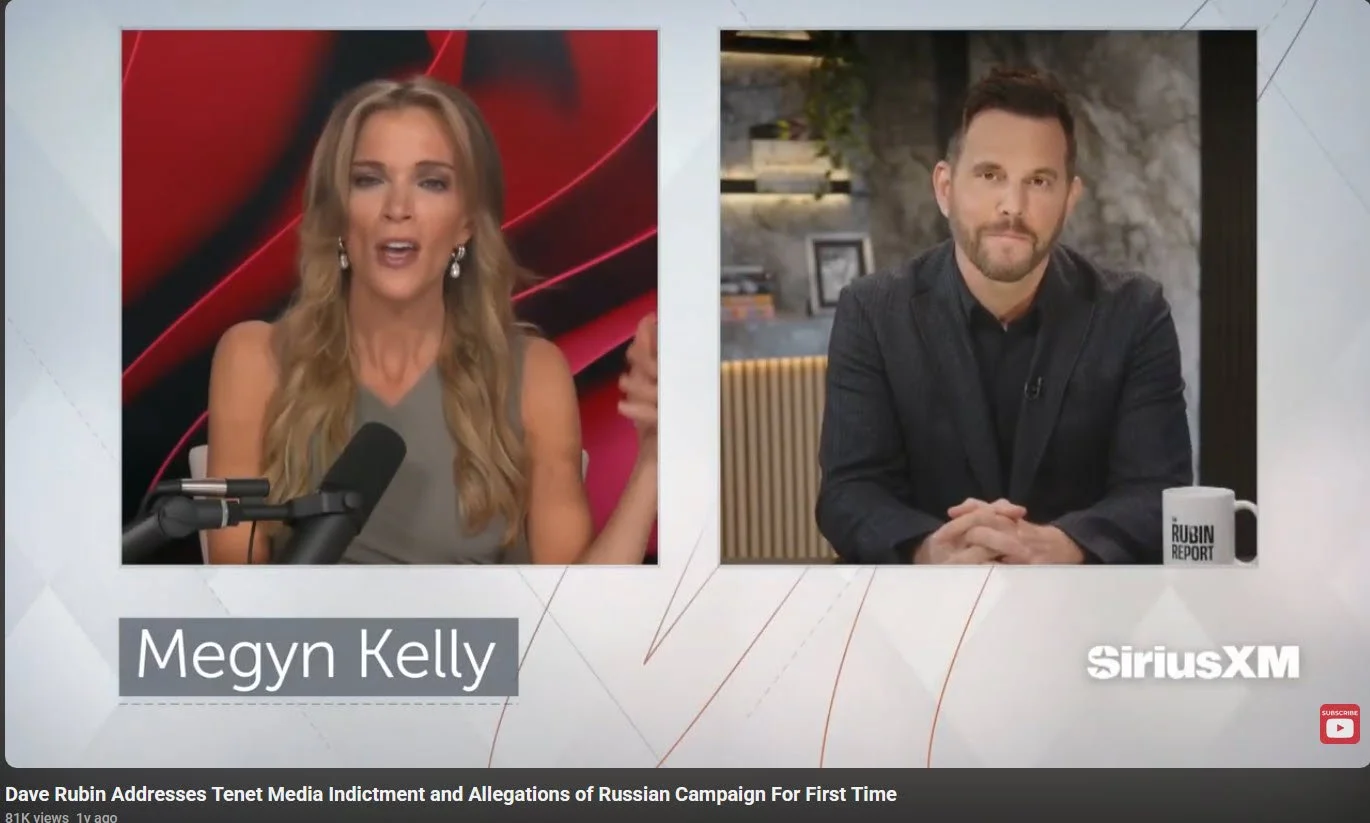
The Russian Tenet case is real, large and extraordinarily well documented. DOJ alleges that between October 2023 and August 2024: RT → foreign shell companies → Tenet Media → American commentators produced approximately: $9.7 million into Tenet and that: $8.7 million went to the production companies of just three commentators. (Department of Justice)
DOJ's case portrays at least several of the commentators as having been deceived about the source of the money. The Tenet founders allegedly told them their backer was a fictional European financier, “Eduard Grigoriann.” None of Pool, Rubin or Johnson was charged with being a Russian agent. (The Washington Post)
Israel is the next case worth following
Israel's current American influence operation is also unquestionably real, but we're at a different point in the money trail.
There is an active FARA registration for Clock Tower X LLC, controlled by former Trump campaign manager Brad Parscale, representing the State of Israel via Havas Media Germany GmbH. The DOJ FARA database contains continuing informational-material filings through September 1, 2026. (Efile Fara) Publicly disclosed contracts include roughly: Israel → Havas → Clock Tower X: $9 million with additional Israeli campaigns involving evangelical outreach, social-media campaigns and influencer recruitment. (Americans For Non-Profit Transparency) Clock Tower X receiving $9 million from an Israeli-government campaign does not prove that Ben Shapiro, Megyn Kelly, Joe Rogan, Tucker Carlson, Candace Owens—or any other famous commentator—received that money.
This actually strengthens Luna's argument is Strengthened
Luna introduced H.R. 10166 on August 27, 2026, to amend FARA to specifically require social-media influencers to submit registration statements. The Congressional Record confirms the bill. (GovInfo)
The problem she is addressing becomes very clear from Tenet:
Foreign government → PR/media firm → shell company/intermediary → influencer
By the time the money reaches the influencer, the influencer may have no idea who actually supplied it.
So I would modify the disclosure concept we discussed earlier. A truly effective statute shouldn't merely say:
“Influencers must disclose when a foreign government pays them.”
It should require something closer to:
“Any entity paying an influencer for political or public-policy communications must disclose the ultimate beneficial source of the funds when those funds originate with a foreign government, foreign political party, foreign state-controlled enterprise, or registered foreign agent.”
That would have exposed the Tenet/RT arrangement before $8.7 million reached three commentators, even if Pool, Rubin and Johnson genuinely did not know Russia was supplying the money.
And based on the evidence I've reviewed so far, I would not put Tucker Carlson, Megyn Kelly, Joe Rogan, Candace Owens or Ben Shapiro into a “foreign government paid them” category. Pool, Rubin and Johnson are materially different because we can actually trace government-origin money into the company paying them.
The next productive step would be to do the same forensic examination of the Israeli $9M+ influencer operation and identify every actual end recipient named in FARA disclosures, invoices and subcontracting records. That is where we may find a much larger 2025–26 list.
Tucker Carlson
Is Tucker just a petulant tool, or a a narcissist acting as a foreign agent against the interests of the United States.. Maybe both
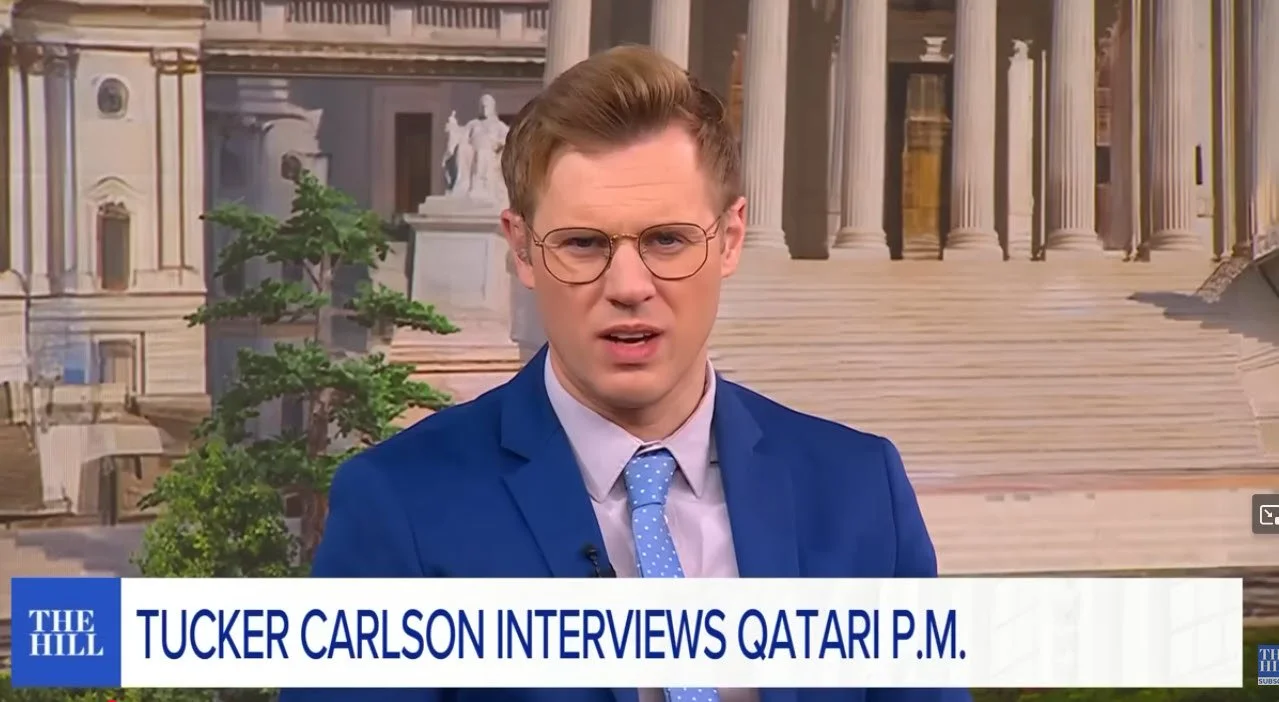
This also gets us back to Tucker Carlson. The meaningful question isn't “Does Tucker say things Qatar or Russia likes?” That's irrelevant to determining agency. The meaningful question is whether Carlson or his company received compensation, directly or indirectly, pursuant to an arrangement to act for a foreign government. If evidence established that, the FARA question would become much more serious. Mere agreement with a foreign government's positions isn't enough.There is no publicly verified evidence, as of September 2026, that Tucker Carlson is being paid by a foreign government. There are, however, enough documented foreign-government influence efforts surrounding him—especially involving Qatar—that the question is reasonable and worth separating into what is proven versus alleged.
Qatar is the strongest case to examine. FARA-related records and reporting show that the Qatari government paid U.S. public-relations/consulting firms, including Lumen8 Advisors, to conduct communications and media outreach. That effort helped facilitate Carlson's interview with Qatar's prime minister. In other words, Qatar paid people to help obtain and facilitate access to Carlson—but that is not evidence Qatar paid Carlson. The public material I've found does not contain a contract, invoice, bank transfer, or FARA disbursement showing money going to Carlson or the Tucker Carlson Network.
There have been allegations that approximately $200,000 was paid in connection with a Carlson/Qatar interview, most prominently promoted by Laura Loomer. But the available documentation does not establish that $200,000 went to Carlson. Carlson and the Tucker Carlson Network have categorically denied accepting Qatari or other foreign-government money.
Russia is even less substantiated. Former Canadian Prime Minister Justin Trudeau publicly alleged that Russian state-controlled RT had funded Carlson and other personalities. Russia has also demonstrably amplified Carlson's material, and the separate Tenet Media prosecution established that Russian money was secretly routed through intermediaries to certain Western influencers. But Carlson was not identified as one of the paid influencers in that case, and I have not found a public contract, payment record or DOJ filing establishing that Russia or RT paid Carlson.
So I would currently classify Carlson this way:
Foreign governments attempting to influence/cultivate him:Yes, documented.
Foreign-government-paid intermediaries arranging access to him:Yes, particularly Qatar.
Carlson expressing positions favorable to particular foreign governments: That's a matter of evaluating his commentary, not evidence of payment.
Proof that Carlson or TCN is secretly receiving foreign-government money:No—not on the presently public evidence.
The really interesting question in light of Luna's investigation is whether her reference to “contracts into the millions” includes Carlson or TCN. I haven't found evidence that Luna has publicly said that it does.