
No Rejection Here - But Students are Shafted
Segment #1026
The College Squeeze: Too Many Seats, Too Few College-Ready Students, and Employers Asking What a Degree Is Worth
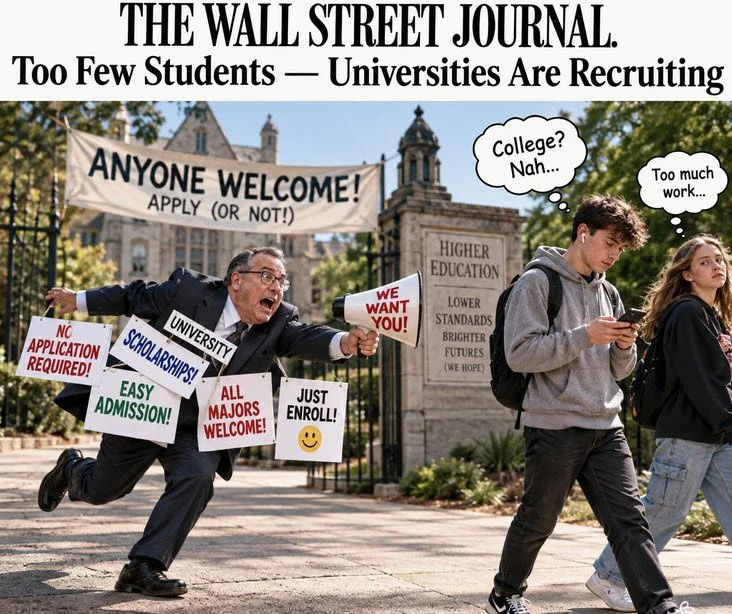
The Wall Street Journal recently reported something that would have seemed extraordinary not very long ago: hundreds of American colleges are sending acceptance offers to students who never applied to them.
The practice, known as direct admissions, allows colleges to use academic information supplied through participating platforms to identify prospective students and offer them admission without requiring the traditional application process. Roughly one-fifth of Common App's participating colleges are now involved in direct admissions, while more than a dozen states have adopted versions of the idea.
There is nothing inherently wrong with simplifying college admissions. Eliminating unnecessary application barriers can help first-generation and lower-income students who might otherwise underestimate their opportunities. But the rapid growth of direct admissions also reveals something important about the changing economics of higher education.
For much of the postwar era, students competed for colleges. They applied, waited to see whether they were accepted and then decided whether they could afford to attend. Increasingly, outside the relatively small universe of highly selective institutions, that relationship is being reversed. Colleges are competing for students. They are simplifying applications, discounting tuition, offering scholarships and, in some cases, admitting students who never expressed any interest in attending.
The demographic explanation is straightforward. There are fewer traditional college-age students coming through the pipeline, and a smaller percentage of high-school graduates is choosing college. Yet universities still have buildings, dormitories, faculty, administrators, athletic programs, technology systems, debt and other fixed expenses to support. An empty classroom seat generates almost no tuition revenue, while much of the cost of maintaining the institution remains.
That creates enormous pressure to fill seats.
The Wall Street Journal story becomes considerably more important, however, when it is connected to two other developments occurring at the same time. A substantial percentage of students reaching the end of high school appear poorly prepared for college-level work, particularly in mathematics and reading. At the other end of the process, employers are increasingly questioning whether some college graduates possess the basic professional skills they expect.
American higher education may therefore be facing a much larger problem than the widely discussed demographic cliff. The country may simultaneously have too many college seats, too few genuinely college-ready students to fill them, and employers becoming less willing to assume that possession of a college degree demonstrates competence.
College Admissible Is Not Necessarily College Ready
The academic-readiness numbers are disturbing.
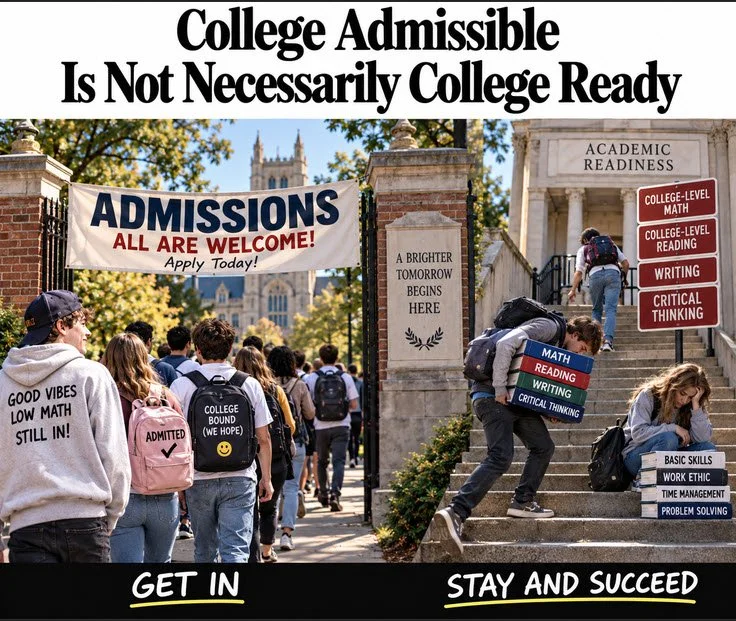
The 2024 National Assessment of Educational Progress found that only 33% of 12th graders were academically prepared for entry-level college mathematics, down from 37% in 2019. Only 35% were considered academically prepared for college-level reading, also down from 37%.
The numbers at the bottom of the achievement scale are even more concerning. Forty-five percent of 12th graders scored below NAEP Basic in mathematics and 32% fell below Basic in reading. These are not standards for admission to Harvard, MIT or another highly selective university. The question is whether students possess the academic foundation necessary to undertake ordinary entry-level college work.
ACT provides another window into the same problem. Among nearly 1.4 million ACT-tested graduates in the Class of 2025, only 30% met at least three of ACT's four College Readiness Benchmarks. ACT's benchmarks are intended to identify scores associated with approximately a 50% probability of earning a B and a 75–80% probability of earning at least a C in corresponding first-year college courses.
Math appears particularly troublesome. Even among ACT-tested students who reported completing a traditional core high-school curriculum, only 45% reached the mathematics benchmark, while 56% reached the reading benchmark.
This creates an important distinction that is easily overlooked: a student can now be college admissible without necessarily being college ready.
That distinction becomes especially important when colleges themselves are under financial pressure to find more students.
Consider a tuition-dependent university that historically needed 2,000 freshmen each year to maintain its finances. If demographic changes and declining interest in college mean that only 1,500 students who traditionally would have met its standards are willing to enroll, the institution has limited choices. It can shrink, cut expenses, raise prices, find alternative revenue, merge, close or broaden the population it is willing to admit.
The financial incentive to broaden admission is obvious.
Once those students arrive, another incentive appears: the university must keep them enrolled. Underprepared students may require tutoring, remedial instruction, intensive advising and other support services, all of which cost money. Those services can be worthwhile and can help capable students overcome deficiencies in their previous education. The more difficult question arises if substantial numbers of students cannot meet existing academic requirements. Does the university successfully bring those students up to the required standard, or does institutional pressure to improve retention and graduation rates eventually contribute to lowering the standard?
That is where the possibility of credential inflation becomes important. The diploma can remain visually identical while the academic threshold required to obtain it gradually changes.
Employers Are Looking at the Finished Product
The higher-education market does not end when a university awards a diploma. Ultimately, employers determine much of the economic value of that credential.
Here, too, warning signs have appeared.
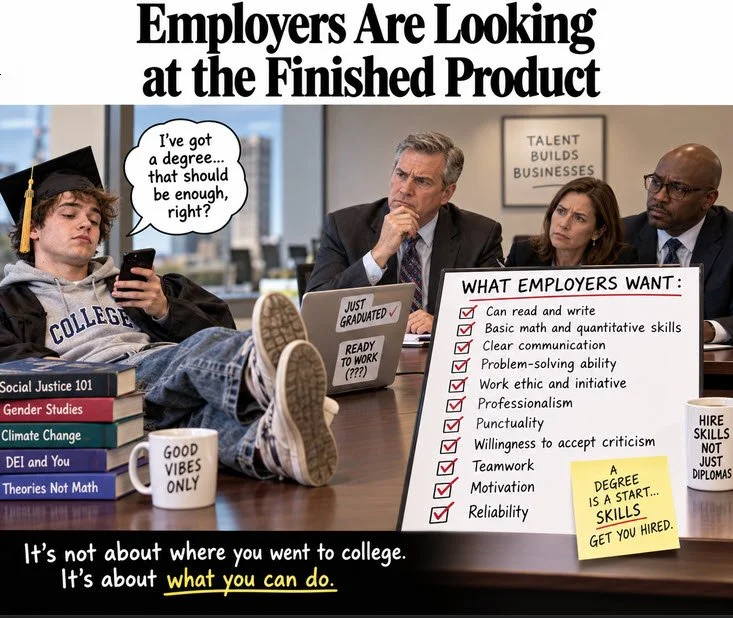
Surveys of hiring managers have produced recurring complaints about recent graduates involving communication, initiative, professionalism, punctuality, willingness to accept criticism, problem-solving ability and work ethic. In one survey of 1,000 hiring managers, 33% said recent graduates lacked work ethic, 29% described them as entitled, 28% cited a lack of motivation, 25% said they did not respond well to feedback and 23% identified punctuality as a problem. Twelve percent said they planned to avoid hiring recent college graduates for some entry-level positions.
These surveys should not be exaggerated into the claim that employers regard an entire generation as unemployable. The National Association of Colleges and Employers reported in 2026 that more than 70% of employers considered recent graduates at least somewhat well prepared and more than 20% considered them very well prepared. Nevertheless, employers continued to identify communication, professionalism and critical thinking as areas needing improvement.
An especially revealing problem is the difference between how graduates evaluate themselves and how employers evaluate them. Earlier NACE research found that 78% of graduates considered themselves highly proficient communicators, compared with only 54% of employers. Eighty percent of students considered themselves highly proficient in professionalism, compared with 50% of employers. For critical thinking, the comparison was 81% of students against 56% of employers.
That suggests something beyond a simple skills gap. There may also be a perception gap in which some graduates do not recognize the deficiencies employers see.
What employers say they want is strikingly conventional. They want people who can read and write, understand numbers, communicate clearly, solve problems, work effectively with other people, accept criticism, take initiative, meet deadlines and reliably perform the work they were hired to do.
Those expectations aren't particularly ideological. They are the basic requirements of functioning in an organization.
This is also why the debate over DEI and campus ideology should be kept in perspective. There is no evidence that DEI programs themselves caused the decline in American mathematics or reading proficiency, and companies have not suddenly stopped valuing employees from different racial, ethnic and socioeconomic backgrounds.
The more legitimate question concerns institutional priorities. Employers consistently place communication, critical thinking, teamwork and professionalism near the top of the abilities they want from graduates. Universities can pursue inclusion, cultural awareness and broader social objectives, but those goals do not replace the institution's fundamental educational responsibility. A college graduate should be able to read difficult material, write coherently, understand basic quantitative reasoning, evaluate evidence, distinguish argument from assertion, communicate with people who disagree and solve unfamiliar problems.
Those are neither conservative nor progressive skills. They are the basic skills of an educated person.
The Bachelor's Degree Is Also Facing Competition
For generations, the bachelor's degree served not only as an educational credential but also as a labor-market signal. An employer could reasonably assume that someone who had successfully completed four years of college possessed some minimum level of reading, writing, quantitative reasoning, persistence and maturity.
If employers become less confident in that assumption, the economic value of the signal declines.
That helps explain the growth of skills-based hiring, apprenticeships, professional certifications and employer training. Internships increasingly serve as extended job auditions, while behavioral interviews and assessments allow employers to evaluate initiative, resilience, communication and problem-solving ability directly rather than assuming a degree demonstrates them.
This matters because students have alternatives as well.
A high-school graduate is no longer necessarily deciding between College A and College B. The real comparison may be among a four-year private college, a state university, community college, trade school, apprenticeship, industry certification, online education, employer-provided training, military service or simply entering the workforce.
That changes the competitive equation for universities. A college increasingly has to demonstrate not merely why a student should attend that particular institution, but why the student should purchase the traditional four-year college product at all.
For a family contemplating tuition and other expenses that can reach tens of thousands of dollars per year, that is a reasonable question. If the student enters college inadequately prepared in reading or mathematics and graduates into a labor market where employers still complain about communication, critical thinking and professionalism, parents are entitled to ask exactly what they received in exchange for the money.
The Real College Crisis
This brings the argument back to the Wall Street Journal report about colleges accepting students who never applied.
Viewed by itself, direct admission can look like an innovative and relatively harmless change in the admissions process. Viewed within the larger marketplace, it may represent something much more consequential.
Universities are increasingly being squeezed from both ends of their business model. At the front door, many institutions are having difficulty finding enough students. At the back door, employers are becoming more interested in demonstrable skills and less willing to assume that possession of a bachelor's degree proves them.
Caught between the two is the student.
The university needs the student because it needs tuition revenue. The student enrolls because American society has spent decades presenting a bachelor's degree as one of the safest routes to economic security. The institution may then have to devote additional resources to bringing an academically underprepared student up to college level. Four or more years later, that graduate encounters an employer who increasingly wants to know not simply where the applicant went to school, but what the applicant can actually do.
That is a potentially dangerous business model for higher education.
Elite universities are unlikely to face the same degree of pressure because prestige, scarcity and powerful alumni networks have economic value of their own. The greatest challenge is likely to fall on the broad middle of American higher education: regional universities and relatively unknown private colleges that lack elite prestige while sometimes charging very substantial tuition.
Yet there is an opportunity hidden within the problem.
A university that develops a genuine reputation among employers for producing graduates who read well, write clearly, understand mathematics, think critically, communicate professionally, work hard, accept criticism and reliably get things done could acquire a tremendous competitive advantage.
For decades, many colleges could operate on the assumption that students were fortunate to be admitted. The Wall Street Journal story suggests that for a large part of higher education that relationship is reversing. Colleges increasingly must persuade students that they are worth attending, while their graduates must persuade employers that the education they received was worth something.
That may ultimately become the accountability mechanism higher education cannot avoid.
The emerging crisis, therefore, may be more complicated than America's much-discussed demographic cliff. The country may have built more college capacity than it has college-ready students to fill, just as employers are beginning to question whether the college credential still guarantees the skills they once assumed came with it.
If that continues, the institutions most likely to thrive will not necessarily be those with the most elaborate campuses, the largest administrations or the cleverest recruiting programs. They will be the colleges that can demonstrate something much simpler and ultimately much more valuable: their graduates leave genuinely better educated and genuinely prepared to work.
This version keeps the same argument and evidence but reads much more like a long-form ArtTrak-style commentary or magazine essay rather than a presentation. The short fragments are now used only where they add genuine impact rather than carrying the structure of the piece.