Radical Iranian Muslims Want You To Listen
Segment #825
I wish I could show you the Iranian public hanging of 19-year-old protestor and wrestler Saleh Mohamed in Qom, Iran. If he can endure this torture then I will always believe that we as Americans should be forced to deal with this
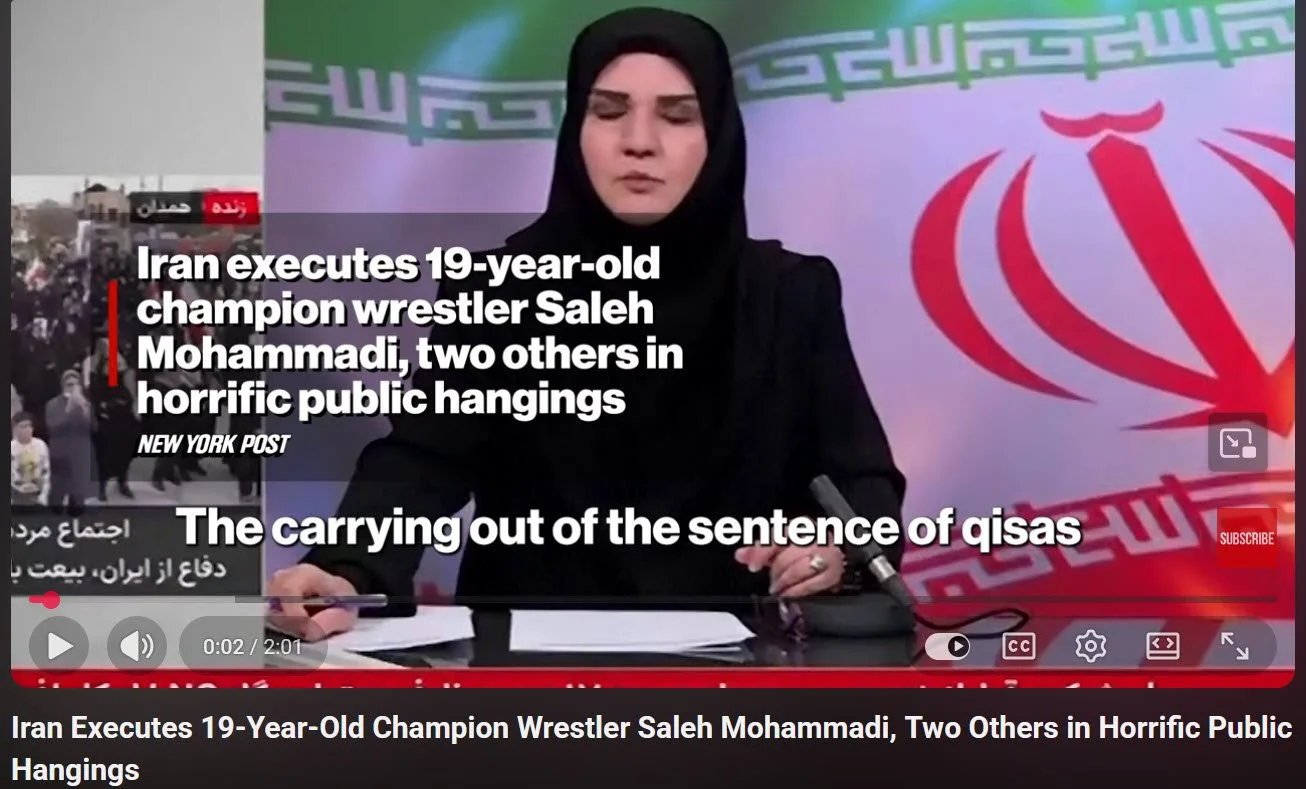
Iran executed a 19-year-old champion wrestler in a public hanging Thursday along with two other people who were arrested during the brutal crackdown on anti-regime protesters in January. Saleh Mohammadi, a rising star from Qom, was allegedly tortured to confess to the capital crime of waging war against God, with the teen executed without a fair trial, according to human rights groups.
reality by actually viewing the images. If I find them, I will post them. We owe that much to the executed victims and their families.
The public execution of Iranian protesters and even athletes demonstrates the brutality of the Islamic Republic and the ideological extremism at the core of its ruling system. When such executions are hidden, minimized, or sanitized by both Iranian state media and Western outlets, the public is shielded from confronting the full barbarity of the regime.
This matters beyond Iran. The regime’s own rhetoric, its use of religious doctrine, and its long record of intimidation, coercion, and violence show that certain Islamist movements are not merely politically authoritarian—they are civilizationally hostile to pluralism, dissent, and individual liberty.
Western societies should therefore distinguish clearly between ordinary Muslims who live peacefully under democratic norms and ideological Islamist movements that reject assimilation, reject secular law as supreme, and seek to transform host societies from within. The evidence from Iran, from jihadist propaganda, and from transnational Islamist networks is sufficient to conclude that committed Islamist extremists do not view coexistence as the end goal; they view it as a tactical phase.
The issue is not Islam as a whole, nor Muslims as a whole. The issue is militant and political Islamism when it openly rejects constitutional order, equality under law, free expression, and national sovereignty. Any immigration, asylum, or security policy that ignores that distinction is strategically naive.
Cultural Concepts and Instructions - Ayatollah’s Little Green Book
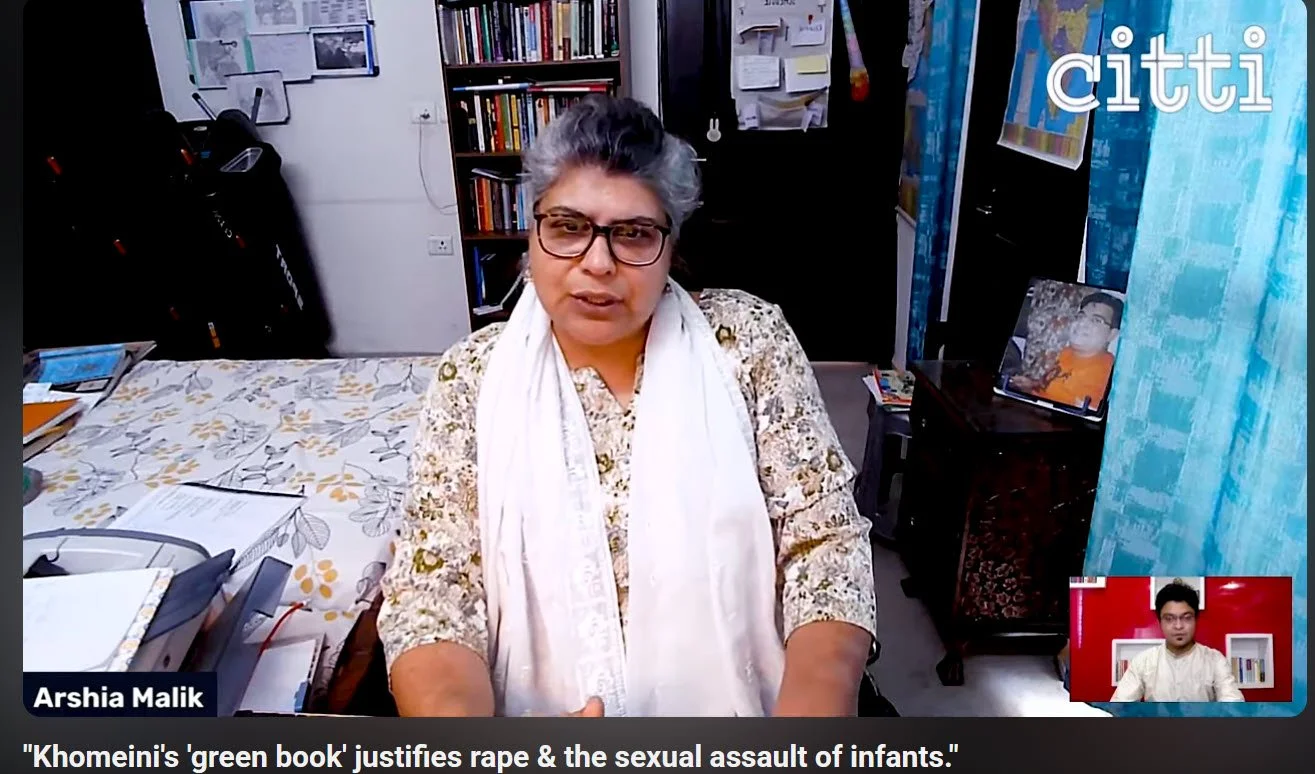
Khomeini's infamous 'green book' is premised on religious doctrine & justifies rape & the sexual assault of infants - with clear instructions on how to go about it: Indian scholar, Arshia Malik
These are not endorsements of the act.
They are post-act rulings: “if this happened, what is the legal consequence?”
Khomeni;s Little Green book is a collection of writings that list among other things what one must do if they engage in activity not necessarily condoned. These instructions give the perpetrator an out.
Sex
If intercourse with a virgin 9-year-old (or under 9 in the notorious discussions) causes ifḍāʾ, he must at minimum continue to support her financially for life and pay her full dower; if no ifḍāʾ occurs, the act is treated as a sin but not necessarily with a fixed corporal punishment in that formulation
If a man commits sodomy with a cow, ewe, or camel, the animal becomes impure, its milk may no longer be consumed, and the animal must be destroyed.
If an animal such as a horse, mule, or donkey is sodomized, its meat becomes forbidden and it may need to be sold outside the locality.
If someone fornicates with an animal and ejaculates, ritual washing/ablution becomes required.
If a man commits sodomy with the son, brother, or father of his wife after marriage, the marriage remains valid.
Women
But other sexual enjoyment (touching, embracing, rubbing the thighs, etc.) is described as not prohibited even if the girl is extremely young
it is recommended to hasten a daughter’s marriage when she reaches maturity,
with the sentiment that it is a father’s “good fortune” if his daughter does not menstruate in his house (i.e., she is married off before or immediately at puberty).
duty of sexual availability to husband (within the framework of “tamkin” / conjugal compliance),
limits on leaving the house without husband’s permission in traditional fiqh discussions,
strong male authority in marital decision-making,
divorce being structurally easier for the man than the woman. may may have temporary marriages
Amnesty documented that in Iran, “adultery while being married” carried a mandatory sentence of execution by stoning
unmarried fornication = typically 100 lashes
A hajib covering the head It is still legally compulsory. It is no longer universally obeyed. And it is no longer uniformly enforced — but it is still a tool of repression.
Non Believers
If you mean Ayatollah Khomeini (Ruhollah Khomeini), his views on non-believers (kuffar / non-Muslims) were very harsh in law and politics, though not every quote you see online is reliable.
Khomeini generally treated non-believers as inferior in the Islamic legal order, often ritually impure, and politically suspect.
That is the clearest honest summary.
1) Khomeini’s legal view: non-believers as ritually impure (najis)
One of the most frequently cited and most important rulings associated with Khomeini is that: non-Muslims are “najis” (ritually impure)
This is not just an insult in the Western sense — in Shi‘a jurisprudence it has practical consequences about touching, food, moisture transfer, and ritual purity.
A source discussing post-revolution Iran summarizes Khomeini’s position bluntly as: “Non-Muslims of any religion or creed are najis.” (John Mark Ministries)
Other materials citing Islamic Laws with Khomeini’s annotations reflect the same framework: if food or moisture comes into contact with the body/hands of non-believers, it may be treated as impure under those rulings. (Islamquest)
2) Khomeini’s political view: non-believers as a threat to Islamic society
In Khomeini’s political ideology, non-Muslim forces — especially the West, Zionists, imperialists, and the Baha’is — were often portrayed as:
corrupting influences, enemies of Islam, subversive actors, sources of moral/political contamination.
A summary of Islamic Government notes Khomeini describing “centers of evil propaganda run by the churches, the Zionists, and the Baha’is” and saying “These centers must be destroyed.” (Cavac's Stuff)
In practical terms: He treated it as: a civilizational enemy, a political danger, and something the Islamic state must contain or suppress.
3) Did Khomeini say “kill all unbelievers”?
Yes, such quotes circulate, They fit the tone of hardline revolutionary Islamism.
But I would not treat that exact wording as securely verified without the original Persian text and exact source page
His documented rulings and state practice already show it.
4) Did he hate all non-believers equally?
In classical Shi‘a law there are categories:
Muslims, People of the Book (usually Jews, Christians, Zoroastrians), Other non-believers / polytheists / atheists / apostates
Modern Shi‘a jurists sometimes soften this. For example, Ali al-Sistani today treats Christians, Jews, and Zoroastrians differently and, on obligatory precaution, excludes them from the harshest impurity rule. (sistani.org)
But Khomeini’s line was generally stricter.
Khomeini’s jurisprudence was more exclusionary and harder-edged than some later Shi‘a authorities.
What does Khomeini say about non-believers?
They are theologically outside the truth.
They are often treated as ritually impure (najis) in his jurisprudence.
They should not dominate Muslims. They are often viewed as politically dangerous to an Islamic society. Some categories may be tolerated, but only in a subordinate framework
His mystical writings sometimes say “do not inwardly despise them,” but that does not erase the legal hierarchy
Non-believers may exist, but they do not stand equal to Muslims in a true Islamic order, and the Islamic state should not let them shape society.