
Piker to El Sayid - I Own You
Segment #1054
There is a potentially important connection between Hasan Piker's political demands and Abdul El-Sayed's refusal to identify Iran as a greater threat than Israel during the October 8, 2026, Michigan Senate debate. It is clear from all these radical DSA candidates that they will certainly go radical if ttbhey happen to deceive the American electorate by moderation their position
Piker Owns El Sayid and all the Radical DSA Candidates he Has Supported
What El-Sayed actually said: When moderator Rick Albin repeatedly asked whether Iran or Israel posed the greater threat to the United States, El-Sayed refused to choose.
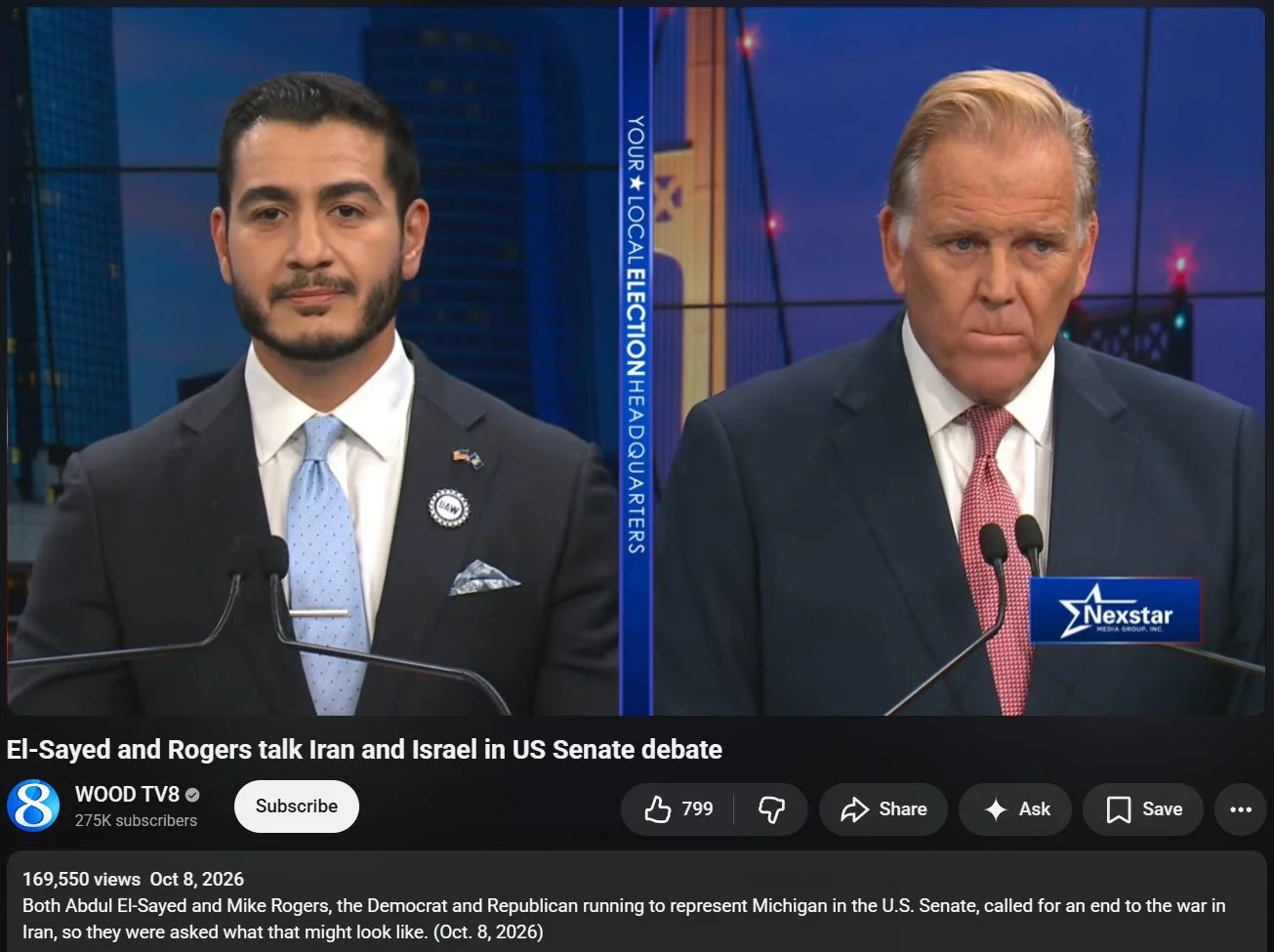
What El-Sayed actually said: When moderator Rick Albin repeatedly asked whether Iran or Israel posed the greater threat to the United States, El-Sayed refused to choose.
Abdul El-Sayed, Hasan Piker, and the Israel–Iran question
The central issue is whether a candidate for the United States Senate is exercising independent judgment or allowing an ideological movement and its influential personalities to dictate his positions.
El-Sayed repeatedly refused to choose between Israel and Iran
During the Michigan Senate debate, the moderator repeatedly asked El-Sayed which country posed the greater threat to the United States.
His eventual answer was: "Both of them have proven dangerous in their own way."
He characterized Iran as a potential direct attacker and Israel as a country that could draw America into unnecessary wars.
RealClearPolitics
My assessment: This was political evasion, not a straightforward national-security assessment. The moderator was asking him to compare threats. El-Sayed substituted an argument about American involvement in foreign wars.
The Piker connection is the more significant question.
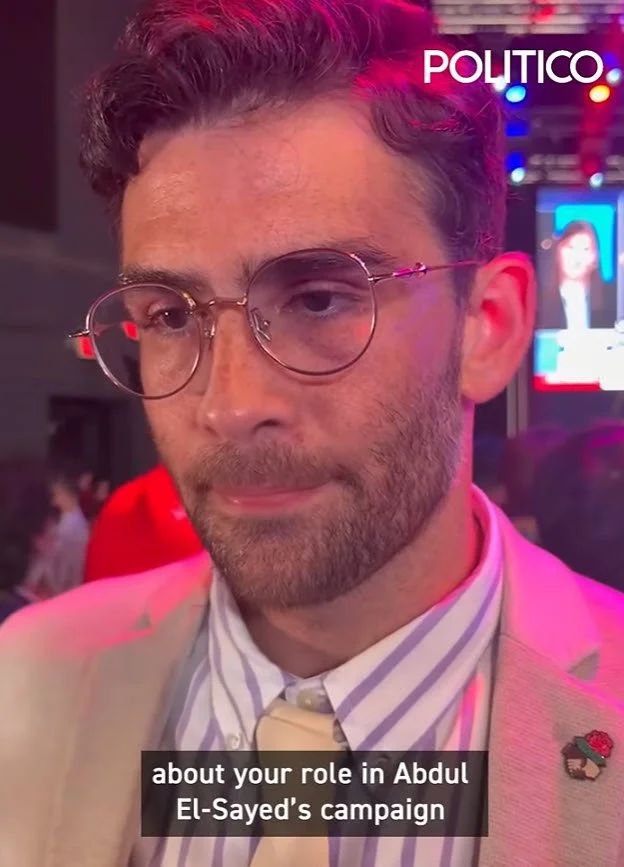
El-Sayed has campaigned with Piker, whose outspoken opposition to Israel has made him a controversial figure within Democratic politics. After the debate, El-Sayed dismissed a reporter's attempt to compare his association with Piker to Mike Rogers' association with Trump. Piker is not simply an uninvolved political commentator Piker actively helped attract younger progressive supporters. At an April rally, Piker was a major draw, and opposition to Israel was a central theme.
Jewish Telegraphic Agency
That creates a legitimate accountability question: How much political influence does Piker exercise over candidates he helps elect?
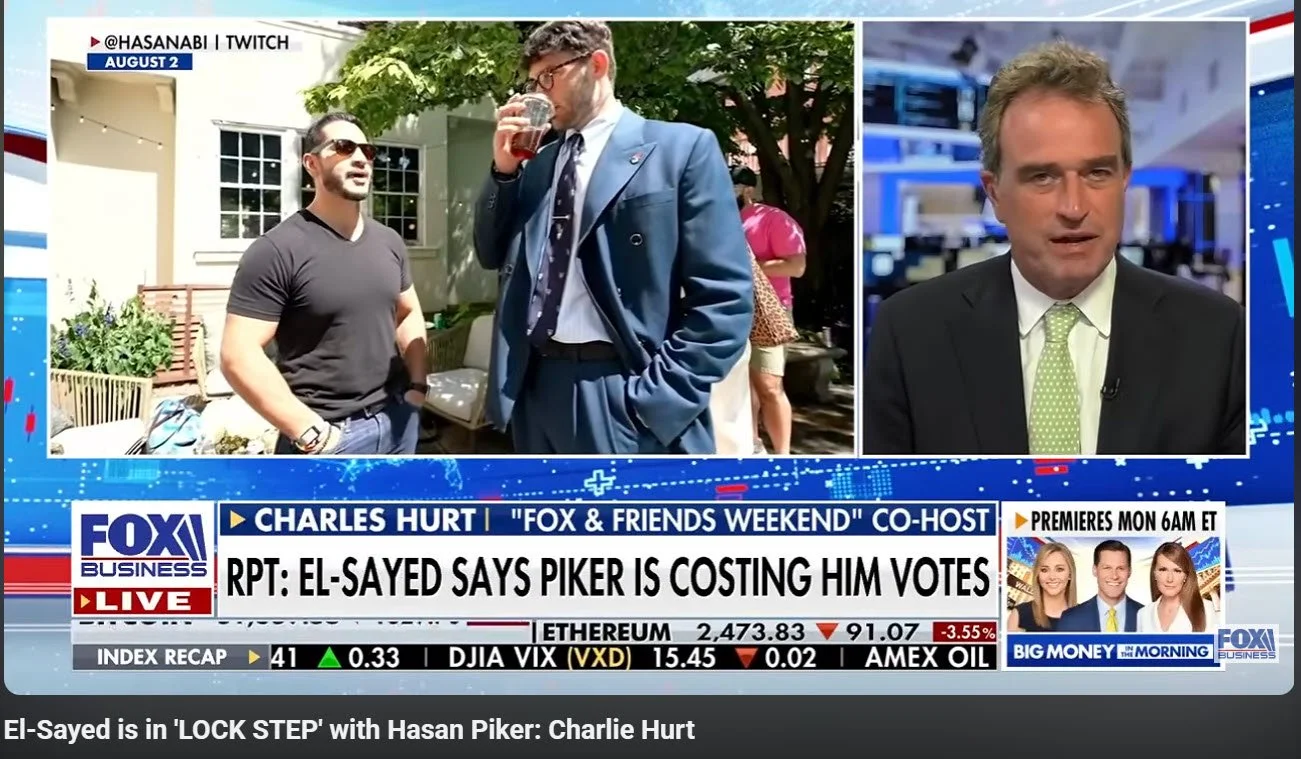
El-Sayed has campaigned with Piker, whose outspoken opposition to Israel has made him a controversial figure within Democratic politics. After the debate, El-Sayed dismissed a reporter's attempt to compare his association with Piker to Mike Rogers' association with Trump.
The Times of Israel
+1
Piker publicly demands that El-Sayed identify Israel as the greater threat.
El-Sayed subsequently refuses to identify Iran as the greater threat.
El-Sayed minimizes questions about Piker's influence over his campaign.
Piker is an anti semite proven by AXIOS
Piker has publicly stated that candidates supported by his movement must remember who helped elect them and must continue to cooperate if they want to retain political power.
The clearest example involves Texas Democratic Senate candidate James Talarico.
The October 2026 statement about Talarico
At an October 2026 appearance at the University of Texas at Austin, Piker reportedly said:
“We gotta hold him to account.”
He went further, saying the movement should remind Talarico that its supporters helped him win political power, adding:
“If he wants to maintain it, he’s gotta play ball.”
These remarks were reported on October 2 by Terresa Monroe-Hamilton, who attributed them to Piker's appearance before University Democrats at UT Austin.
RAIR Foundation
This is substantially stronger evidence than a general endorsement. Piker was describing an ongoing obligation that he expected to exist after the election, with continued political support tied to the candidate's cooperation.
The reporting supports the conclusion that Piker was demanding political accountability to his supporters. Whether that amounts to an assertion of ownership is an interpretation; he did not literally use the word own in the quoted remarks.
Piker explicitly demands shared ideological convictions
A May 29, 2026 interview provides additional evidence, this time from a lengthy transcript rather than a short political clip.
At approximately 1:58:20, Piker says:
“You can have an ideological commitment to a movement. I certainly do.”
He then says he demands that the elected representatives he promotes share his moral convictions. This is particularly important because Piker simultaneously states that he has no loyalty to the Democratic Party as an institution. His stated allegiance is to a political movement and its principles, not the party label.
ScribeHawk
Read the May 29 interview transcript — approximately 1:57–1:59
The DSA discussion addresses enforcing loyalty after elections
On a panel with Democratic Socialists of America leaders, Piker participated in a discussion of the organization's political program.
The recorded session includes two especially relevant topics: holding elected officials accountable and dealing with candidates who abandon the socialist label after receiving an endorsement and winning office.
Zolotube
What these findings establish
Taken together, the evidence reveals a consistent political approach:
Before elections: Piker supports candidates whose positions advance his movement's goals.
After elections: He advocates continuing organized pressure to ensure those candidates follow through.
On ideological differences: He explicitly expects candidates he promotes to share his fundamental convictions.
On party loyalty: He places ideological commitment above loyalty to the Democratic Party itself.
The important qualification is that Piker frames this as democratic accountability and grassroots organizing. Critics interpret the Talarico remarks as an attempt to exert control over elected officials. The public record establishes his stated intentions to apply pressure, but not that he has authority to compel compliance.
The strongest evidence is the combination of the Talarico remarks and the May 29 interview. One describes the political consequences he wants candidates to recognize; the other explains his ideological expectations.
There is now a documented basis for saying that Piker demands continued allegiance to his movement's principles from candidates he supports—not merely that he endorses them.