
Segment #1083
And there is absolutely no evidence that congress would ever pass legislation that would be against their self interest and they would in fact do everything possible to not go on the record with a vote. They are entitled and they are by definition and their actions better than every citizen they represent.
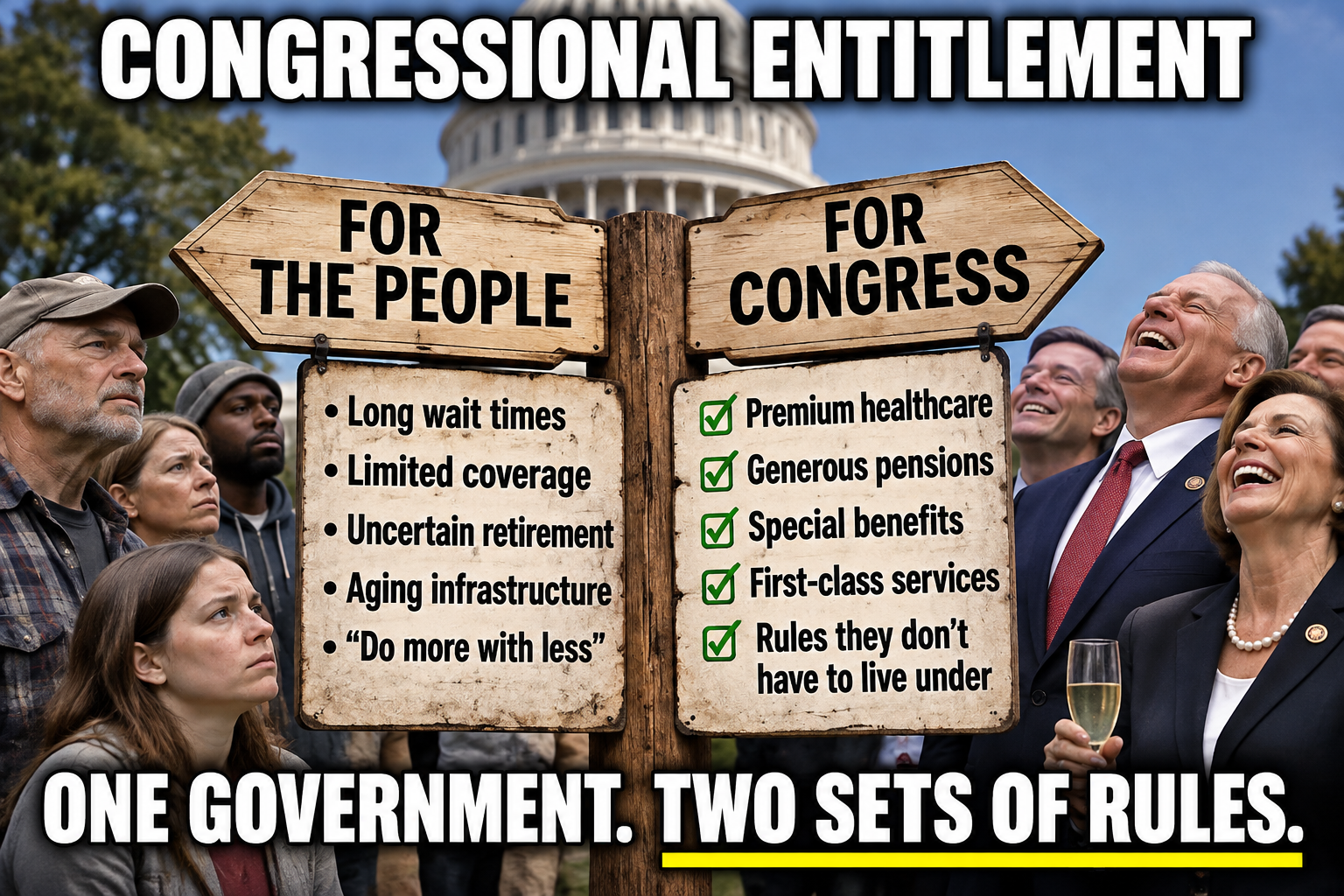
A Proposal for Equal Treatment and Accountability for America's Elected Officials
The Principle: If Government Services Are Good Enough for the American People, They Are Good Enough for the Politicians Who Mandate Them
If America's elected officials believe that government-managed healthcare, retirement programs, education and other public services represent the best solutions for the American people, they should be required to participate in those same systems under precisely the same rules.
There should be no special government benefits, preferential treatment, exclusive programs or taxpayer-funded privileges for the politicians who create and administer these systems.
This is not an argument against personal wealth, private enterprise or individual choice. Quite the opposite. Every American, including every elected official, should remain free to spend personal funds to obtain better healthcare, additional retirement income, private education or any other service they can afford.
The distinction is simple: Politicians may purchase additional benefits with their own money, but they should not receive special benefits at taxpayer expense simply because they hold public office.
Healthcare: The Same System, the Same Rules
If Congress establishes a universal government healthcare system, members of Congress, the president, senior administration officials and their families should be subject to the same coverage rules as the citizens they represent.
That means:
The same eligibility requirements and covered benefits.
The same access to doctors, specialists and hospitals.
The same waiting lists and scheduling procedures.
The same prescription drug coverage and restrictions.
No exclusive taxpayer-funded healthcare plans or preferential treatment based on political office.
Any official wishing to obtain faster treatment, additional services or private insurance should be free to do so, provided the additional expense is paid from personal funds rather than special government benefits.
Politicians should experience the consequences of their healthcare policies rather than being insulated from them.
Retirement: No Special Government-Funded Privileges
Retirement benefits should follow the same principle.
Elected officials should participate in Social Security under the same contribution requirements, benefit formulas and eligibility rules that apply to ordinary Americans.
They should not receive special taxpayer-funded pension arrangements, preferential retirement ages or additional government retirement benefits unavailable to the general public solely because of their political positions.
Officials should remain free to invest their own earnings in IRAs, 401(k)s, private investments, annuities or other retirement vehicles available under generally applicable law.
If Congress believes Social Security provides an adequate retirement foundation for Americans, its members should be prepared to rely on that same foundation, supplemented by their own savings and investments.
Public office should not confer a taxpayer-financed retirement advantage over the people who pay for it.
Education and Other Government Services
The same standard should apply to public education and other government-funded services.
Politicians should have access to the same public schools, public programs and government services available to their constituents, without exclusive benefits arising from their positions.
They should retain the right to pay personally for private schools, tutoring, supplemental services or other alternatives.
The objective is not to restrict individual choice. It is to eliminate government-financed privileges reserved for those in political power.
Personal Wealth and Private Spending Must Remain Protected
Equal treatment under government programs does not mean everyone must live identically.
A successful business owner, physician, tradesperson, retiree or elected official should be free to spend personal income and accumulated wealth as they choose.
There is nothing inherently objectionable about someone purchasing better services with privately earned money.
The objection arises when politicians establish one set of government benefits for the public and a more generous taxpayer-financed arrangement for themselves.
The distinction must be maintained between:
Private advantage earned or purchased with personal resources, which remains an individual freedom, and special public benefits granted because of political office, which should be prohibited.
Transparency and Enforcement
A meaningful reform would require more than political promises.
Congress should establish clear statutory standards requiring public disclosure of compensation, retirement arrangements, health benefits and other government-funded privileges provided to elected officials.
An independent auditing process should identify benefits that exceed those available under generally applicable public programs.
Legitimate compensation, documented official expenses, security requirements and reasonable employment-related protections would need to be distinguished from preferential personal benefits. Any exceptions should be narrowly defined, publicly disclosed and independently reviewed.
The rules should apply equally regardless of political party or seniority.
Why This Matters
The fundamental problem is the separation between those who make public policy and those who must live with its consequences.
When politicians are insulated from the financial burdens, waiting periods, service limitations and retirement uncertainties their policies create, they have less direct personal exposure to the performance of those programs.
Requiring elected officials to participate on equal terms would not automatically make government programs more efficient. It would, however, remove a source of preferential treatment and strengthen accountability.
If a healthcare system develops unacceptable waiting lists, politicians should confront those same restrictions unless they pay privately for alternatives available to everyone.
If Social Security becomes inadequate to support retirement, politicians should face the same benefit limitations as other recipients.
If government services deteriorate, the officials responsible for those policies should not enjoy exclusive taxpayer-funded arrangements that shield them from the consequences.
Conclusion: Public Service Should Not Create a Privileged Class
America's elected officials are representatives of the people, not a separate class entitled to superior government benefits.
Whether the country moves toward greater government control of healthcare and retirement or retains a predominantly private system, the principle should remain unchanged.
One government. One set of rules. Equal public benefits. No special privileges.
Politicians should remain free, like every other American, to use their own money to purchase additional services, improve their retirement security and provide for their families.
What they should not be permitted to do is use taxpayer funds to establish a privileged system for themselves while requiring everyone else to live under a different standard.
If politicians are confident enough in government programs to impose them on the American people, they should be confident enough to live under those same programs themselves.
A legislative version of this proposal would need to address existing federal employee pension rights, contractual protections and constitutional limits on changing congressional compensation. Those issues affect implementation but do not prevent Congress from considering uniform benefit rules prospectively.