
Segment #1084
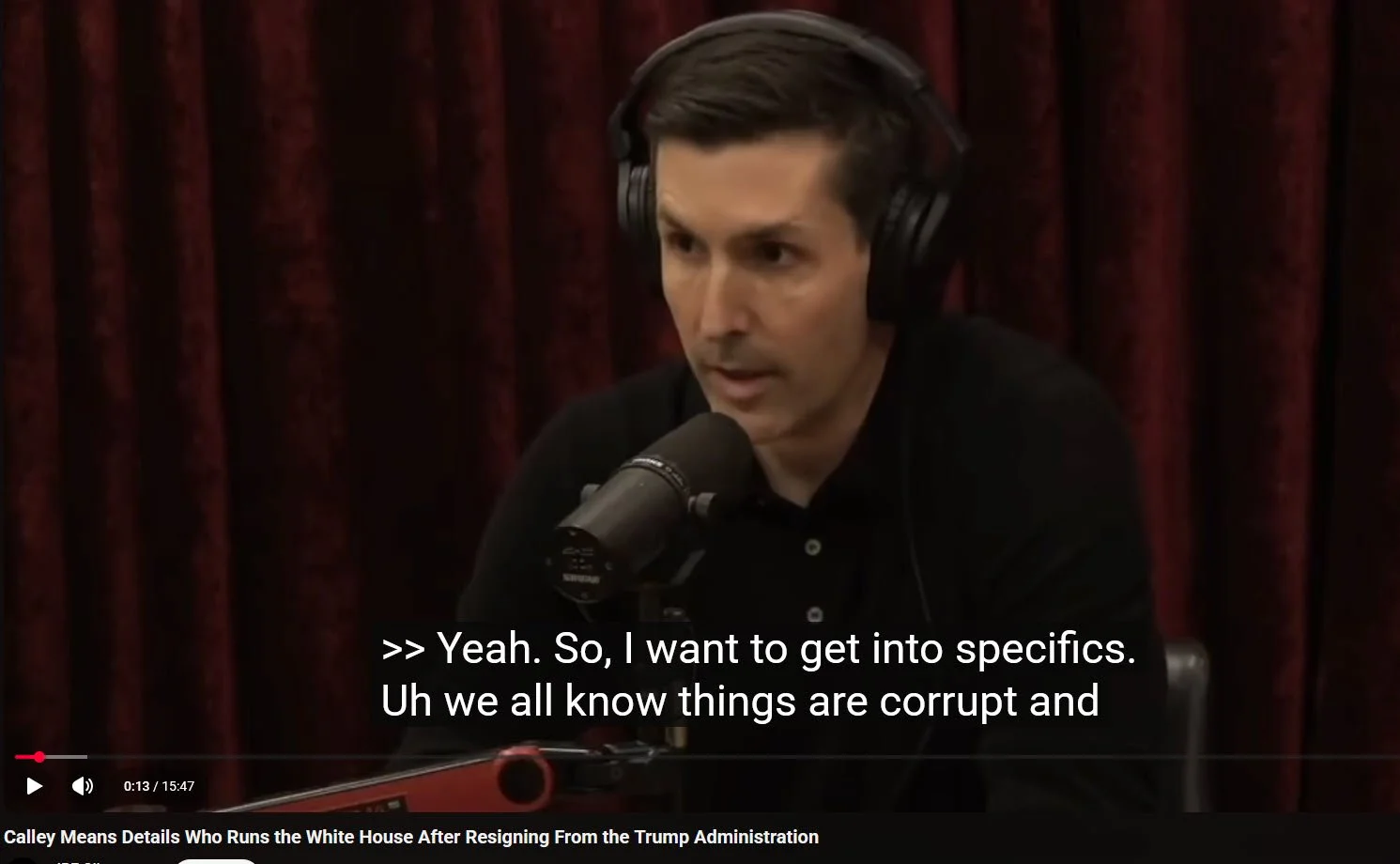
The most important interview for your blog is Joe Rogan's November 6, 2026, conversation with Calley Means, Episode #2578. Unlike his earlier appearance with his sister Casey in 2024, this interview contains allegations from someone who actually worked inside the Trump administration.
Means, a former senior adviser at the Department of Health and Human Services, describes how corporate lobbying and political self-interest allegedly obstructed reforms that the administration had promised voters. His criticism reaches into the White House itself.
November 7, 2026
If you want to understand why Americans have so little faith in Washington, listen to Calley Means' November 6 interview with Joe Rogan. Means recently resigned as a senior adviser to Health Secretary Robert F. Kennedy Jr., and his account of what happened inside the Trump administration is a disturbing illustration of how Washington operates. The voters elect politicians who promise reform, but once those politicians take office, corporate lobbyists, political operatives, and entrenched financial interests get to work protecting the system. The politicians make the promises. The corporations make the money. The taxpayers get the bill.
Means describes an administration elected in part on promises to confront chronic disease, reform America's food supply, and challenge the influence of pharmaceutical and chemical companies. Yet he alleges that efforts to address glyphosate, establish a definition of ultra-processed foods, and improve federally funded school meals encountered extraordinary resistance from corporate interests and influential White House officials. According to Means, even proposals that merely informed consumers, without imposing new regulations, became political battlegrounds. His account raises an obvious question: If Washington cannot even agree to tell Americans what is in their food, whose interests is it really protecting?
Perhaps the most revealing part of the interview is Means' criticism of the Affordable Care Act. He argues that Obamacare was shaped by the insurance industry and created incentives that allowed insurers to benefit from ever-increasing healthcare spending. His broader argument is that America's healthcare system rewards managing disease rather than preventing it. Americans pay enormous amounts for healthcare while continuing to struggle with obesity, diabetes, and other chronic conditions. Means' specific claims about the ACA and healthcare costs deserve independent examination, but the fundamental question is legitimate: Why does a system consuming so much of the nation's wealth produce such disappointing results?
What makes this interview particularly significant is that Means is not simply another political commentator attacking the opposing party. He is criticizing the administration he served and the movement he supported. The White House disputes his characterization and points to reforms involving dietary guidelines, food additives, and agricultural policy. Those accomplishments deserve recognition, but they do not resolve his allegations about corporate influence and blocked reforms.
Republicans and Democrats can argue endlessly about who deserves the blame, but the larger problem transcends party affiliation. Corporate America spends enormous sums influencing legislation, regulation, and the people responsible for enforcing both. Politicians depend on financial and political support, while voters are expected to believe that their elected representatives remain independent of those interests. Sometimes they do. Too often, the incentives point in the opposite direction.
The real scandal is not that corporate interests attempt to influence Washington. Everyone knows they do. The scandal is how routinely the political system accommodates them while continuing to claim that the American people come first.
Calley Means has made serious allegations that warrant scrutiny, not automatic acceptance. But his interview provides an unusually revealing look at the conflict between campaign promises, corporate influence, and actual governance. If even an administration elected to challenge entrenched interests struggles to overcome them, Americans have every reason to question whether changing the party in power is enough to change Washington.
The voters are promised reform. The lobbyists negotiate the details. And somehow, the people paying for the entire operation always seem to come last.
Source: The Joe Rogan Experience, Episode #2578, November 6, 2026, Calley Means. Listen to the interview.
The strongest aspect of this story is that Means is accusing his own political side of undermining its promises. That makes it more than another partisan attack and provides a useful foundation for your broader argument about congressional entitlement, corporate influence, and political self-interest.