
Probability of U.S. Fiscal Deterioration Under DSA Economic Policies, 2026–2040
The United States already faces a deteriorating long-term fiscal outlook. If the Democratic Socialists of America (DSA) gained sufficient governing power to enact its economic program, the additional fiscal risk would depend primarily on how its spending commitments were financed, their effect on economic growth, and whether projected savings materialized.
The current U.S. fiscal trajectory
The Congressional Budget Office projects:
2026: Federal deficit of $1.9 trillion, with publicly held debt at 101% of GDP.
2036: Federal deficit of $3.1 trillion, with debt at 120% of GDP.
2056: Debt reaching 175% of GDP under current law.
These projections already indicate substantial fiscal pressure without assuming DSA control.
Congressional Budget Office
Projected U.S. federal debt under current law
Debt held by the public, percentage of GDP. CBO projections, not a DSA policy scenario.
What changes under a DSA policy scenario?
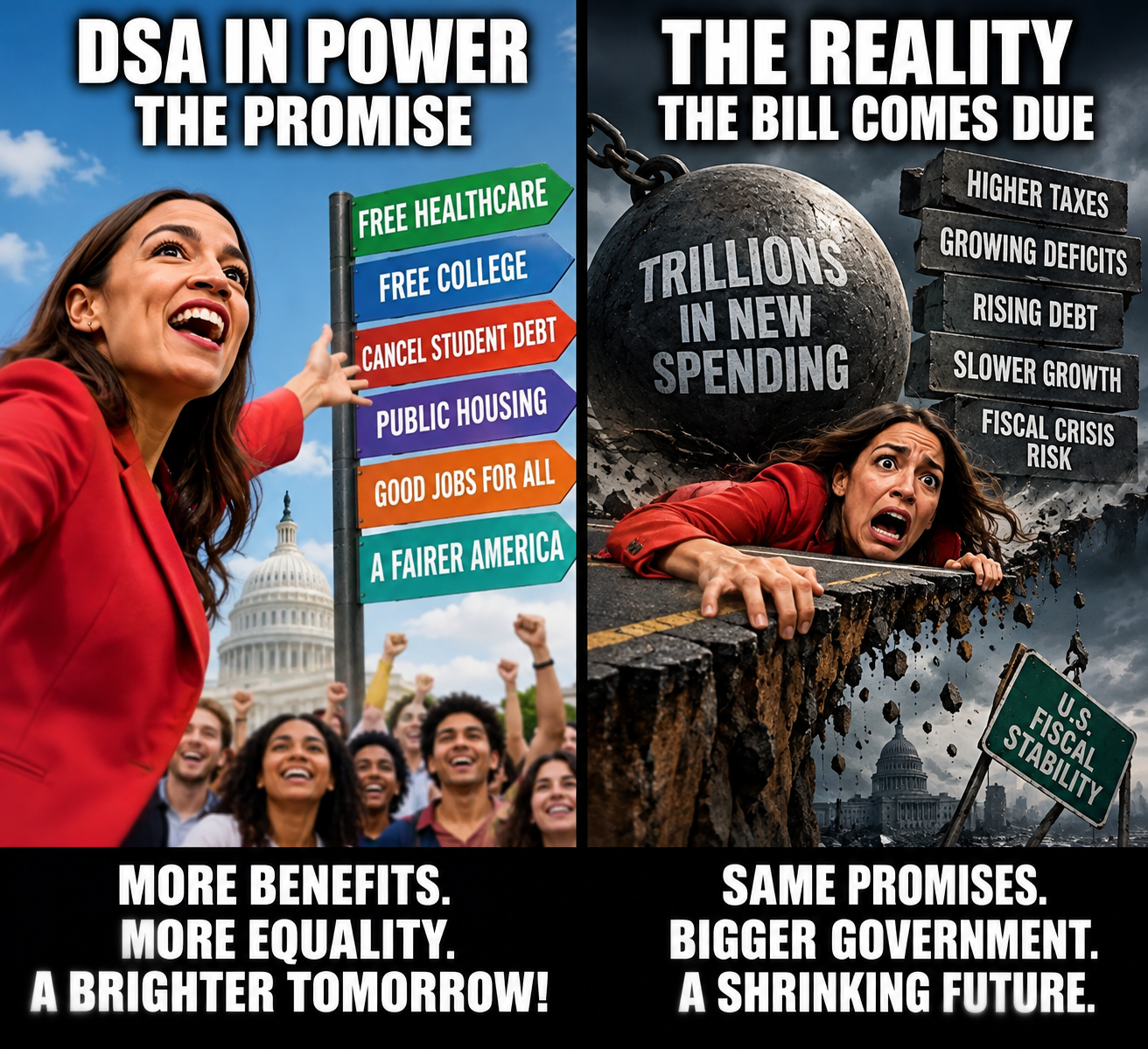
The DSA's 2026 program advocates universal healthcare without charges at the point of service, publicly owned housing, free public education, student debt cancellation, and expanded worker benefits. These policies would alter both federal expenditures and taxation.
DSA Program
A 2026 American Action Forum analysis estimates that one Medicare for All proposal could require approximately $47.4 trillion in additional federal financing over 2027–2036 before new taxes, with a substantial financing gap remaining under its modeled tax package. This is one proposal-specific estimate, not an official score of the entire DSA platform.
AAF
Importantly, federal spending would increase partly because healthcare costs currently paid through private premiums and other channels would shift to government. Higher federal expenditure does not automatically mean an equally large increase in total national healthcare costs.
Probability-based fiscal scenarios
A defensible probability calculation must distinguish three possible implementations.
DSA policies with sufficient financing - Taxes and savings broadly cover new commitments - Higher tax burden and possible growth tradeoffs; debt effects uncertain
DSA policies partly financed - Spending exceeds new revenue - Larger deficits, debt-service costs and eventual adjustment requirements
DSA policies largely debt-financed - Persistent new borrowing compounds existing deficits - Faster debt accumulation and greater vulnerability to financial shocks
There is no established empirical probability that DSA governing power would produce any one of these outcomes. Assigning a figure such as 80% or 90% without modeling legislation, revenues, spending, and economic responses would create false precision.
The University of Pennsylvania's Penn Wharton Budget Model estimated in June 2026 that federal debt has an approximate outer sustainability limit of 210% of GDP. Under its historical healthcare-cost-growth assumptions, that threshold could be reached within 20 years, with a modeled 25% probability of reaching it within 14 years. That estimate concerns the existing U.S. fiscal trajectory, not a DSA takeover scenario.
Penn Wharton Budget Model
Timeline of potential problems
2027–2030: If substantial new programs were enacted without matching revenue, federal deficits could widen quickly. The immediate effects would depend on implementation speed, tax legislation, and financial-market responses.
2030–2035: Persistent additional borrowing could raise interest costs and crowd out other spending. Governments might face increasing pressure to revise benefits, raise taxes, or slow expenditure growth.
2035–2040: Debt sustainability would become increasingly sensitive to interest rates, economic growth, and healthcare spending. A severe financing crisis is possible under unfavorable assumptions, but no reliable DSA-specific probability or date can currently be established.
Probability-weighted conclusion
The most consequential fiscal variable is not whether policymakers identify as democratic socialists, but the size of the gap between permanent spending commitments and sustainable government revenue.
Under your probability framework, the next step is to estimate three measurable outcomes by 2035: the probability that federal debt exceeds the CBO baseline, the probability that debt-service costs require major fiscal adjustments, and the probability of severe financing disruption.
Those estimates should be calculated separately under fully financed, partially financed, and predominantly debt-financed versions of the DSA program, incorporating possible benefits from expanded healthcare coverage and changes in household costs alongside taxation and economic-growth effects.
The supported conclusion is conditional: An expansion of government commitments without sufficient financing would worsen an already difficult fiscal outlook. Whether DSA policies produce that result depends on their actual design and implementation. The current evidence supports analyzing that risk, but not assigning a credible numerical probability to DSA control alone.