Segment #1071
When Religious Teachings Can Be Used to Justify Deception
Most non-Muslims have little understanding of Islamic scripture, religious teachings, or the ways those teachings can be interpreted. The central issue is not whether Islam universally commands Muslims to lie to nonbelievers. It is whether Islamic texts and traditions CAN be interpreted to justify deception of nonbelievers. The answer is yes. A religious teaching does not have to mandate behavior universally to provide moral justification for those who choose to invoke it.
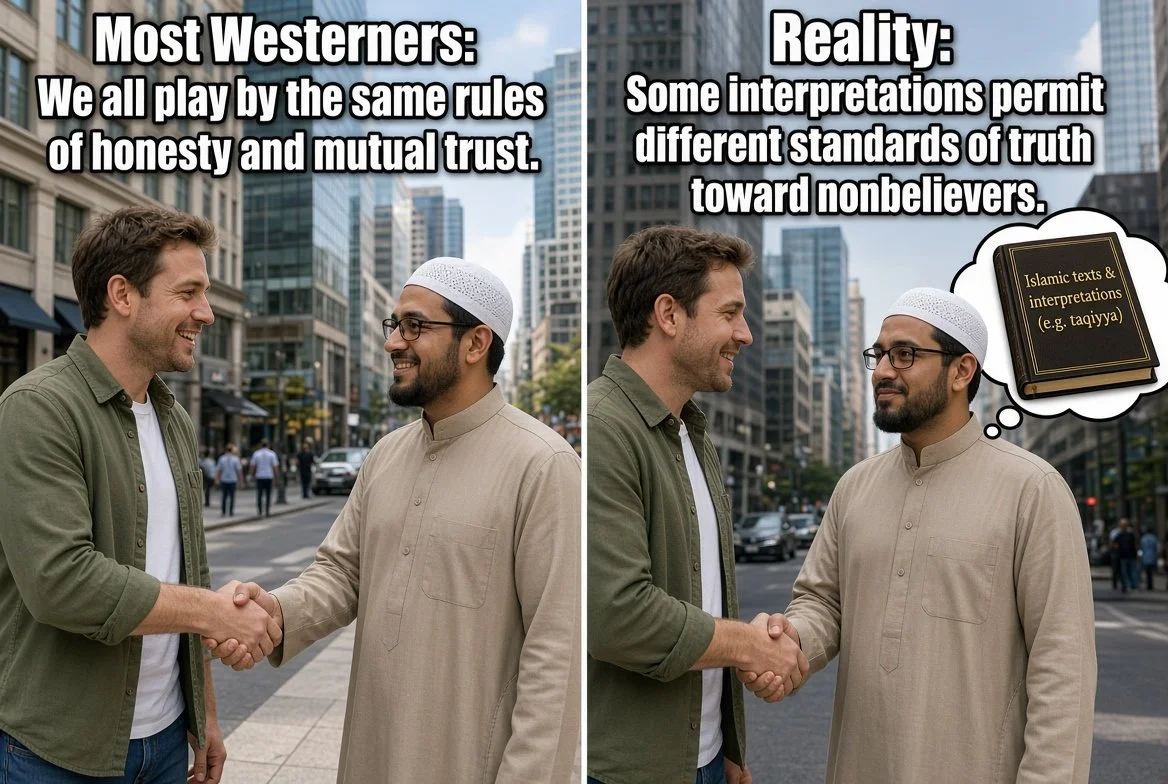
We cannot automatically assume that individuals or communities unwilling to integrate into Western society share its cultural values, civic expectations, or standards of conduct. That becomes particularly dangerous when religious interpretations are used to justify conduct that conflicts with the principles of honesty, accountability, and equal treatment under the law.
The result can be two teams playing the same game under two different sets of rules. Those who embrace such interpretations understand the distinction. Most Westerners are barely aware that it exists. And that ignorance creates a vulnerability in any society built on mutual trust.The central issue is not whether Islam universally commands Muslims to lie to nonbelievers. It is whether Islamic religious texts and traditions CAN be interpreted to justify deceiving nonbelievers. The answer is yes.
That distinction matters because religious teachings do not have to command a particular behavior universally to provide a justification for individuals who choose to engage in it. Many western countries are screwed. It’s over and they just don’t know it yet
The textual foundation
Islamic scripture and jurisprudence contain several provisions that can be interpreted to permit deception under particular circumstances.
Quran 3:28 addresses relationships between believers and unbelievers, including an exception involving precautionary protection. Some classical interpretations permit concealment when believers face danger from nonbelievers.
Quran 16:106 permits outward denial of faith under coercion while maintaining inward belief. This is one foundation for taqiyya, the concealment of religious identity or convictions under threat.
Sahih al-Bukhari 3030 states that warfare involves deception. The danger arises when an extremist interprets political, cultural, or religious competition as a form of continuing warfare and attempts to extend that permission beyond actual military conflict.
Sahih Muslim 2605 recognizes exceptions concerning warfare, reconciliation, and relations between spouses.
Tawriya is a recognized concept in Islamic jurisprudence involving statements with more than one possible meaning. Under certain interpretations, it permits a speaker to intend a technically truthful meaning while deliberately allowing the listener to understand something false.
None of these sources, individually or collectively, establishes an unrestricted right to deceive non-Muslims. But their existence creates interpretive possibilities that can be exploited.
Why this can become dangerous
The danger is greatest when three conditions occur together:
Religious exceptionalism: A group believes its religious obligations supersede the laws and civic obligations of the society in which it lives.
Social separation: Its leadership discourages meaningful participation in broader civic institutions, reinforcing an insider-versus-outsider mentality.
Moral justification for deception: Religious exceptions originally associated with persecution, warfare, or other limited circumstances are expanded to justify misleading outsiders.
Under those conditions, deception can become more than an individual moral failure. It can become an instrument for protecting institutional interests, concealing misconduct, or pursuing ideological objectives.
That possibility deserves serious scrutiny regardless of the religion involved.
The assimilation question
A secular democracy depends on shared civic obligations. Citizens do not have to abandon their religion, language, or cultural traditions. They do, however, have to accept that civil law applies equally to everyone.
A community that rejects the authority of civil law, discourages accountability to outsiders, and treats deception of nonmembers as religiously permissible creates a serious problem for social trust.
The problem becomes especially consequential when such interpretations are used to justify dishonesty in government, public benefits, education, law enforcement, or political activity.
However, religious separation alone does not establish dishonesty, and the existence of permissive interpretations does not establish that a particular Muslim community follows them. Those conclusions require evidence of actual teaching, conduct, or institutional practice.
The larger issue
Religious freedom protects the right to believe and practice a faith. It does not create an exemption from laws against fraud, perjury, corruption, or other misconduct.
A democratic society has every reason to scrutinize religious leaders or organizations that explicitly teach followers that deceiving outsiders is acceptable. That scrutiny should focus on documented teachings and behavior rather than assuming that an entire religious population shares an extremist interpretation.
The fundamental danger is the transformation of a limited religious exception into a broad moral license to deceive outsiders. When that interpretation is combined with rejection of common civic obligations, it can undermine the trust on which a pluralistic society depends.
That is the strongest version of the argument: Islamic texts can be read to justify deception in specified circumstances, and expansive interpretations can become dangerous when used to excuse dishonest conduct toward nonbelievers.