
NYSE Texas?
Segment #886
The main New York Stock Exchange (NYSE) on Wall Street is not actually pack-and-moving its entire operation or its iconic trading floor to Texas. However, they have already established a massive, official presence there. The NYSE launched a dedicated, fully electronic exchange in Dallas called NYSE Texas, which officially opened for business on March 31, 2025.

How NYSE Texas Was Created
Instead of moving the physical building from Manhattan, the NYSE’s parent company (Intercontinental Exchange) took its existing, 143-year-old Chicago-based electronic exchange (NYSE Chicago), reincorporated it in Texas, and rebranded it as NYSE Texas.
The Timeline: The plan was announced in February 2025, and because the technical infrastructure was already in place, the exchange went live just a month later on March 31, 2025.
Current Status: As of 2026, NYSE Texas is fully operational in Dallas and already features over 100 dual-listed companies (including high-profile listings like Trump Media & Technology Group).
Why the Stock Market is Heading to Texas
Texas has been rapidly developing its own financial hub, cheekily dubbed "Y'all Street." The NYSE's quick move to set up shop in Dallas was largely driven by two things:
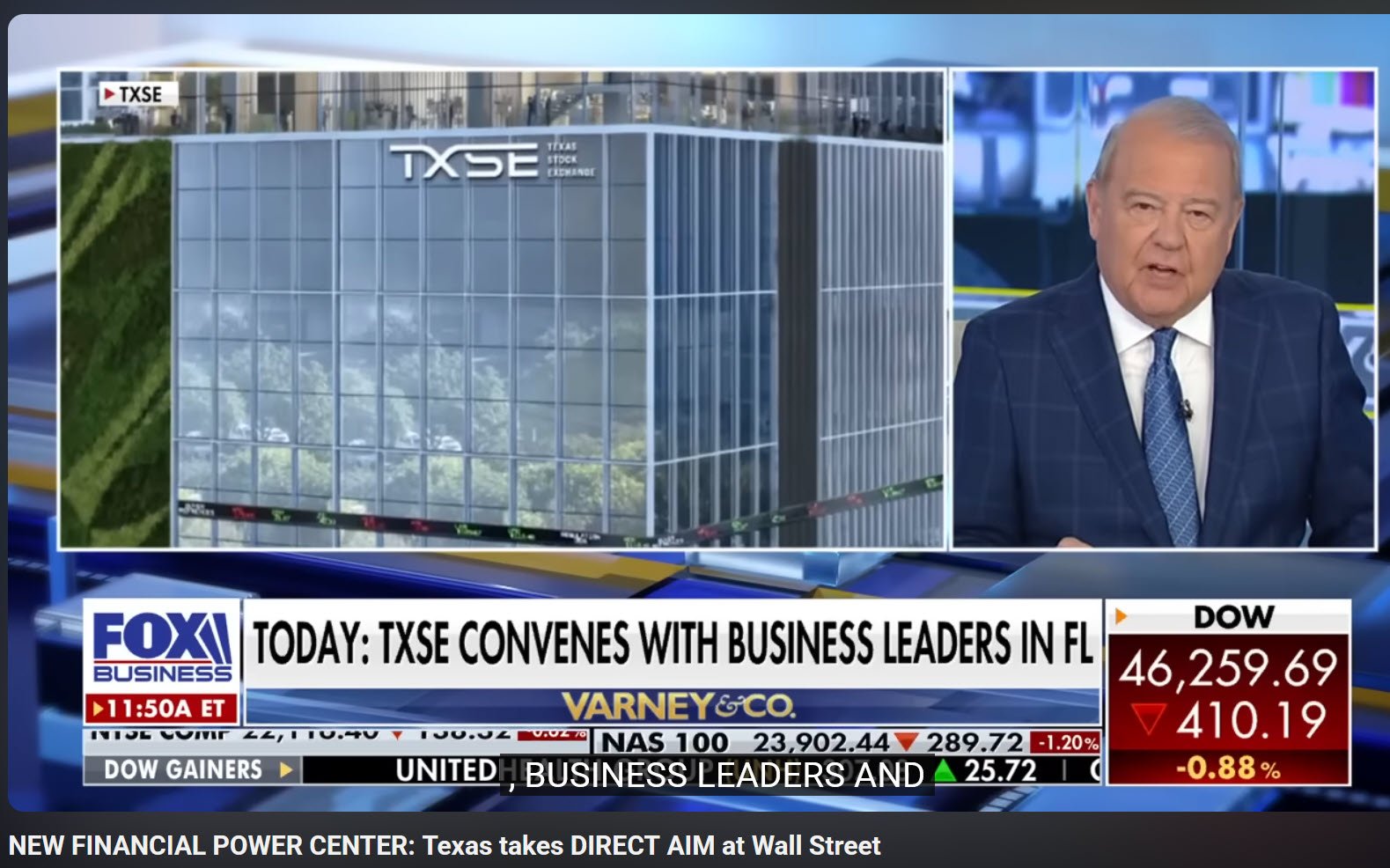
Texas Gov. Greg Abbott joins 'Varney & Co.' to discuss the July 2026 opening of the Texas Stock Exchange and NASA's Artemis II mission
Impact of New York Stock Exchange - Texas
A Massive Local Market: Texas is home to more NYSE-listed companies than any other state, representing trillions of dollars in market value.
Heavy Competition: A brand-new, independent competitor called the Texas Stock Exchange (TXSE)—backed by major Wall Street heavyweights like BlackRock and Citadel Securities—received SEC approval and is launching its own Dallas-based national exchange in 2026. The NYSE wanted to beat them to the punch.
What is the Difference?
While the historic building and physical floor brokers remain at 11 Wall Street in New York, NYSE Texas operates as a fully electronic exchange out of Dallas. It allows companies to dual-list, giving them access to Texas's highly favorable corporate laws, shareholder litigation protections, and pro-business tax environment.
The launch of the Texas Stock Exchange (TXSE) represents one of the most significant structural shifts in U.S. capital markets in decades. Fully approved by the SEC and backed by $270 million in funding from heavyweights like BlackRock, Citadel Securities, JPMorgan Chase, Goldman Sachs, and Bank of America, this Dallas-headquartered exchange is preparing for a full launch.
The creation of the TXSE introduces a powerful alternative to the New York-centric "Y’all Street" movement, carrying profound implications across three distinct levels: internationally, nationally, and within the state of Texas itself.
International Impact: A New Gateway to U.S. Capital
For global markets, the TXSE introduces a new, competitive entry point into the world's most liquid capital ecosystem.
Global Listings and ADRs: The TXSE is positioning itself as a highly attractive venue for international companies looking to tap into U.S. capital. By facilitating the listing of American Depositary Receipts (ADRs), it gives foreign issuers a direct route to global investors.
Geopolitical and Governance Arbitrage: Many international companies have grown wary of the stringent, highly politicized, and expensive ESG (Environmental, Social, and Governance) compliance mandates of the NYSE and Nasdaq. The TXSE offers a more streamlined, partner-focused regulatory environment, which could entice international firms—particularly from Europe, Latin America, and Asia—seeking U.S. liquidity without the heavy regulatory friction
A Magnified Global Economic Profile: Texas' economy is already the 8th largest in the world (on par with countries like Italy and Canada). Establishing its own national securities exchange elevates the state from a regional powerhouse to a sovereign-level financial hub on the global stage.
National Impact: Disrupting the Duopoly
For nearly a century, Wall Street—anchored by the NYSE and Nasdaq—has held a virtual duopoly on national stock listings. The TXSE is a direct challenge to this status quo.
Breaking the NYSE/Nasdaq Duopoly: By offering double-listings (allowing companies to list on both TXSE and NYSE/Nasdaq), the TXSE is introducing direct, aggressive competition. This rivalry is expected to drive down listing fees and compliance costs nationwide, forcing the legacy New York exchanges to innovate and lower their own barrier-to-entry pricing.
Reversing the "Shrinking Public Market" Trend: Over the past 25 years, the number of publicly traded companies in the U.S. has plummeted by over 45% due to the overwhelming costs and litigation of going public. By establishing a lower-friction, business-friendly listing model, the TXSE aims to make IPOs viable again for small-to-mid-cap national companies.
The Rise of the "Southeast Quadrant" (SeQ): The TXSE is targeting a massive, underserved geographic region. The "Southeast Quadrant" of the U.S. (stretching from Texas to North Carolina) contains roughly 1,000 public companies and over 14,000 sponsor-backed private companies. The TXSE serves as a physical and symbolic home for this economically surging half of the country, pulling the financial center of gravity away from Manhattan.
Impact within Texas: Solidifying "Y'all Street"
Locally, the TXSE is the crowning achievement of Texas' multi-decade corporate migration boom, signaling that the state is no longer just a hub for operations, but the ultimate hub for capital.
Anchoring the Corporate Migration: Over the last decade, dozens of Fortune 500 companies (including Tesla, Hewlett Packard Enterprise, and Chevron) have relocated their headquarters to Texas. Having a local, world-class exchange gives these companies—and the 1 in 10 U.S. public companies already based in Texas—a powerful, brand-aligned venue to list their shares close to home.
Economic Windfall and Job Creation: Headquartered in Downtown Dallas, the physical footprint of the exchange (the Texas Market Center) will create high-paying jobs in market operations, financial technology, compliance, and corporate law. It elevates Dallas' status as the second-largest financial hub in the U.S. by industry employment.
Favorable Regulatory and Legal Ecosystem: Texas recently established a specialized Texas Business Court system designed to handle complex corporate litigation quickly and predictably. Combined with state-level policy support and the TXSE’s partner-centric model, Texas businesses will benefit from lower litigation risks and cheaper Directors and Officers (D&O) insurance.
Unlocking Regional Venture and PE Capital: Texas has an enormous pipeline of private-equity-backed firms. The TXSE provides a streamlined "exit ramp" for these local companies to transition from private to public, keeping the generated wealth, investment capital, and entrepreneurial ecosystem entirely within the state.
Impact in Dallas
The physical presence of the Texas Stock Exchange (TXSE) in Downtown Dallas acts as a massive accelerant for the city's economy, officially cementing Dallas as the secondary financial capital of the United States.
The launch of the TXSE—coupled with major moves from legacy competitors—directly impacts Dallas across several key areas:
The Consolidation of "Y'all Street"
For years, the Dallas-Fort Worth (DFW) metroplex has quietly built a massive financial sector. The arrival of the TXSE acts as the anchor for this ecosystem, which locals and Wall Street insiders now call "Y'all Street."
The Talent Magnet: DFW already boasts the second-largest concentration of financial services jobs in the nation, trailing only New York. The physical exchange will draw top-tier traders, quantitative analysts, securities attorneys, and fintech engineers to the city.
A Hub for Major Firms: Financial giants aren't just investing in the TXSE; they are physically moving to Dallas. Goldman Sachs is building a massive, $500 million campus in downtown Dallas, Charles Schwab is headquartered in nearby Westlake, and institutions like Vanguard, Deloitte, and JPMorgan Chase have exponentially expanded their local footprints.
The "Stock Exchange Shootout" in Dallas
The TXSE has triggered a highly competitive geographical migration. Dallas is no longer just hosting a regional startup exchange; it has become the battleground for the future of U.S. stock trading:
The NYSE Moves In: Recognizing the threat of the TXSE, the New York Stock Exchange countered by relocating its Chicago-based electronic exchange to Dallas, rebranding it as NYSE Texas.
Nasdaq Expands: Nasdaq has opened a major corporate office in Dallas to directly service the hundreds of Texas-based companies listed on its exchange and defend its market share.
With the TXSE, NYSE Texas, and Nasdaq all operating major hubs out of Dallas, the city has successfully broken Manhattan's century-long geographic monopoly on national exchange infrastructure.
Local Economic and Real Estate Windfall
The downstream effects on the Dallas economy are highly tangible, transforming the local business landscape:
Commercial Real Estate Boom: The physical offices, data center redundancies (utilizing major Dallas hubs like Equinix DA11), and headquarters for the TXSE are breathing new life into Dallas's commercial real estate sectors.
Professional Services Growth: A stock exchange requires a massive supporting cast. Local Dallas law firms, corporate accounting practices, public relations agencies, and compliance consultants are rapidly expanding their teams to handle the influx of listing companies and regulatory filings.
Local Capital for Dallas Startups: The presence of a local exchange makes it significantly easier for North Texas startups and mid-market private equity firms to secure funding. It creates a seamless, regional pipeline from early-stage venture capital to a public IPO, all without founders ever having to board a flight to New York.