
Delaware - Friendly to Business?
Segment #885
Breaking News from Newsmax.com
Dell Leaves Delaware for Texas, $3 Trillion Quits State
Dell Technologies is the latest major corporation to abandon Delaware as its legal home, marking another high-profile move in what analysts describe as a rapidly accelerating corporate exodus from the state. The company announced Monday that its board has unanimously approved a plan to re-domesticate from Delaware to Texas. With a market capitalization of roughly $137.6 billion and an enterprise value exceeding $158 billion, Dell becomes one of the largest companies to formally sever ties with Delaware’s corporate system.
But Dell’s decision is part of a much larger trend of significant public companies exiting the left-leaning Blue State that has strongly embraced anti-business and woke policies in recent decades. What started as a trickle of exiting companies turned into a stampede over the past two years, with more than 60 public companies representing over $3 trillion in combined market value having left Delaware. Just last week, NYSE-listed technology firm Samsara, with a market cap of over $17 billion, announced it had left Delaware for Nevada after a shareholder vote.
Dozens more have already exited Delaware, including Tesla, SpaceX, Coinbase, Roblox, Dropbox, Dillard’s, and Simon Property Group. Other companies continue to line up shareholder votes to follow suit, signaling that the pace of departures may accelerate further. Even more telling is the behavior of companies that skipped over Delaware in the first place. Exxon Mobil, one of the world’s largest corporations with a market cap above $600 billion, recently opted to move its incorporation from New Jersey directly to Texas—bypassing Delaware entirely.
For decades, Delaware’s Court of Chancery was viewed as the premier venue for resolving corporate disputes, offering expertise and predictability. But that reputation is gone. Corporate executives and analysts now argue that Delaware’s legal environment has become less predictable and more costly, especially as trial lawyers have donated heavily to the state’s Democratic political machine for influence.
A primary concern is the rise in shareholder litigation, with companies citing what they describe as “opportunistic” or “meritless” lawsuits. These cases are often settled quickly to avoid prolonged legal battles, resulting in substantial fees for trial attorneys but limited benefits for shareholders. With big money at work, Delaware's judges no longer see the law as black and white. Harvard professor emeritus Alan Dershowitz has called the state's judiciary "one of the most corrupt in the nation." The renowned lawyer has said corporations and their boards put themselves at serious risk by staying domiciled in Delaware.

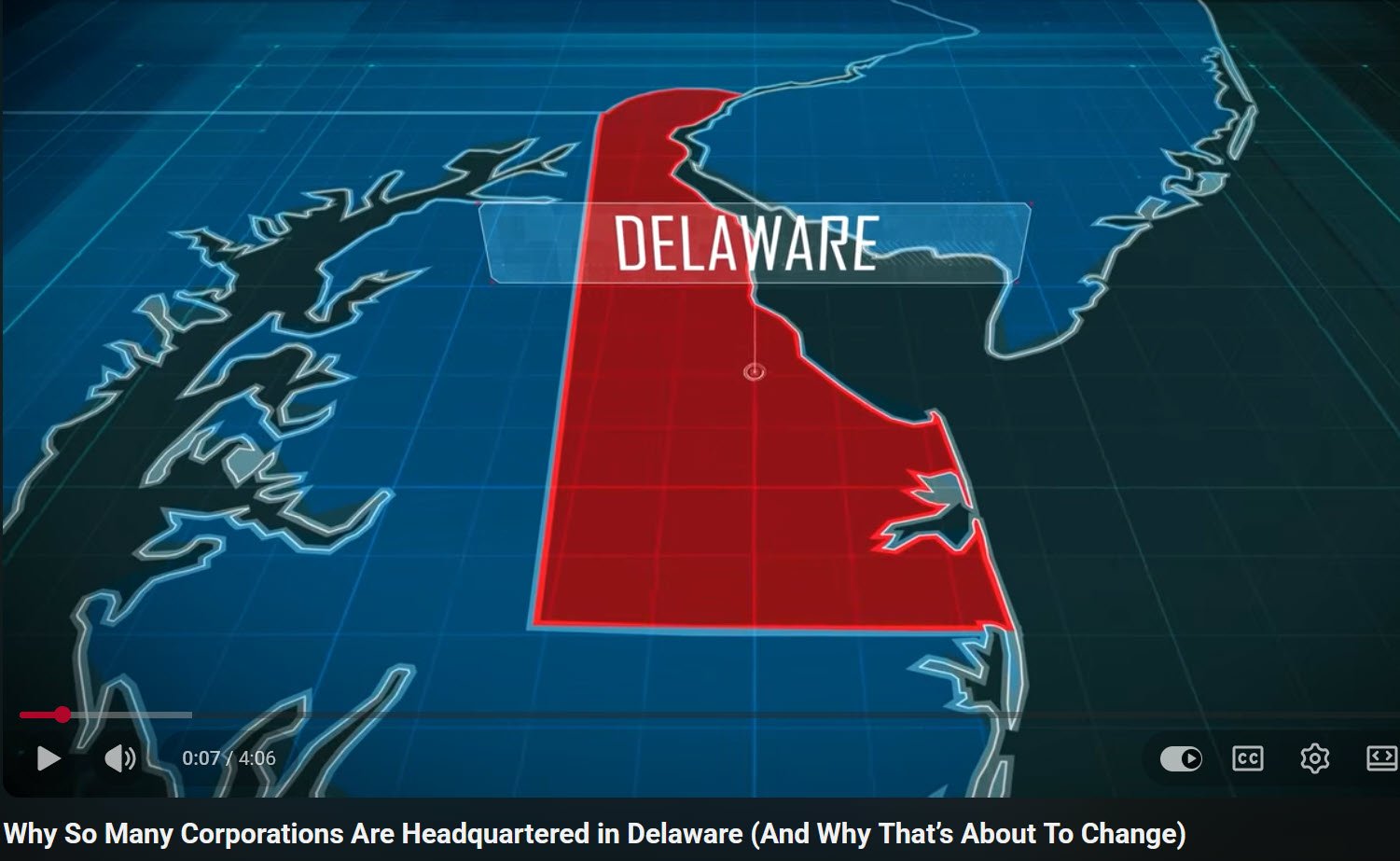
Big name companies from Tesla and Meta to Roblox and Dropbox have left or are considering leaving Delaware, long the king of U.S. corporate law. Most of the country’s biggest companies including Amazon and Google are incorporated in Delaware, but after a series of controversial court decisions, a wave of companies are looking at an exit. Business incorporation accounted for nearly 30% of revenue for DE in 2024, so what’s at stake for the state?
In 2023, Dell settled the case for $1 billion, the largest in Delaware Chancery Court history. The court also awarded five plaintiff trial attorney firms involved in the case a fee award of $267 million. Critics say the system has created a feedback loop in which legal firms are incentivized to file suits, increasing costs for corporations through higher insurance premiums and legal expenses. "Delaware's once-esteemed Court of Chancery is increasingly viewed by corporate leaders as unpredictable, with rulings that introduce uncertainty into routine business decisions and open the door for enterprising trial attorneys to file lucrative lawsuits," Karen Harned, a former director of the National Federation of Independent Business Legal Center, recently wrote in DelawareOnline.com.

Delaware has long been America’s corporate capital and is home to more than a million businesses, including half of the Fortune 500. But today, the state is facing a crisis. From Elon Musk’s legal battles to companies rethinking incorporation, Delaware’s dominance is being challenged. In this video, we break down why Delaware became the go-to place for corporations, what’s changing now, and what it means for the future of American business.
Some business leaders point to what they describe as increasingly "woke" or left-leaning policies in Delaware, arguing that the state's political climate is less aligned with business interests than it once was. As Delaware's dominance wanes, Texas has aggressively positioned itself as a pro-business alternative.
A key factor is the creation of the Texas Business Court in 2024, designed to handle complex corporate disputes with greater speed and predictability. Business leaders say the court offers a streamlined, codified legal framework that reduces uncertainty compared to Delaware's case-law-driven system. State officials have also emphasized regulatory reforms, tax advantages, and a broader business-friendly environment. Texas Gov. Greg Abbott welcomed Dell's move, calling it evidence that companies thrive when they are "welcomed, not punished." The state's appeal is further strengthened by the fact that many companies already maintain significant operations there.
The implications for Delaware are significant. For over a century, the state has relied heavily on incorporation fees and its reputation as the nation's corporate capital. But with trillions in market value leaving — and more companies considering similar moves — its long-standing dominance is being challenged. Industry observers say the shift reflects a broader realignment in corporate America, as companies seek jurisdictions that offer what Delaware once provided: stability, predictability, and a fair legal system. Dell's departure underscores a clear message: the balance of power in corporate law is changing — and the migration away from Delaware is no longer hypothetical.
Shareholders are expected to vote on the proposal at Dell's annual meeting on June 25.
Dell Leaves Delaware for Texas, $3 Trillion Quits State | Newsmax.com