
NCAA and the WNBA Have Lost Control
Segment #1027
The NCAA and WNBA Have Lost Control — But for Very Different Reasons
The NCAA and the WNBA have very different problems, but they are arriving at a remarkably similar place. Both appear to be losing control of their sports while becoming increasingly disconnected from many of the fans whose money, attention and loyalty ultimately make those sports possible. For the NCAA, the crisis is about the rapidly disappearing distinction between college and professional athletics. For the WNBA, the issue cuts closer to the reason women's sports exist as a separate category in the first place: what defines eligibility for women's competition?
Neither issue is going away, and neither organization can solve its problem by pretending the underlying question does not exist.
The NCAA: Keep College College and the Pros Pro
College athletes deserved greater economic rights. The old NCAA model had become increasingly difficult to defend when universities, conferences, coaches and television networks were generating billions of dollars while athletes faced severe restrictions on their own ability to earn money. Something had to change. But correcting an unfair system did not require erasing the distinction between college athletics and professional sports.
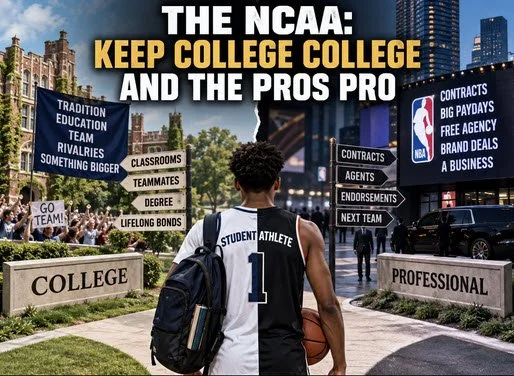
That distinction is now disappearing at breathtaking speed. NIL was supposed to allow athletes to profit from their names, images and likenesses, but it quickly became intertwined with recruiting and player retention. The transfer portal increasingly resembles professional free agency. Revenue sharing pushes major college athletics further toward direct professional compensation. Agents, collectives, lawsuits, conference realignment and competing state laws have created a system in which the NCAA often looks less like the governing body of college sports than an organization desperately trying to catch up with a revolution it no longer controls.
What has emerged is a strange hybrid: professional economics wearing college uniforms. The NFL and NBA at least acknowledge what they are. They have contracts, collective bargaining agreements, salary structures, defined free-agency rules and established relationships between labor and management. College athletics increasingly has the money, player movement and negotiating behavior of professional sports without an equally coherent professional structure.
Something more important than administrative order may be disappearing in the process. College teams traditionally represented universities, and the connection between player, institution and fan was a central part of the product. Athletes attended the school, developed within its program and often became identified with the university. Rivalries mattered because the institutions mattered. The uniform represented something larger than whichever athlete happened to be wearing it that season.
That relationship becomes harder to maintain when players increasingly resemble temporary free agents moving from school to school in pursuit of better financial or athletic opportunities. There is nothing inherently wrong with an athlete pursuing the best opportunity available, but eventually the fan is entitled to ask what exactly remains “college” about the product.
Nobody should begrudge athletes the right to earn money. The question is whether there remains any meaningful boundary between college athletics and professional sports. If major college football and basketball are going to become professional leagues associated with universities, then perhaps everyone should simply admit it and build the appropriate structure around that reality. But if these are still supposed to be college sports, there has to be something distinctly collegiate about them.
The NCAA's great failure has been its inability to decide which system it is governing. It defended the old amateur model long after that model became untenable and then watched the replacement system race toward professionalization without establishing a coherent stopping point. College sports now risk becoming minor-league professional sports financed by television networks, boosters and universities while retaining the language and traditions of amateur collegiate competition.
At some point, the NCAA has to decide: keep college college and the pros pro—or admit that the distinction no longer exists.
The WNBA: A Women's League Has to Define the Women's Category
The WNBA faces a fundamentally different challenge. Women's professional basketball exists as a separate competitive category because physical differences between men and women matter in elite athletic competition. That principle is not incidental to women's sports; historically, it is a major reason a protected women's category exists at all.
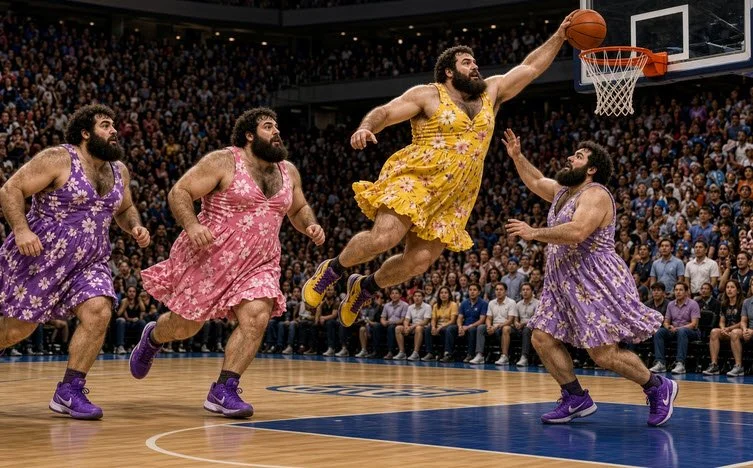
That makes questions surrounding transgender eligibility in women's sports difficult to avoid indefinitely. Whatever one's political or cultural views, a women's professional sports organization ultimately has to be able to explain who qualifies for its competitive category and the sporting principles on which that determination is based.
This need not be a judgment about anyone's dignity, civil rights or ability to live as they choose. It is a question about competitive classification. Sports draw boundaries constantly. Athletes compete in categories defined by age, weight, sex, disability and other characteristics because physical differences can affect meaningful and fair competition. The existence of women's sports itself rests on the proposition that sex is one of those relevant distinctions.
The WNBA therefore cannot treat the definition of the competitive category at the center of its own existence as merely a political question better left unanswered. It needs rules that are clear, defensible and grounded in competitive fairness. If biological sex is not relevant to eligibility for women's professional basketball, the league eventually has to explain what principle justifies maintaining a separate women's category. If biological sex is relevant, then the league has to establish where the eligibility boundary lies and be prepared to defend it.
Avoiding the issue may appear politically safer in the short term, but ambiguity carries its own risks, particularly because women's sports have become part of a much larger national debate. A governing organization that cannot clearly explain the organizing principle of its own competitive category leaves the definition to politicians, activists, courts, players and social media. That is another form of surrendering control.
The timing makes the problem more consequential. The WNBA has finally achieved something it pursued for decades: broad mainstream attention. Television audiences have expanded, attendance has risen, sponsorship has grown and a new generation of stars has brought millions of people into women's basketball who previously paid little attention to it. The league has an extraordinary opportunity to convert that surge of curiosity into long-term loyalty.
But a new audience is an opportunity, not an entitlement. Fans do not owe the WNBA their loyalty. Sponsors do not owe it advertising dollars, and television networks do not owe it ever-increasing rights fees. The league has to earn and retain that support by producing compelling basketball and maintaining confidence in the integrity of its competition. If a meaningful portion of the audience concludes that league leadership is unwilling to address basic questions affecting competitive fairness, those customers have another option available every night: they can simply stop watching.
The Constituency Both Organizations Cannot Control
This is where two very different problems finally converge. The NCAA is wrestling with money, professionalism and the erosion of the traditional relationship between athlete and university. The WNBA faces questions about governance, competitive credibility and the definition of the women's category itself. Yet both organizations operate in environments increasingly dominated by arguments among athletes, administrators, lawyers, owners, agents, activists, politicians, broadcasters and sponsors.
Lost in all of that is the constituency with the simplest and ultimately most powerful vote: the fan.
The NCAA can rewrite eligibility rules. Courts can rewrite compensation rules. Conferences can chase television contracts, schools can change conferences, athletes can transfer and agents can negotiate ever-larger deals. None of them, however, can force alumni and fans to remain emotionally invested in college teams they gradually cease to recognize.
The same applies to the WNBA. The league can negotiate contracts, issue statements, discipline players, expand franchises and participate in broader cultural debates, but it cannot order Americans to watch women's basketball. Professional sports are entertainment businesses operating in an intensely competitive marketplace for people's time and money. That elementary economic reality can get lost remarkably quickly when everyone inside the institution becomes consumed with fighting everyone else inside the institution.
Fans can change the channel. Alumni can stop donating. Season-ticket holders can stop renewing. Sponsors can move their advertising budgets elsewhere. Networks that enthusiastically purchased yesterday's growth story can become considerably less enthusiastic if audiences stop growing. None of these decisions has to occur dramatically. Institutional decline rarely begins with a stadium suddenly becoming empty. It begins when people care a little less, watch a little less, donate a little less and eventually discover that they no longer miss what they once followed religiously.
That is the real danger facing both organizations. The NCAA risks turning college athletics into minor-league professional sports while continuing to market the traditions and emotional attachments of college competition. The WNBA risks allowing political and institutional battles—including the question of how the women's competitive category is defined and protected—to distract from an extraordinary opportunity to build a much larger permanent audience.
These are different problems, but they carry the same warning. The people running sports can change rules, compensation systems, eligibility requirements, contracts and organizational structures. What they cannot manufacture is genuine fan loyalty once they have squandered it.
The NCAA needs to decide whether college sports are still meaningfully college sports. The WNBA needs to articulate and defend the principles that define women's professional competition. Both need to understand that their institutions ultimately survive not because administrators, lawyers, activists or athletes declare them important, but because millions of ordinary people continue to believe they are worth watching.
In the end, the fans get the last vote—and they cast it simply by watching or walking away.
I kept the strongest lines, but used them as conclusions to developed paragraphs rather than constant interruptions. The result should read much more like a serious, hard-hitting op-ed.