
Nick Shirley in 3rd World Oakland
Segment #967
Reality on the Ground
In his street-level videos on Oakland—specifically his short documentary ***Dregs of the City: Oakland*** and his live stream ***IRL Inside America's 3rd World City | Oakland***—Nick Shirley takes his camera directly into the city's most troubled neighborhoods to document the severe urban decay and lack of law enforcement. Shirley's footage in these videos is raw and confrontational, designed to show what he frames as the failure of local government policies. Here is a summary of what he captured on the ground:
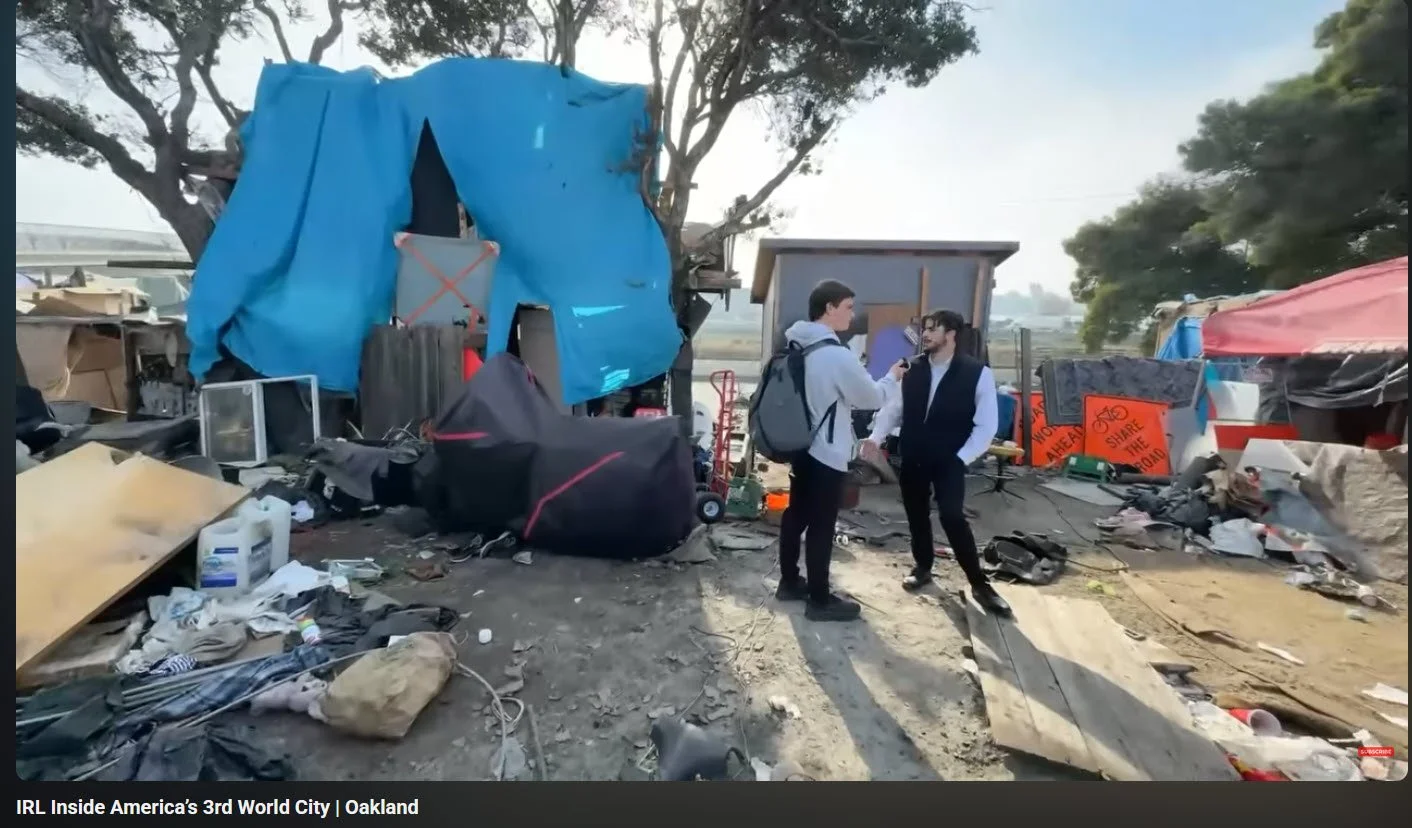
Nick Shirley explores the streets and encampments of Oakland, California, documenting the severe living conditions and high crime rates. Guided through the San Antonio district, the stream reveals the stark reality of the city's homelessness crisis and public safety challenges.
The "Shantytowns" and Encampments: Shirley toured massive, unregulated homeless encampments—often described as shantytowns—where people live in dilapidated RVs, makeshift tents, and structures built from scavenged materials. His footage highlights the extreme squalor, towering piles of trash, and the complete lack of sanitation or running water in these sprawling, city-block-sized camps.
The Open-Air Drug Crisis: Throughout his Oakland coverage, Shirley films the brutal reality of the city's addiction crisis. He captures footage of individuals in the severe throes of fentanyl and meth addiction, documenting open-air drug use and the erratic, tragic behavior of people suffering on the streets in broad daylight.
Prostitution and Pimps: A major focus of independent street journalism in Oakland centers on areas like International Boulevard, which has gained national infamy for its highly visible, open-air sex trade. Shirley's footage delves into these corridors, capturing the brazenness of the prostitution rings. He documents sex workers operating in the middle of the day and the presence of pimps coordinating the illicit trade with little to no visible police intervention.
The "Oakland Pirates": One of the most unique and jarring aspects Shirley highlighted in his Dregs of the City documentary was the phenomenon of the "Oakland Pirates." He documented homeless individuals who have taken to the Oakland Estuary, living on stolen, sunken, or abandoned boats, and scavenging or raiding other vessels in the harbor.
The Takeaway: Shirley uses this gritty, unvarnished footage to build a broader narrative. By pointing his camera at the pimps, drug markets, and shantytowns, he aims to shock the viewer and argue that taxpayer funds and local leadership have completely failed to maintain basic public safety and dignity in one of America's major cities.
Nick Shirley’s street-level coverage taps into very real, deeply entrenched challenges that Oakland faces. Independent journalists and creators often emphasize the shock factor to capture attention, but the actual reality on the ground is a mix of extreme crisis, immense local frustration, and an ongoing, high-stakes battle over policy and funding.
Where this situation is going depends heavily on how the city, state, and community respond to these specific issues.
The Reality Behind the Footage & Current Trajectory
First, the institutional design of the state's response created a massive bureaucratic industry that operates without consequence for failure. By routing billions of dollars through over forty separate, uncoordinated programs, the state political leadership constructed a highly fragmented web of agencies, non-profits, and local developers. This decentralized structure means that no single entity or political leader bears ultimate responsibility for the results on the street. The state points to the counties, the counties point to the cities, and the cities point to their non-profit contractors. This lack of a centralized chain of command is exactly how twenty-four billion dollars can disappear into the system without anyone being held accountable for the fact that the street population grew by thirty thousand people during the exact same timeframe.
Second, the state explicitly chose to bypass basic operational standards that any private business or functional government would mandate. The decision by the California Interagency Council on Homelessness to stop gathering outcome data and tracking expenditures is not a passive mistake; it is a profound failure of basic oversight. In any standard administrative framework, funding is strictly contingent on hitting performance targets. By handing out massive block grants under initiatives like the Homeless Housing, Assistance and Prevention program while failing to track where the money went or whether recipients returned directly to the streets, the system insulated itself from scrutiny. This complete lack of tracking allowed billions to flow continuously to local municipal programs and politically connected organizations regardless of whether those groups were actually reducing the number of people suffering on the sidewalk.
Third, this operational structure created a powerful status quo that resists course correction. Because a vast ecosystem of non-profits, consultants, and service providers became entirely dependent on the continuous flow of state grants, a multi-billion dollar industry developed around managing the crisis rather than solving it. When a system rewards organizations based on the volume of services rendered or temporary beds managed, rather than the number of people successfully transitioned off the streets and out of addiction, it builds a powerful counter-incentive. True resolution would shrink the very budgets and influence these agencies rely on.