When Words Put a Target on Someone's Back
Segment #1029
The controversy surrounding the lone holdout juror in the Lindsay Clancy trial raises a question much larger than one juror, one lawyer or one sensational criminal case. It forces us to confront something that has become increasingly dangerous in the age of social media: when does attacking someone publicly cease to be criticism and become the equivalent of painting a target on that person's back?
After the Clancy jury deadlocked 11–1, defense attorney Kevin Reddington publicly blamed the lone holdout, saying that the juror had "robbed" Clancy and the other jurors. The defense had previously sought to have the juror removed, arguing that he was refusing to follow the law, but the judge declined to do so. (People.com)
Reddington has every right to be furious about the outcome. He has every right to criticize the legal system, the judge's ruling and even the reasoning he believes produced the mistrial. The juror, however, presents a different problem. He is not a politician, television personality or activist who sought public attention. He is an ordinary citizen whom the government summoned to perform a compulsory civic responsibility. Whatever one thinks of his decision, publicly turning him into the villain of an emotionally explosive national story creates a foreseeable danger. The court apparently recognizes that danger: after the mistrial, the identities of the jurors remained protected because of safety concerns. (CT Insider)
But the principle should not stop with jurors.
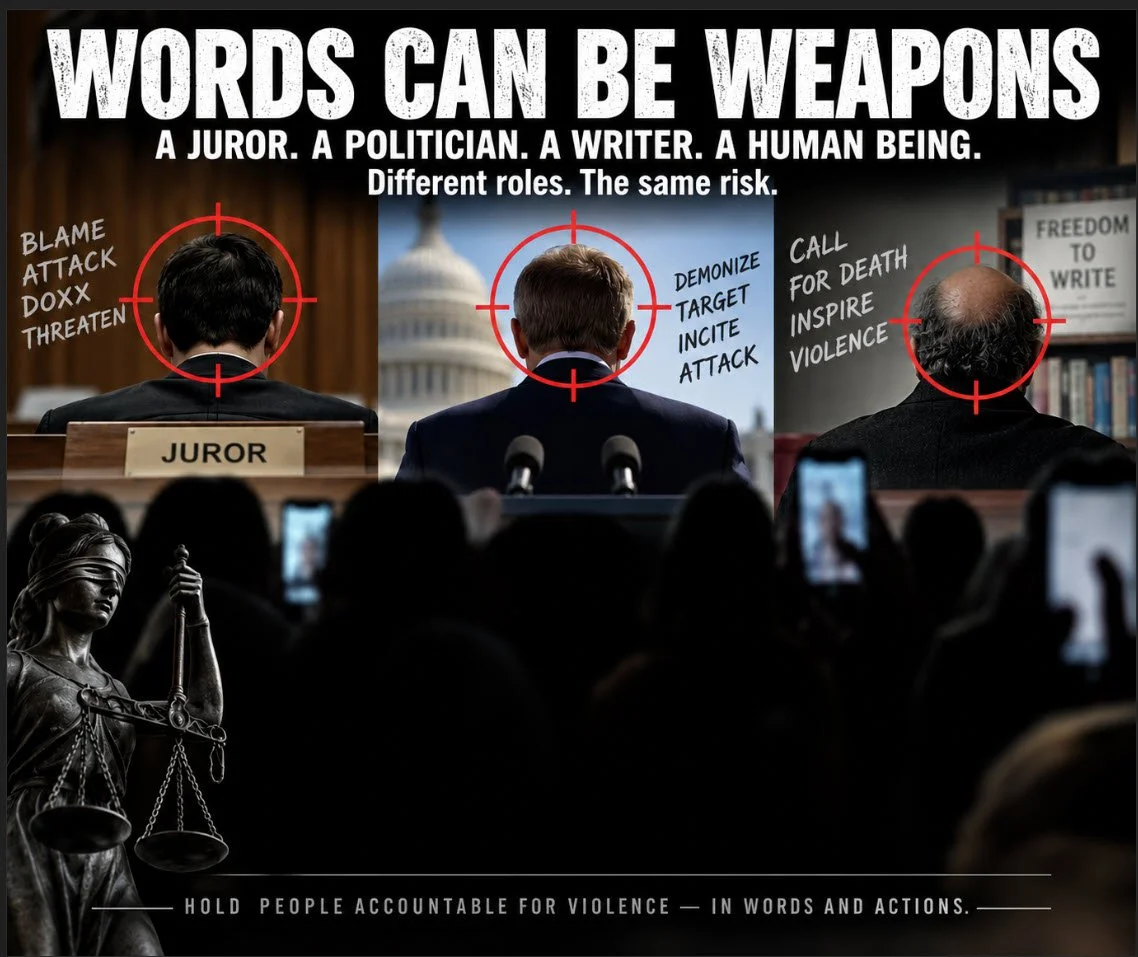
America has entered an era in which politicians, judges, journalists, commentators, celebrities and ordinary citizens can be transformed almost instantaneously from people into targets. A person with an audience of millions can identify an enemy in the morning, and by afternoon thousands of strangers can be searching for that person's home, family, employer and daily routine. Most will do nothing. A few may send vile messages. But it takes only one unstable, fanatical or violence-prone follower to convert rhetoric into bloodshed.
We therefore need to distinguish three very different things that are too often thrown together.
There is criticism, which must remain protected. There is reckless demonization, which may be reprehensible but is usually constitutionally protected. And then there is the deliberate encouragement of violence against an identifiable human being. That third category is where society has a legitimate interest in imposing serious consequences.
The distinction matters enormously. We cannot have a law under which saying that a politician is "destroying America," calling a prosecutor corrupt, saying a judge should be removed, or declaring that a juror reached a disgraceful decision becomes criminal merely because some disturbed person later commits violence. That would destroy political speech and give the government extraordinary power to punish its critics.
History nevertheless demonstrates that calls for killing can become something very different from political hyperbole.
Salman Rushdie provides perhaps the clearest modern example. In 1989, Iran's Ayatollah Ruhollah Khomeini issued a fatwa calling for Rushdie's execution because of The Satanic Verses. More than three decades later, Hadi Matar rushed onto a stage in New York and repeatedly stabbed Rushdie. This is no longer a matter of commentators speculating about whether inflammatory rhetoric somehow influenced an attacker. Federal prosecutors established that Matar was attempting to carry out the fatwa. Evidence showed that he had researched it and its continuing validity for more than a year before attacking Rushdie. In July 2026, a federal jury convicted him of terrorism-related offenses arising from the attack. (Department of Justice)
That is the phenomenon the law should address.
The political violence America has experienced in recent years makes the question increasingly urgent. Representative Gabrielle Giffords was shot and grievously wounded in 2011. Representative Steve Scalise was shot at a congressional baseball practice in 2017. David DePape broke into Nancy Pelosi's home intending to kidnap the Speaker and instead brutally assaulted her husband Paul Pelosi with a hammer; federal prosecutors established that his plan was rooted in his hostility toward Pelosi because of her political position. (Department of Justice) Donald Trump survived an assassination attempt in Pennsylvania in 2024 and another planned assassination attempt in Florida later that year; Ryan Routh was subsequently convicted and sentenced to life imprisonment for the Florida attempt. (Department of Justice) Conservative activist Charlie Kirk was assassinated during a public appearance in 2025, an event subsequently referenced in additional threats against other public figures and government officials. (Department of Justice)
Those cases should not be carelessly lumped together as proof that political rhetoric caused the violence. In many cases it did not, or no such causal relationship has been established. That is precisely why any new law must be written carefully.
Gabrielle Giffords is a particularly important warning against jumping from correlation to causation. Before she was shot, Sarah Palin's political action committee had published a map placing targeted congressional districts, including Giffords's, beneath stylized crosshairs. After the shooting, critics immediately connected the graphic to the attack. But investigators never established that Jared Loughner committed the shooting because of Palin's map. (The Washington Post) However offensive or irresponsible someone considers the graphic, criminal liability cannot rest upon "he said something inflammatory and later somebody committed a crime."
The standard must be much higher.
Federal law already recognizes part of this principle. Under 18 U.S.C. §373, intentionally soliciting, commanding, inducing or attempting to persuade another person to commit certain violent felonies can itself constitute a federal crime. Federal law also specifically protects jurors against threats, force and intimidation intended to influence them, and against injury inflicted because of their jury service.
The problem is that our legal architecture was largely constructed before a single person with a microphone, podcast or social-media account could instantly direct millions of people toward one identifiable individual. The old image of solicitation is one person telling another person to commit a crime. The modern version can be one person telling an audience of two million that a named individual deserves to die and knowing that somewhere within that enormous audience may be someone willing to act.
That should lead to a narrow but serious legal proposal.
The law should impose enhanced criminal liability when a person intentionally and explicitly encourages the killing or serious physical injury of a specific, identifiable person or narrowly identifiable group, and that advocacy can be proven to have materially contributed to an ensuing attack. If the victim is injured, the speaker who intentionally helped set the violence in motion should face substantial criminal liability. If the victim is killed, the consequences should be correspondingly severe.
The critical words are intentionally, explicitly, identifiable and materially contributed.
Without those requirements, such a law could become a weapon against free speech. With them, the government would have to prove far more than angry language. Prosecutors would need evidence demonstrating that the defendant actually intended to encourage violence and that the resulting attacker received, adopted or acted upon that encouragement. A prosecutor should not be able to say merely, "You demonized this politician and six months later someone shot him." There should have to be a demonstrable bridge between the speaker, the call for violence and the person who acted.
The First Amendment makes that line difficult to draw, as it should. The Supreme Court's incitement doctrine protects even repulsive advocacy unless demanding constitutional requirements are satisfied. Existing federal solicitation law likewise requires intent and circumstances strongly corroborating that intent. Free societies should tolerate enormous amounts of offensive speech because allowing government to decide which political rhetoric is too dangerous creates dangers of its own.
But freedom of speech has never meant freedom to hire a killer, threaten someone's life or intentionally solicit another person to commit a violent felony. Technology should not create an absurd loophole in which telling one person to murder someone can constitute criminal solicitation while deliberately broadcasting the same instruction to hundreds of thousands of people automatically becomes protected commentary.
That is where the Clancy juror fits into the larger discussion.
No one should suggest that criticizing this juror is equivalent to ordering his murder. It plainly is not. Reddington's criticism should not itself be criminalized merely because it is harsh. The point is that the episode demonstrates how easily an individual can suddenly become the focus of enormous public anger. With jurors the problem is particularly troubling because they never asked for the attention in the first place.
The same principle, however, should ultimately protect everyone. It should protect Donald Trump and Nancy Pelosi. It should protect Alexandria Ocasio-Cortez and conservative media personalities. It should protect judges, prosecutors, witnesses and journalists. It should protect Salman Rushdie. And it should protect an anonymous juror sitting in a Massachusetts courthouse.
This cannot become another partisan rule in which threats are considered terrifying when directed at our side and amusing when directed at the other. Political violence is political violence. A bullet does not acquire a different moral character depending upon the party registration of the person it hits.
Nor should the standard depend upon whether the person doing the targeting is a politician, lawyer, television host, podcaster, activist or anonymous social-media celebrity. What should matter is conduct and intent.
There is also a cultural issue here that legislation alone cannot solve. We have become remarkably casual about fantasies of political death. People joke about assassinations, celebrate the deaths of ideological opponents and speak about other human beings as though eliminating them would solve political disagreements. The overwhelming majority of people who engage in this rhetoric will never commit violence themselves. The danger is that they are broadcasting into an audience whose members they cannot see and whose mental stability they cannot possibly know. That changes the moral calculus of having a large audience.
Influence should carry responsibility. A person with millions of followers has considerably more power than someone muttering angrily at a bar. That does not mean the influential person should have fewer First Amendment rights. It means that when he crosses the already narrow line from expressing hatred to intentionally urging people to commit violence, the scale of his megaphone should not immunize him from responsibility.
We should be able to draw that line without criminalizing political speech.
Say that a politician is incompetent. Call him dangerous. Campaign to defeat him. Demand his resignation. Ridicule him. Protest outside his office. Write a vicious editorial about him. Say that a jury reached an appalling decision. Say that a judge disgraced the bench. All of that belongs in a free country.
But "I think this man is destroying America" and "someone should kill this man" are not the same statement. And "someone should kill this man" becomes more serious still when it is directed at a massive audience, identifies the intended victim, and is followed by an attacker saying, in substance, I heard the call and carried it out.
At that point we are no longer debating whether offensive ideas should be censored. We are asking who bears responsibility for intentionally setting violence in motion.
The person who pulls the trigger or wields the knife bears the primary responsibility and should always be prosecuted accordingly. But when evidence proves that another person deliberately encouraged that act and that encouragement materially helped produce it, society should not pretend that the instigator had nothing to do with the result simply because his weapon was a microphone rather than a gun.