
Segment #714
It is becoming very apparent that most of the politicians from the governor , the mayor, the police chief and fire department chief have all been lying to avoid accountability. The multiple versions of discocered documents found by the LA Times uncovers the incmpetence and corruption.
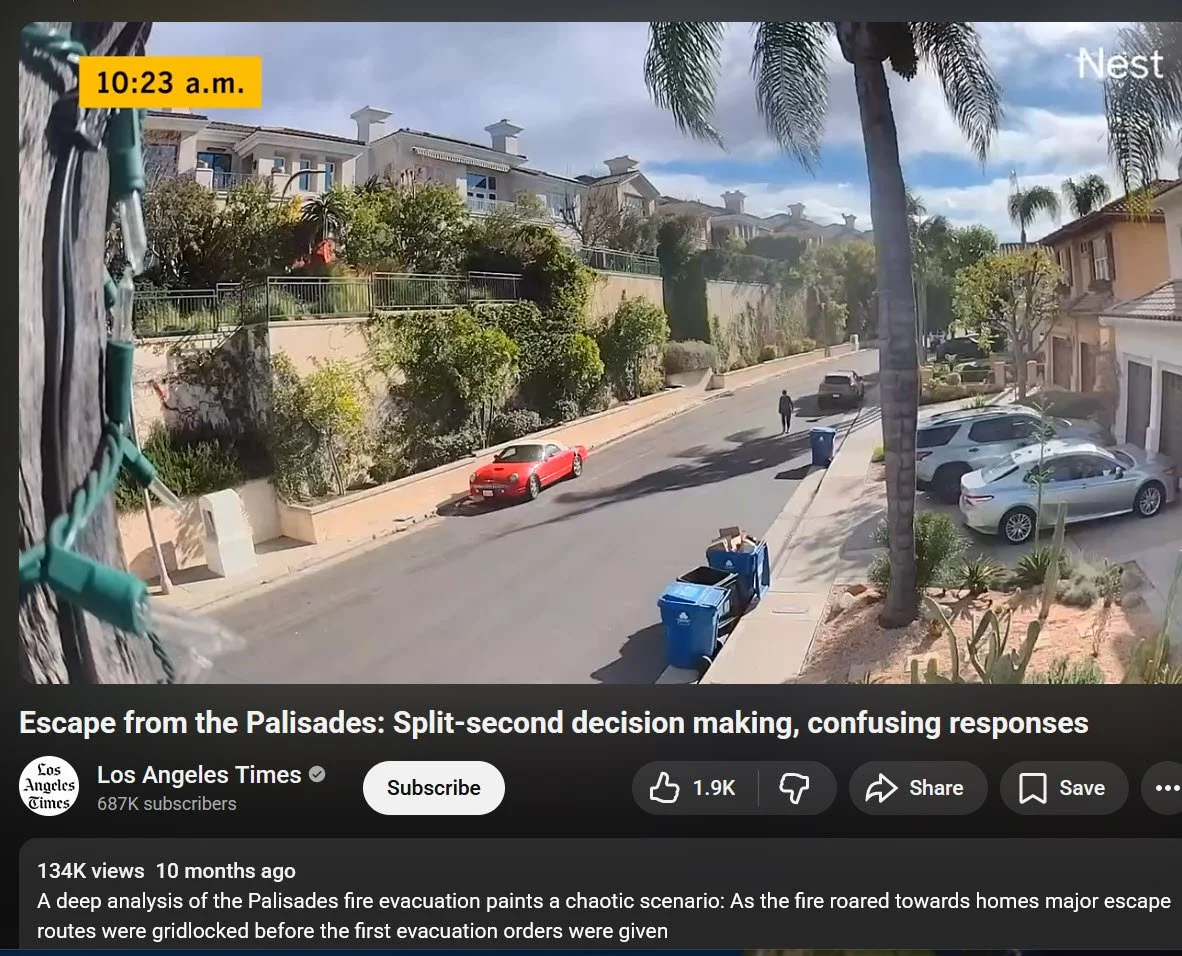
February 2, 2025 - A deep analysis of the Palisades fire evacuation paints a chaotic scenario: As the fire roared towards homes major escape routes were gridlocked before the first evacuation orders were given.
Los Angeles Times Recently Published an Update Which Appears Below
Times Investigation: LAFD report on Palisades fire was watered down, records show
The Palisades fire was fanned by gusting Santa Ana winds.
(Brian van der Brug / Los Angeles Times)
and Paul Pringle
Dec. 20, 2025 12 PM PT
The Times obtained seven drafts of the LAFD’s after-action report on the Palisades fire.
Deletions and revisions in the drafts amounted to an effort to downplay the failures of city and LAFD leadership.
The most significant edits involved the LAFD’s deployment decisions before the fire, as the wind warnings became increasingly dire.
For months after the Palisades fire, many who had lost their homes eagerly awaited the Los Angeles Fire Department’s after-action report, which was expected to provide a frank evaluation of the agency’s handling of the disaster.
A first draft was completed by August, possibly earlier.
And then the deletions and other changes began — behind closed doors — in what amounted to an effort to downplay the failures of city and LAFD leadership in preparing for and fighting the Jan. 7 fire, which killed 12 people and destroyed thousands of homes, records obtained by The Times show.
In one instance, LAFD officials removed language saying that the decision not to fully staff up and pre-deploy all available crews and engines ahead of the extreme wind forecast “did not align” with the department’s policy and procedures during red flag days.
Instead, the final report said that the number of engine companies rolled out ahead of the fire “went above and beyond the standard LAFD pre-deployment matrix.”
Another deleted passage in the report said that some crews waited more than an hour for an assignment the day of the fire. A section on “failures” was renamed “primary challenges,” and an item saying that crews and leaders had violated national guidelines on how to avoid firefighter deaths and injuries was scratched.
Other changes in the report, which was overseen by then-interim Fire Chief Ronnie Villanueva, seemed similarly intended to soften its impact and burnish the Fire Department’s image. Two drafts contain notes written in the margins, including a suggestion to replace the image on the cover page — which showed palm trees on fire against an orange sky — with a “positive” one, such as “firefighters on the frontline,” the note said. The final report’s cover displays the LAFD seal.
The Times obtained seven drafts of the report through the state Public Records Act. Only three of those drafts are marked with dates: Two versions are dated Aug. 25, and there is a draft from Oct. 6, two days before the LAFD released the final report to the public.
No names are attached to the edits. It is unclear if names were in the original documents and had been removed in the drafts given to The Times.
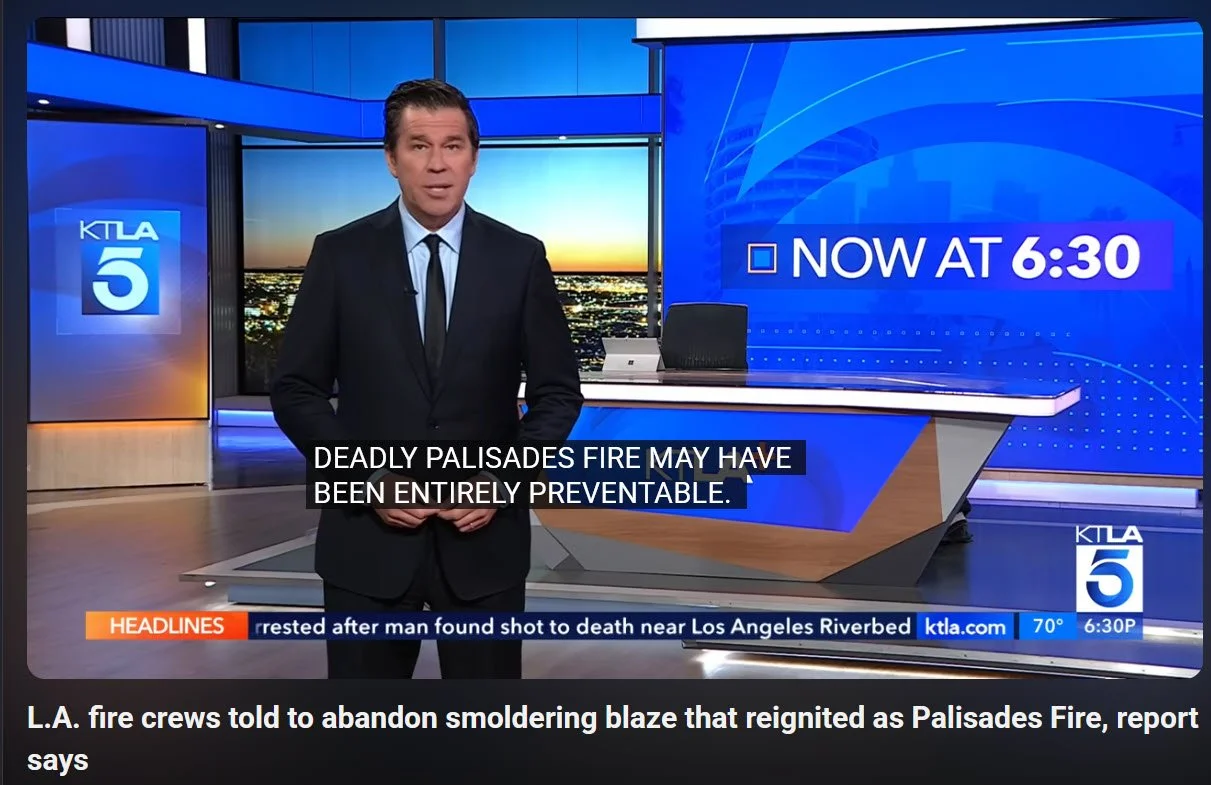
84,837 views Oct 30, 2025
A new report in the Los Angeles Times indicates that firefighters were ordered to abandon the smoldering underground fire that later became the devastating Palisades Fire, something the crews on the ground thought was a "bad idea." KTLA's Annie Rose Ramos reports on Oct. 30, 2025.
The deletions and revisions are likely to deepen concerns over the LAFD’s ability to acknowledge its mistakes before and during the blaze — and to avoid repeating them in the future. Already, Palisades fire victims have expressed outrage over unanswered questions and contradictory information about the LAFD’s preparations after the dangerous weather forecast, including how fire officials handled a smaller New Year’s Day blaze, called the Lachman fire, that rekindled into the massive Palisades fire six days later.
Some drafts described an on-duty LAFD captain calling Fire Station 23 in the Palisades on Jan. 7 to report that “the Lachman fire started up again,” indicating the captain’s belief that the Palisades fire was caused by a reignition of the earlier blaze.
The reference was deleted in one draft, then restored in the public version, which otherwise contains only a brief mention of the previous fire. Some have said that the after-action report’s failure to thoroughly examine the Lachman fire reignition was designed to shield LAFD leadership and Mayor Karen Bass’ administration from criticism and accountability.
After Palisades failures, is LAFD prepared for the next major wildfire?
Dec. 17, 2025
Weeks after the report’s release, The Times reported that a battalion chief ordered firefighters to roll up their hoses and leave the burn area on Jan. 2, even though they had complained that the ground was still smoldering and rocks remained hot to the touch. Another battalion chief assigned to the LAFD’s risk management section knew about the complaints for months, but the department kept that information out of the after-action report.
After The Times report, Bass asked Villanueva to “thoroughly investigate” the LAFD’s missteps in putting out the Lachman fire.
“A full understanding of the Lachman fire response is essential to an accurate accounting of what occurred during the January wildfires,” Bass wrote.
Fire Chief Jaime Moore, who started in the job last month, has been tasked with commissioning the independent investigation that Bass requested.
In a statement provided Saturday afternoon after this article was posted online, the LAFD refused to answer detailed questions from The Times about the altered drafts, including queries about why the material about the reignition was removed and then brought back, citing an ongoing federal court case. Federal prosecutors have charged a former Palisades resident with deliberately setting the Lachman fire.
“All information regarding the draft development, edits, internal deliberations, and decision-making process is associated with matters that are currently subject to an ongoing federal court proceeding,” the statement said. “Consistent with standard legal practice and upon advice from counsel, the LAFD must refrain from providing additional comment while the case is active to avoid prejudicing the proceedings or addressing matters that could be subjected to judicial review.”
Villanueva did not respond to a request for comment.
A spokesperson for Bass said her office did not demand changes to the drafts and asked the LAFD to confirm only the accuracy of items such as how the weather and the department’s budget factored into the disaster.
“The report was written and edited by the Fire Department,” the spokesperson, Clara Karger, said in an email. “We did not red-line, review every page or review every draft of the report. We did not discuss the Lachman Fire because it was not part of the report.”
Genethia Hudley Hayes, president of the Board of Fire Commissioners, told The Times that she reviewed a paper copy of a “working document” about a week before the final report was made public. She said she raised concerns with Villanueva and the city attorney’s office over the possibility that “material findings” were or would be changed. She also said she consulted a private attorney about her “obligations” as a commissioner overseeing the LAFD’s operations, though that conversation “had nothing to do with the after-action” report.
Hudley Hayes said she noticed only small differences between the final report and the draft she reviewed. For example, she said, “mistakes” had been changed to “challenges,” and names of firefighters had been removed.
“I was completely OK with it,” she said. “All the things I read in the final report did not in any way obfuscate anything, as far as I’m concerned.”
She reiterated her position that an examination of missteps during the Lachman fire did not belong in the after-action report, a view not shared by former LAFD chief officers interviewed by The Times.
“The after-action report should have gone back all the way to Dec. 31,” said former LAFD Battalion Chief Rick Crawford, who retired from the agency last year and is now emergency and crisis management coordinator for the U.S. Capitol. “There are major gaps in this after-action report.”
Days before Palisades inferno, firefighters were ordered to leave smoldering burn site
Oct. 30, 2025
Former LAFD Assistant Chief Patrick Butler, who is now chief of the Redondo Beach Fire Department, agreed that the Lachman fire should have been addressed in the report and said the deletions were “a deliberate effort to hide the truth and cover up the facts.”
He said the removal of the reference to the LAFD’s violations of the national Standard Firefighting Orders and Watchouts was a “serious issue” because they were “written in the blood” of firefighters killed in the line of duty. Without citing the national guidelines, the final report said that the Palisades fire’s extraordinary nature “occasionally caused officers and firefighters to think and operate beyond standard safety protocols.”
The final after-action report does not mention that a person called authorities to report seeing smoke in the area on Jan. 3. The LAFD has since provided conflicting information about how it responded to that call.
Villanueva told The Times in October that firefighters returned to the burn area and “cold-trailed” an additional time, meaning they used their hands to feel for heat and dug out hot spots. But records showed they cleared the call within 34 minutes.
Fire officials did not answer questions from The Times about the discrepancy. In an emailed statement this week, the LAFD said crews had used remote cameras, walked around the burn site and used a 20-foot extension ladder to access a fenced-off area but did not see any smoke or fire.
“After an extensive investigation, the incident was determined to be a false alarm,” the statement said.
The most significant changes in the various iterations of the after-action report involved the LAFD’s deployment decisions before the fire, as the wind warnings became increasingly dire.
In a series of reports earlier this year, The Times found that top LAFD officials decided not to staff dozens of available engines that could have been pre-deployed to the Palisades and other areas flagged as high risk, as it had done in the past.
One draft contained a passage in the “failures” section on what the LAFD could have done: “If the Department had adequately augmented all available resources as done in years past in preparation for the weather event, the Department would have been required to recall members for all available positions unfilled by voluntary overtime, which would have allowed for all remaining resources to be staffed and available for augmentation, pre-deployment, and pre-positioning.” The draft said the decision was an attempt to be “fiscally responsible” that went against the department’s policy and procedures.
That language was absent in the final report, which said that the LAFD “balanced fiscal responsibility with proper preparation for predicted weather and fire behavior by following the LAFD predeployment matrix.”
Even with the deletions, the published report delivered a harsh critique of the LAFD’s performance during the Palisades fire, pointing to a disorganized response, failures in communication and chiefs who didn’t understand their roles. The report found that top commanders lacked a fundamental knowledge of wildland firefighting tactics, including “basic suppression techniques.”
A paperwork error resulted in the use of only a third of the state-funded resources that were available for pre-positioning in high-risk areas, the report said. And when the fire broke out on the morning of Jan. 7, the initial dispatch called for only seven engine companies, when the weather conditions required 27.
There was confusion among firefighters over which radio channel to use. The report said that three L.A. County engines showed up within the first hour, requesting an assignment and receiving no reply. Four other LAFD engines waited 20 minutes without an assignment.
In the early afternoon, the staging area — where engines were checking in — was overrun by fire.
The report made 42 recommendations, ranging from establishing better communication channels to more training. In a television interview this month, Moore said the LAFD has adopted about three-quarters of them.
Buillding Permits Issued Since The Fire
As of mid-December 2025, nearly a year after the January 2025 Palisades Fire (which destroyed around 6,800–7,000 structures in Pacific Palisades and surrounding areas), rebuilding progress has accelerated but remains limited. Approximately 12–13% of destroyed homes in the Palisades have received rebuilding permits, according to analyses from the Los Angeles Times and city data.Key details on permits and progress:
Over 1,000 homes are under construction in Pacific Palisades as of early December 2025.
Rebuilding plans have been approved for nearly 750 addresses, per the mayor's office.
In November 2025, nearly 2,000 rebuilding permits were reported issued across the combined Palisades and related fire zones (including Eaton), with about 340–390 projects actively under construction in Palisades specifically.
Note that "permits issued" often includes multiple types per property (e.g., grading, electrical, building), so the number of unique homes permitted for full rebuilds is lower—roughly corresponding to the hundreds under construction. Earlier in 2025, progress was slower (e.g., only a handful of permits by March–April, rising to hundreds by summer), but executive orders from Mayor Bass and state support have sped up processing to about three times the pre-fire rate for single-family homes.Rebuilding has faced challenges like insurance delays, labor shortages, and bureaucracy, but momentum is growing, with the first fully rebuilt homes receiving occupancy certificates in late 2025. For the most current official figures, check the Los Angeles Department of Building and Safety (LADBS) or mayor's office updates.
Major Challenges in Rebuilding After the Palisades Fire (as of December 2025)
Nearly a year after the January 2025 Palisades Fire destroyed thousands of homes, rebuilding has gained some momentum—with over 1,000 homes under construction in Pacific Palisades and permits issued for about 12–13% of destroyed properties—but significant hurdles persist for many residents. These challenges have slowed recovery, leading to frustration, financial strain, and some homeowners choosing to sell lots instead of rebuilding.Here are the primary obstacles reported across multiple sources:
Insurance Delays and Gaps: Many residents are underinsured or facing prolonged disputes with insurers over payouts. Construction costs often exceed insurance coverage (sometimes double), leaving homeowners to cover large gaps out-of-pocket. Short-term mortgage relief programs are expiring around the one-year mark, adding pressure while people continue paying for nonexistent homes.
Bureaucratic and Permitting Delays: Despite executive orders from Mayor Karen Bass to expedite processes (reducing permitting times for single-family homes), survivors report inconsistent guidance, understaffing at city agencies like the Los Angeles Department of Building and Safety, and stifling red tape. Early progress was slow, with backlash over perceived missteps in recovery leadership.
Labor Shortages and Supply Chain Issues: A strained construction labor market and delays in materials have extended timelines, even for projects with approved permits.
High Rebuilding Costs: Escalating expenses for fire-resistant materials, wider defensible spaces, and compliance with updated codes make projects unaffordable for middle-class residents, many of whom lived in older homes predating modern fire-safety standards.
Financial and Personal Decisions: Some homeowners are undecided about rebuilding due to costs, emotional trauma, or lack of funds. Others face restrictions, such as Gov. Gavin Newsom's executive order pausing duplex/lot-split options (under SB 9) in high-fire-risk areas to preserve neighborhood character and aid evacuations—prompting lawsuits from pro-development groups arguing it limits affordability.
Lack of Coordinated Master Plan: Disputes over leadership roles (city vs. county) and funding shortages for infrastructure (e.g., undergrounding power lines) have muddied long-term recovery efforts.
Progress varies by individual circumstances—quick insurance settlements and pre-existing plans enable faster rebuilds (a few families are moving back by late 2025)—but for many, the process "feels endless." Momentum has improved since summer, with pre-approved designs and accelerated reviews helping, but full community recovery is expected to take years. For the latest updates, check the Los Angeles Department of Building and Safety dashboard or mayor's office reports.