Segment #932
Make no mistake: if these capabilities are already public knowledge, the true, classified state of the art is far beyond anything we can fathom. That said, understanding this public baseline gives us a fascinating glimpse into just how advanced the starting point really is."
It is a sobering reminder that in the world of high-level signals intelligence and cyber operations, by the time the public learns how a target was tracked, the agencies involved have already moved on to the next generation of technology
Whether Iran turns the global internet back on or forces a total blackout actually doesn't change the game as much as you'd think for tracking high-level leadership. Here is why:
High-Level Leadership Doesn't Use the Public Internet
The top tier of Iranian leadership—like the Supreme Leader, high-ranking Islamic Revolutionary Guard Corps (IRGC) commanders, and nuclear scientists—never relies on commercial, public internet connections for their sensitive communications. They use heavily encrypted, closed military networks and hardwired fiber-optic lines that are physically separate from the public web. Whether an ordinary citizen in Tehran can log onto a website has no bearing on these closed networks.
The Blackout is for the Public, Not the State
When Iran implements an internet blackout (or heavy throttling), it is designed as a domestic "kill switch" to stop regular citizens from organizing protests, sharing videos of unrest with the outside world, or bypass censorship. During these blackouts, the regime maintains "white SIM cards" and dedicated fiber lanes that keep government offices, security forces, and leadership completely online and connected to their own infrastructure.
Intelligence Uses Backdoors, Not Public Feeds
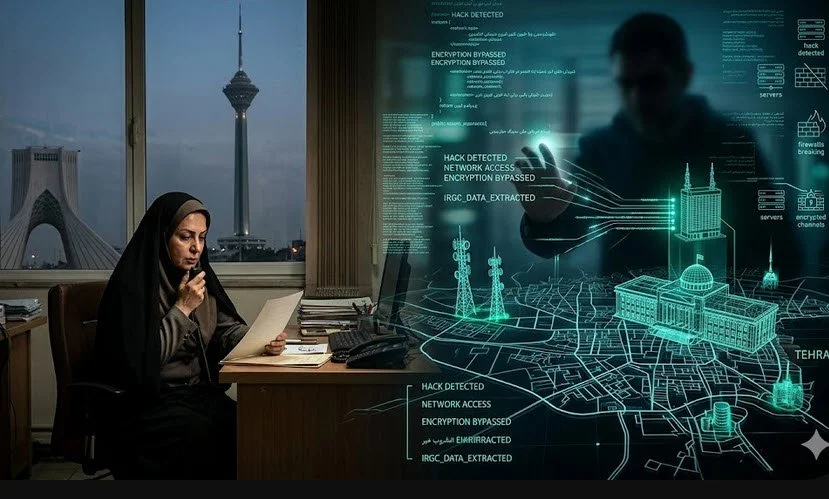
Foreign intelligence agencies (like the CIA or Israel's Mossad) don't rely on open internet traffic to track targets. Instead, they exploit vulnerabilities that exist regardless of public internet status. A prime example of this was recently revealed: foreign intelligence managed to compromise Tehran’s massive, closed-circuit traffic and surveillance camera network. By using AI algorithms to sift through those internal feeds, they were able to track the physical movements of leadership and their bodyguards in real time. Because those camera networks are localized infrastructure, they remain active and vulnerable to cyber-intrusion even if the outside world is completely cut off from Iran's public web.
Human Intelligence (HUMINT) and Signals Remain Constant
The most critical tracking of leadership comes from a combination of:
Human Sources: Informants on the ground who pass physical confirmation of locations.
Electronic Signatures: Advanced satellite imagery, thermal tracking, and intercepts of localized radio or closed communication frequencies.
So, while turning the internet back on is a massive relief for the Iranian economy and regular citizens trying to communicate, it doesn't give foreign intelligence a brand-new window into the regime's leadership. The windows they use are usually ones they've quietly cut through the back door themselves.
Iran Capabilities to Stay Hidden from Western Intelligence Gathering
No, they cannot achieve true invisibility. While a nation-state can build incredibly thick layers of operational security, staying entirely hidden from a modern, multi-tiered Western intelligence apparatus is virtually impossible over the long term.
To achieve complete invisibility, a leadership structure would have to exist in total stasis—never moving, never communicating, and never interacting with the physical or digital world. The battle for survival vs. penetration comes down to a constant game of measure and countermeasure.
How Iran Attempts to Stay Invisible
The Iranian regime uses highly disciplined, low-tech, and localized defense protocols to hide its leadership:
Air-Gapped and Fiber Networks: They completely isolate military and leadership communications from the public internet using physical, underground fiber-optic lines.
The "Pager Lesson" / Low-Tech Shields: Following high-profile intelligence breaches—such as the 2024 pager explosions that devastated Hezbollah's communications network—the regime heavily enforces strict "no-device" zones. High-level meetings often require participants to strip themselves of all commercial electronics, reliance on written couriers, and face-to-face discussions in hardened bunkers.
Decoy and Tunnel Ecosystems: The Islamic Revolutionary Guard Corps (IRGC) relies heavily on vast networks of deeply buried underground facilities and tunnels (referred to as "missile cities" and command bunkers) beneath major urban areas and mountains, designed to mask physical signatures.
Aggressive Counter-Intelligence: The Ministry of Intelligence and Security (MOIS) ruthlessly hunts for internal spies and turncoats, using domestic terror and surveillance to keep its inner circle terrified of cooperating with foreign handlers.
Why Complete Invisibility Fails
Despite these extreme measures, Western and allied intelligence agencies (like the US and Israel) routinely breach these bubbles through a concept known as Mosaic Intelligence—piecing together tiny fragments from different disciplines until a clear picture emerges.
The Cyber Vulnerability of "Isolated" Infrastructure Even when a network is air-gapped, it must interface with physical machinery. Western cyber intelligence has proven adept at finding the single point of failure. A stark example of this was when intelligence agencies successfully penetrated Tehran’s internal municipal traffic and closed-circuit surveillance camera network.
Even though these cameras were meant to control internal domestic dissent and were isolated from the outside web, a single vulnerability allowed hackers to siphon the feeds. Armed with modern AI facial and vehicle recognition software, analysts could map out the exact travel routes, schedules, and security details of the supreme leadership in real time.
The Human Element (HUMINT) is Inescapable
Technology doesn't operate itself. Every secure network, bunker, and courier system relies on humans, and humans are susceptible to compromise through money, ideology, coercion, or a desire for regime change. An air-gapped system can be breached by an insider plugging in a compromised USB drive (the classic Stuxnet model). A courier's routine can be compromised by an informant tracking departures from a secure compound.
Signature Management Flaws
Even if an Iranian leader never touches a phone or a computer, their environment reacts to them.
SIGNINT (Signals Intelligence): If a leader moves to a hidden underground bunker, electronic traffic in that specific area briefly spikes as security details establish perimeter guards.
GEOINT (Geospatial Intelligence): Advanced satellite constellations use synthetic aperture radar (SAR) to see through cloud cover and darkness, tracking subtle changes in vehicle movements, patterns of life, or thermal outputs outside a "secret" facility.
The Bottom Line
Iranian leadership can achieve temporary obscurity, but not permanent invisibility. The moment a leader issues a command, moves locations, or relies on subordinates to execute policy, they leave a signature. In modern warfare, intelligence agencies don't need a target to log into an email account; they just need to exploit one cracked seam in the regime's massive internal infrastructure.