
Idealism From A Petulant Child
Segment #900
"I find Tucker Carlson's ideas interesting and certainly worth debating. What is offensive, however, is his petulant, spoiled, and enabled attitude—one where he believes he can throw a hand grenade into a crowded room and simply walk away, disavowing any responsibility for the carnage. His positions on Iran are a prime example; it is telling that both he and The New York Times are favorite commentators featured on Iranian, Chinese, and Russian state television.
The fact that Carlson emboldens adversaries and puts our own side in jeopardy is apparently of no concern to him. So, what should he do instead? He should use his massive megaphone to interview key players—not to stand on a soapbox and pontificate, but to genuinely guide the conversation in a positive direction that empowers everyone. Instead, he prefers to pout, playing the victim who isn't being heard. A rare exception to this was his interview with Elon Musk, where they productively discussed the vital concept of a 'TruthGPT.
This MSNOW segment below highlights a distinct disconnect in Tucker’s commentary, where his inflated sense of self-importance takes precedence over the existential political threats he frequently warns against. Rather than focusing on how potential leaders like Kamala Harris or Gavin Newsom might disrupt American life, he often shifts the spotlight to himself, exhibiting the behavior of an entitled child. Ultimately, when weighed against global crises—such as thwarting Iranian-backed terrorism—Tucker's personal tribulations pale in comparison to what truly matters to the world stage.

Tucker Carlson’s commentary on artificial intelligence focuses heavily on warning against its potential risks—such as mass job displacement, cultural homogenization, energy grid strain, and a loss of human agency. Rather than presenting a detailed, highly technical policy framework or standard regulatory roadmap, his approach to guiding AI in a "non-destructive direction" centers primarily on cultural, systemic, and foundational principles. To be fair Tucker does offer proposals and solutions which you can view below. What is objectionable and what I characterize as petulant is his seeming inability to comprehend fully the impact of his statements and the very possibility he could be making things worse.
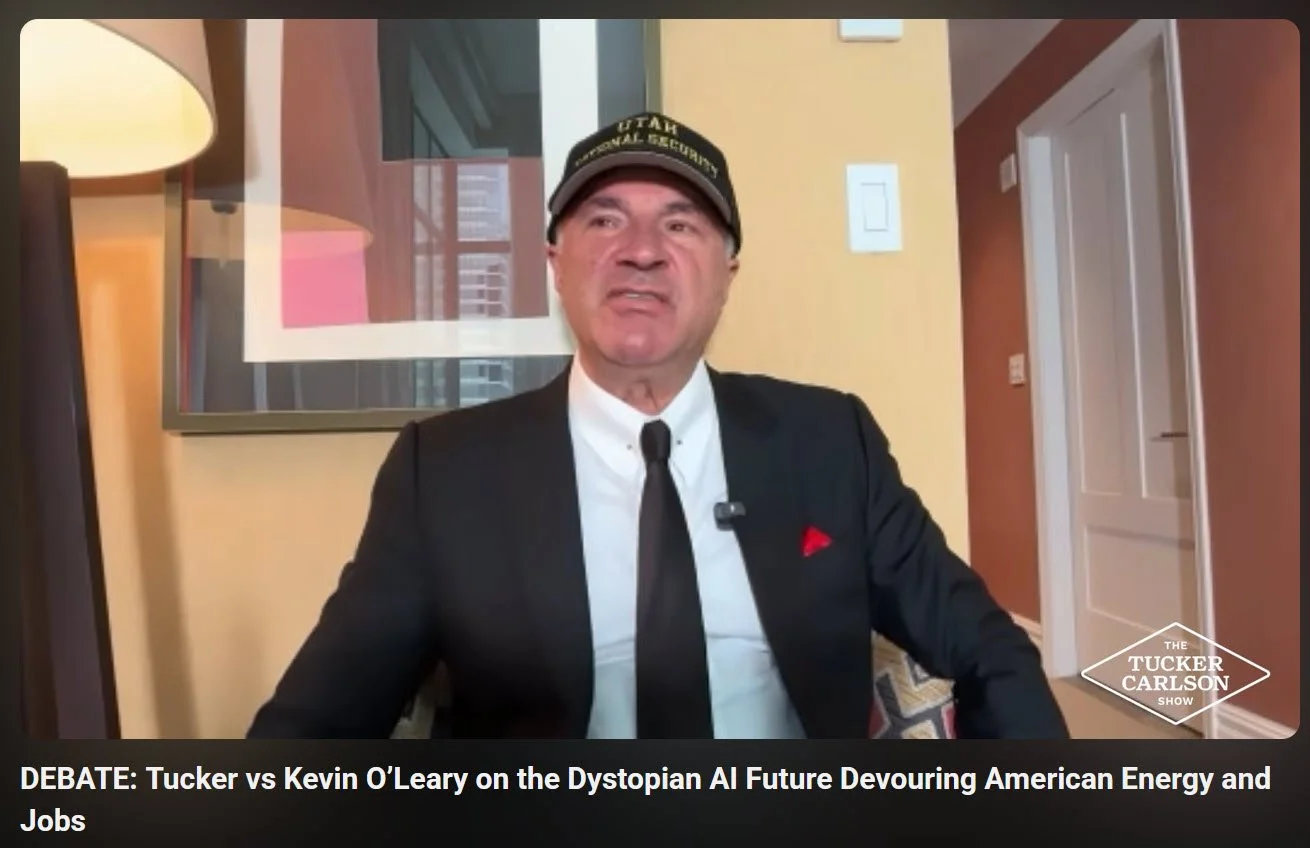
Kevin O’Leary says anyone who opposes his dystopian data center is probably working for China. A debate.
Tucker Carlson and AI
Rejecting Political Bias and Demanding "Maximum Truth-Seeking"
Carlson’s most prominent constructive platform for AI has been pushing for models that are completely independent of corporate or political engineering.
The "TruthGPT" Concept: During a major 2023 interview with Elon Musk, Carlson strongly endorsed and helped popularize the concept of a "maximum truth-seeking AI" (which Musk dubbed TruthGPT). Carlson's argument is that an AI programmed to strictly understand the nature of the universe—rather than one trained to be politically correct or to withhold information—is fundamentally safer because it prioritizes objective reality over ideological compliance.
Proposal: Decouple AI development from corporate, ideological, or political guardrails. How it Works: Instead of training models with "safety filters" designed to prevent offense or enforce political correctness, Carlson advocates for models programmed with a single, unyielding directive: objective reality. The theory here is that an AI focused entirely on the literal truth of the universe is inherently safer because it cannot be manipulated by elites to control public narrative or distort facts.
Asserting Human Supremacy Over "The Machine"
Carlson frequently frames the threat of AI as a spiritual and philosophical crisis where humanity is volunteering to subordinate itself to technology.
The "Machine Can't Rule the Man" Principle: In media appearances (including a 2026 interview with India Today), Carlson has argued that the ultimate solution is a foundational cultural shift asserting that technology must never dominate human governance, family life, or spiritual authority. He advocates for strict boundaries on where AI can be applied, maintaining that core human decisions—like law, ethics, and leadership—must remain strictly in human hands.
Proposal: Decouple AI development from corporate, ideological, or political guardrails. How it Works: Instead of training models with "safety filters" designed to prevent offense or enforce political correctness, Carlson advocates for models programmed with a single, unyielding directive: objective reality. The theory here is that an AI focused entirely on the literal truth of the universe is inherently safer because it cannot be manipulated by elites to control public narrative or distort facts.
Subjecting Tech Leaders to Public Accountability
Rather than trusting Silicon Valley to self-regulate behind closed doors, Carlson uses his platform to confront tech leaders directly on behalf of the public interest.
Challenging Centralized Control: In an in-depth interview with OpenAI CEO Sam Altman, Carlson actively pressed the executive on the moral and ethical dimensions of AI development, questioning whether a small group of technologists should have the authority to decide the ethical guardrails for the rest of humanity. His proposed solution here is demanding radical transparency and public accountability for the private corporations building these models.
Proposal: Strip Silicon Valley of its self-regulatory power through radical transparency and aggressive public oversight. How it Works: Carlson rejects the idea that a small, centralized group of tech executives should quietly decide the moral guardrails for global humanity. His proposal demands that these corporations operate under complete public scrutiny. If tech leaders are building tools that alter human society, they must be forced to answer to the public interest, rather than hiding behind proprietary algorithms and closed-door corporate boards.
Radical De-escalation and Critical Questioning
When considering the worst-case scenarios of AI-driven societal collapse or total displacement of human labor, Carlson’s positions lean toward immediate, aggressive mitigation rather than passive acceptance.
"Strangle it in the Crib": In a highly publicized 2024 appearance on The Joe Rogan Experience, Carlson went as far as suggesting that if a technology poses an existential threat to human livelihood and energy infrastructure, society has every right to halt it entirely (hyperbolically suggesting we should "bomb the data centers" or "strangle it in the crib" before it is too late). While provocative, the underlying solution he argues for is a willingness by governments and populations to simply say "no" to destructive technological advancement, rather than treating its rollout as an inevitable, unstoppable force.
Proposal: Reject the myth of technological inevitability; exercise the right to simply say "no" to existential threats. How it Works: Using provocative rhetoric like "strangle it in the crib," Carlson’s underlying proposal is that society and governments should be willing to use forceful, immediate mitigation to halt dangerous tech. If a specific AI advancement threatens human livelihood, national security, or critical infrastructure, Carlson argues that total prohibition—or even dismantling the physical infrastructure (like data centers) supporting it—should be firmly on the table.
Prioritizing Tangible Human Skills
In discussions regarding the future labor market (such as interviews on his network exploring AI job displacement), Carlson has highlighted the need for an economic shift toward things AI cannot replicate. He advocates for a societal return to localized, physical, and deeply interpersonal skills—such as trade work, farming, and true community-building—as a practical shield against an automated, digital economy.
Proposal: Restructure the economy and education system to value localized, physical, and interpersonal labor. How it Works: As a practical shield against mass job displacement, Carlson proposes a societal pivot away from purely digital or administrative careers. By reinvesting in and elevating trade work, farming, manual craftsmanship, and localized community-building, humanity can create an economic safe haven. The goal is to anchor human livelihood in tangible skills that a digital algorithm fundamentally cannot replicate.