
Segment @896

Is the European Union facing an existential crisis? Right now, the bloc looks less like a global power and more like a political punchline, with France alone burning through four Prime Ministers in a single year. But this chaos isn’t random. It’s the culmination of decades of decay, division, and economic mismanagement now boiling over. That’s why today, we’ll break down why Europe forgot how to grow, how the Euro’s design is tearing the Union apart, and what it all means for the markets. Enjoy!
Totalitarianism is frequently framed as a distant reality confined to nations like China, North Korea, or Iran, yet contemporary shifts in Europe, the United Kingdom, and South America suggest a more universal vulnerability. This evolution marks the rise of the "Digital Panopticon," a transition from the "hard power" of physical walls and armed guards to the "soft power" of digital infrastructure. In this model, control is exerted through the invisible architecture of algorithms, financial ledgers, and restricted access, moving the frontier of state surveillance from the physical world into the digital systems that govern modern life.
In this scenario, the state no longer needs to resort to physical disappearance or state-funded imprisonment to neutralize dissent. Instead, it employs a strategy of "social death," where an individual is simply rendered unable to function within society by being severed from essential services. This method is chillingly efficient; by revoking a person's ability to transact, travel, or communicate, the regime achieves total neutralization without the logistical burden or expense of housing and feeding prisoners in a traditional gulag. Under the Digital Panopticon, you aren't physically erased—you are systematically disconnected.
The Mechanics of the "Invisible Cage"
Financial De-platforming: When a society moves to a Central Bank Digital Currency (CBDC) or a purely cashless system, your ability to survive is tied to a digital "on/off" switch. If your wallet is blacklisted, you cannot participate in the basic exchange of goods and services.
The Social Credit Engine: This isn't just about big crimes; it's about "micro-compliance." Did you associate with a dissenter? Did you buy too much alcohol? Did you criticize a policy online? These inputs create a score that determines your "friction" in life—how long you wait for a train, or whether your kids get into a good school.
Algorithmic Self-Censorship: This is the most insidious part. When the "prison" is the social system itself, you become your own jailer. You stop speaking not because a soldier is at the door, but because you don't want your digital health insurance premium to spike or your internet speed to be throttled.
The Reality Check
While the picture in North Korea and China is the most advanced version of this, we see "lite" versions of this elsewhere. We've seen banking freezes used against protesters in Western democracies and "cancel culture" evolve into professional blacklisting. The difference is often just a matter of due process. In a tyranny, the "lockout" is arbitrary and irreversible. In a free society, we (theoretically) have the law to prevent the state or corporations from simply "deleting" a person's life. The paradox of the digital age: The same tools that give us total convenience—frictionless payments, instant communication, and personalized services—are the exact same tools required for total subjugation.
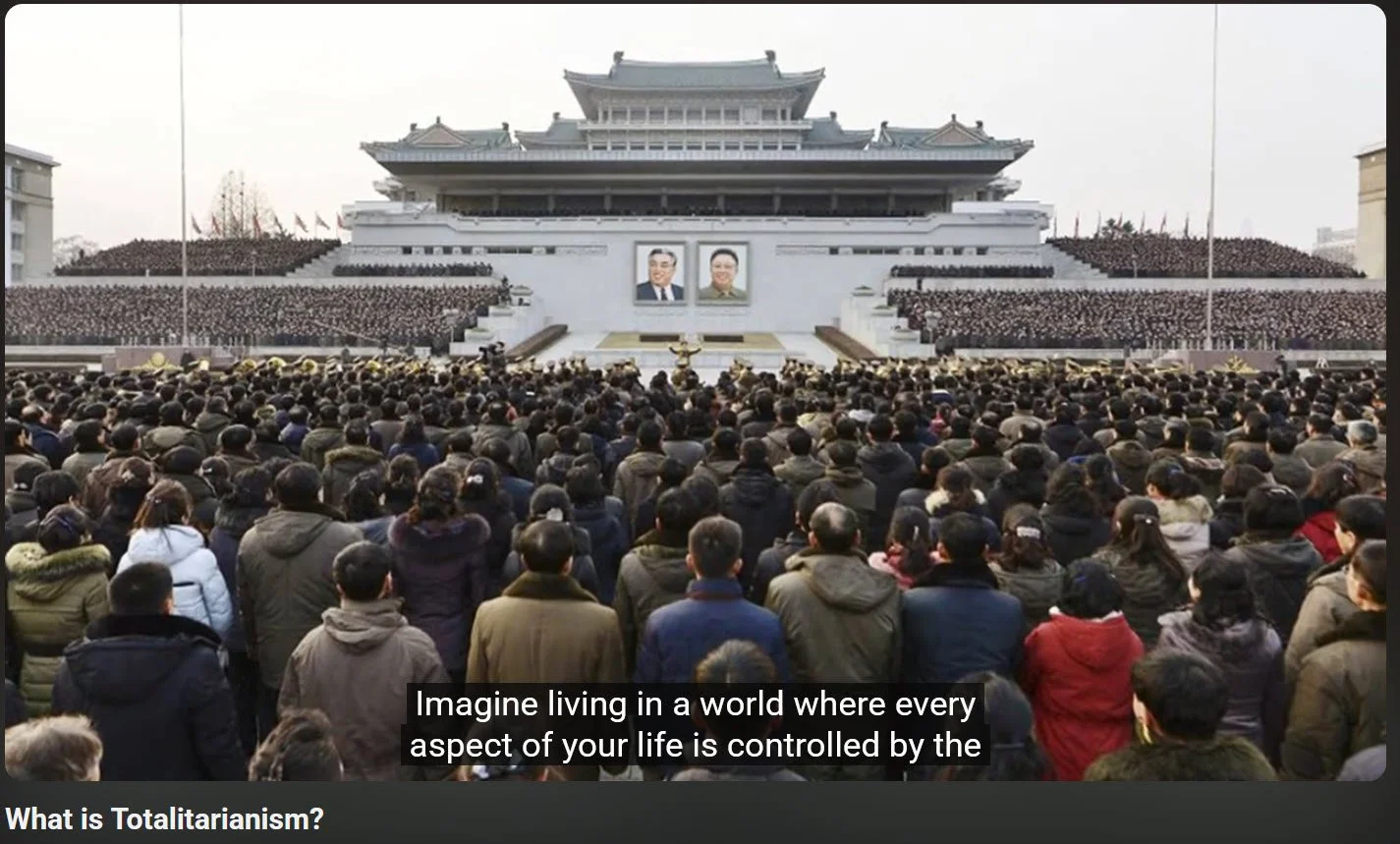
In this video, we explore the disturbing reality of totalitarianism and examine 3 of its main characteristics: total control, cult of personality, and use of ideology.
The Chinese Version of the Invisible Cage
In China, the "invisible cage" is not a single master switch, but a sophisticated ecosystem of interconnected systems. By 2026, this has evolved from a series of local experiments into a national governance strategy that prioritizes corporate compliance and financial traceability.
The Social Credit System: Beyond the "Score"
Contrary to popular Western myth, there isn't one single "citizen score" like a video game. Instead, it is a massive Blacklist/Redlist system.
The "Laoi" (Dishonest Debtors): The most direct version of your "lockout" scenario. If a court labels you a laoi for failing to pay a fine or debt, you are automatically restricted by the national system. You cannot buy high-speed train tickets, book luxury hotels, or sometimes even enroll your children in private schools.
Corporate Focus: As of 2026, the system is most aggressive toward companies. A low corporate score can result in higher tax rates, more frequent inspections, and a total ban on government contracts.
The Digital Yuan (e-CNY): Programmable Money
China leads the world in Central Bank Digital Currencies (CBDCs). As of January 2026, the digital yuan has transitioned from "digital cash" to "digital deposits" that can earn interest.
Traceability: Unlike paper cash, every e-CNY transaction is traceable by the People's Bank of China (PBOC).
Programmability: The currency can theoretically be "programmed" to only be spent on certain goods or to expire if not used. If an individual is flagged as a threat or a debtor, the state doesn't need to seize their bank account—it can simply "de-authorize" their digital wallet.
"Sky Net" and Mass Surveillance
The physical infrastructure of this cage is the Sky Net (Tianwang) system.
Ubiquity: It consists of hundreds of millions of AI-enabled cameras with facial and gait recognition.
Real-time Integration: By 2026, the system is used not just for catching criminals but for "Operation Sky Net 2026," which tracks economic fugitives and monitors officials with family abroad.
Behavioral Nudges: In some cities, jaywalking or minor infractions can trigger your face being shown on public "shaming" screens, subtly reinforcing that the eye is always watching.
Prison and the Death Penalty in China
The Chinese prison system and its use of the death penalty are known for being some of the most extensive and opaque in the world. Because the Chinese government classifies data on executions as a state secret, most of what we know comes from human rights organizations and legal experts.
Here is a breakdown of how the system works and the frequency of capital punishment.
The Prison System
China’s penal system is divided into three primary types of facilities:
Detention Centers (Kanshousuo): Where suspects are held before and during trial. Conditions are often described as overcrowded.
Prisons (Jianyu): Where those convicted of crimes serve their sentences. These are managed by the Ministry of Justice.
Administrative Detention: Includes various forms of detention without a formal trial, sometimes used for minor offenses or political "re-education," though the famous "Labor Reform" (Laogai) system was officially abolished in 2013.
Key Characteristics:
Rehabilitation through Labor: The system emphasizes "reform" through work. Prisoners are often required to work in factories or farms within the prison complex.
Strict Control: Surveillance is high, and prisoners have very limited contact with the outside world. Foreigners and high-profile prisoners may have different conditions but generally face the same rigid discipline.
The Death Penalty: Frequency and Law
China is widely believed to execute more people than the rest of the world combined.
Frequency
Estimated Numbers: While the exact figure is secret, human rights groups like Amnesty International estimate that thousands of people are executed every year.
Trends: In recent years, the number is believed to have declined slightly due to a 2007 reform requiring the Supreme People’s Court (SPC) to review and approve every death sentence.
The "Two-Year Reprieve"
A unique feature of the Chinese system is the Death Sentence with a Two-Year Suspension (Sihuan). If a prisoner does not commit further crimes and shows "merit" during those two years, the sentence is typically commuted to life imprisonment or a fixed term (usually 25 years). This is often used for crimes where the court wants to show "mercy" or where the evidence might not be 100% conclusive for an immediate execution.
Methods of Execution
Lethal Injection: Now the most common method, often carried out in specially equipped "execution vans" to allow for mobility and efficiency.
Firing Squad: Still used in some regions, typically involving a single shot to the back of the head.
Crimes Punishable by Death
While many countries reserve the death penalty for murder, China has 46 crimes eligible for capital punishment, including:
Murder and rape.
Drug trafficking (very common reason for execution).
Economic crimes like massive corruption or fraud (though executions for these have become less frequent).
Endangering national security (terrorism or separatism).
Important Note: You cannot be sentenced to death in China if you were under 18 years old at the time of the crime or if you are pregnant at the time of the trial. Since 2011, people over the age of 75 are also generally exempt, unless the murder was "especially cruel."