
Segment #998
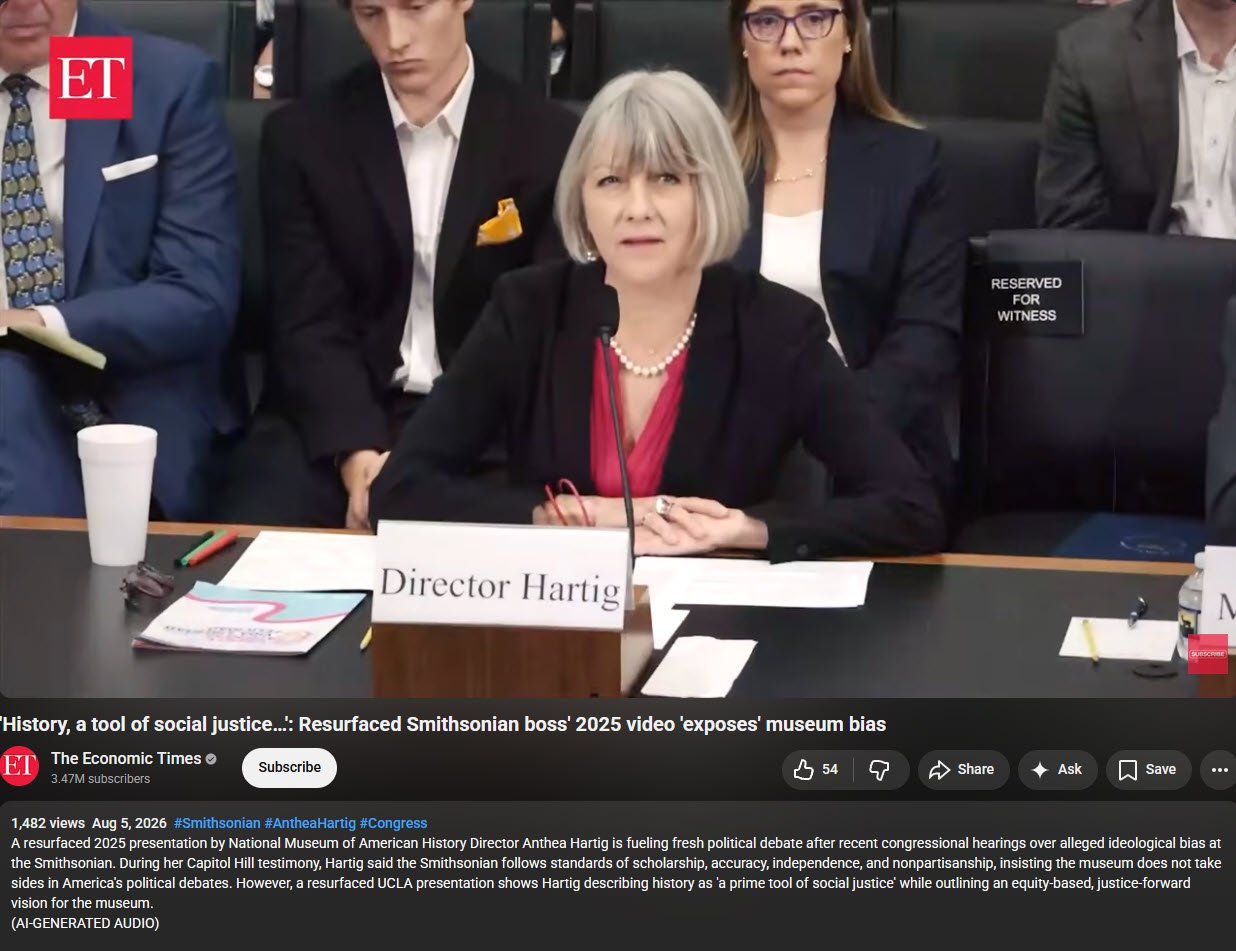
Dr. Anthea Hartig, Director of the National Museum of American History (part of the Smithsonian Institution in Washington, D.C., rceently made the statement in a presentation delivered at the University of California, Los Angeles (UCLA) in February 2025, where she described "history as a practice" as a "prime tool of social justice." During the address, she outlined how the museum was adopting an "equity-based, justice-forward, community-driven, and necessarily humble approach to public history and to service."While traditional or left-leaning perspectives view history as a weapon for structural reform, conservative political thought approaches "history as a tool for social justice" with deep skepticism. From a conservative standpoint, instrumentalizing history for contemporary political campaigns degrades historical truth, undermines constitutional stability, and threatens social cohesion.
The History of conservative Skepticism Toward "History as a Tool"
The conservative critique of using history for current ideological aims is rooted in classical liberal and traditionalist thought:
Edmund Burke and Organic Continuity: In Reflections on the Revolution in France (1790), Edmund Burke argued that society is a partnership between the living, the dead, and the yet to be born. Burke warned against discarding long-standing institutions based on abstract theories of justice. For conservatives, history is meant to cultivate humility and respect for inherited wisdom—not to be mined for arguments to disassemble social structures.
Critique of Whig History and Marxism: In the 20th century, thinkers like Herbert Butterfield (The Whig Interpretation of History) and Thomas Sowell critiqued the habit of reading present-day moral standards backward into the past. Marxist historiography explicitely treated history as a class struggle meant to fuel revolution. Conservatives identified this as a dangerous precedent: when historical study ceases to be an objective search for truth and becomes a tool for political agendas, narrative replaces fact.
The American Founding and Restraint: Conservative historians point to the American Founders, who studied classical history (Rome, Greece) not to tear down society, but to understand human nature's flaws and build checks and balances to prevent tyranny. History was a warning system against ideological zeal, not a battery for social engineering.
Why Conservatives View "History as a Tool for Social Justice" as Dangerous
When history is weaponized to serve current political concepts of social justice, conservatives identify several distinct dangers:
Subversion of Objective Truth: When history is viewed primarily as a "tool" for a specific political outcome, historical rigor gives way to confirmation bias. Complex historical figures and nuanced context are flattened into moral caricature—either pure oppressors or pure victims—to serve today's political narrative.
Erosion of National Cohesion and Shared Identity: A nation requires a shared narrative, shared values, and mutual civic memory to bind a diverse populace together. Reducing national history strictly to a series of crimes, systemic oppression, and grievances undermines patriotic devotion and fosters tribal resentment, weakening the shared civic trust required for self-governance.
Presentism and Moral Arrogance: Evaluating historical figures solely by modern moral standards ("presentism") ignores the constraints, knowledge, and moral consensus of their eras. This creates an unsustainable moral superiority in the present, encouraging the destruction of monuments, institutions, and traditions without understanding why they were built in the first place.
Legitimizing Institutional Destruction: If history is framed as nothing more than a system of power dynamics designed to oppress, then existing institutions—law, market economies, standard educational curricula—are rendered illegitimate by default. This opens the door to radical restructuring and state expansion under the guise of "rectifying history," often replacing proven frameworks with unstable, utopian social experiments.