Segment #999
Here is an outline of the newly declassified documents and records detailed in the video (published August 6, 2026, by attorney Robert Gouveia): The best we can hope for is publicizing all the despicable things that happened with full knowledge of Dem leadership over the past ten years. Allowing bureaucrats to stage a coup against a sitting president is not what happens in a democracy. In a strange way we should be grateful. In France, Germany, UK, and Ireland you will be jailed for such speech. With more whistleblowers coming forward there is a lot more information to be revealed.
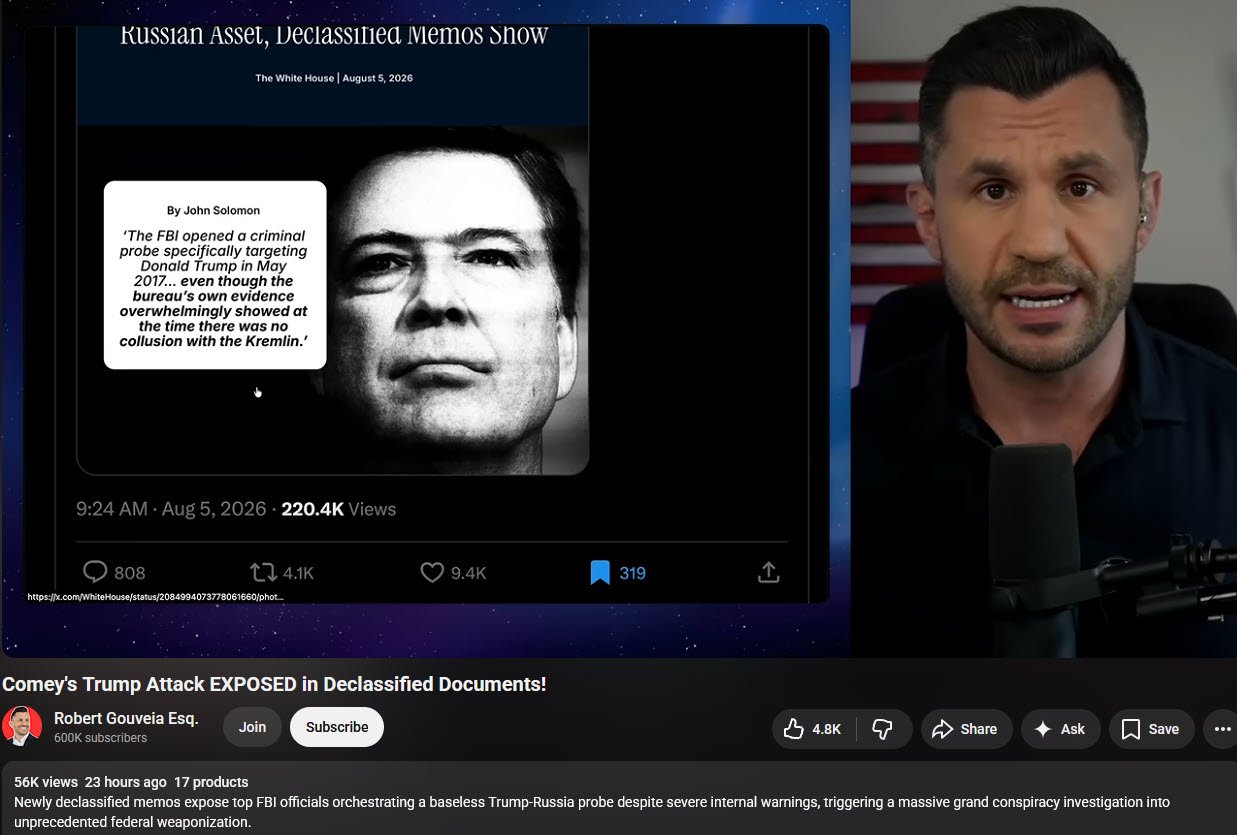
Opening of Operation "Oxford" (May 2017)
Initiation: On May 16, 2017—one week after President Trump fired FBI Director James Comey—acting FBI Director Andrew McCabe and counterintelligence officials authorized a new investigation codenamed "Oxford" [04:54].
Stated Scope: The probe was initiated to determine whether Trump was acting under the control/direction of Russia or had criminally obstructed justice by firing Comey [05:36].
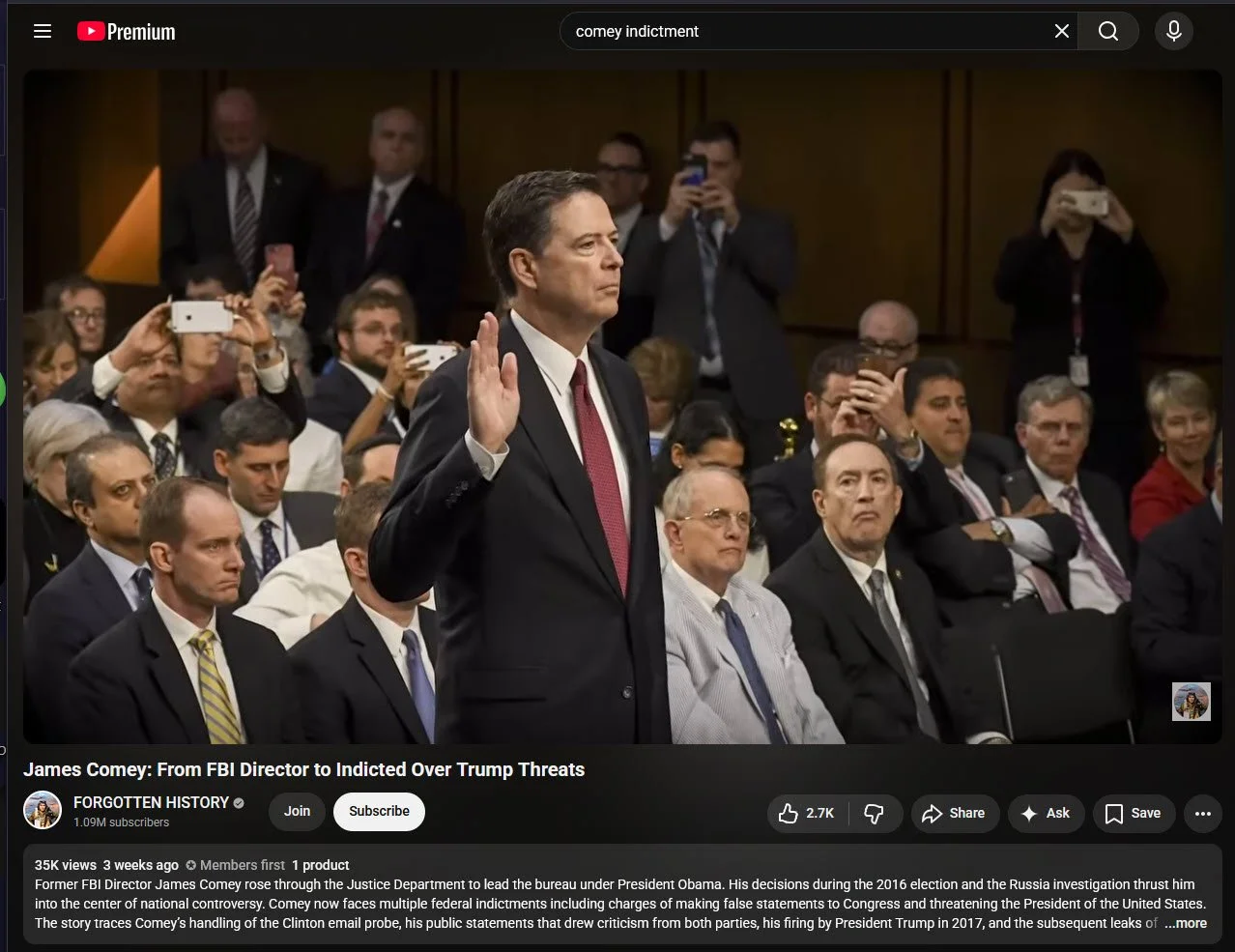
Peter Strzok & Lisa Page Text Messages (May 19, 2017)
"No Big There There": Text exchanges between lead Crossfire Hurricane agent Peter Strzok and FBI attorney Lisa Page show Strzok expressing doubt about the probe, stating in a message: "I hesitate in part because my gut sense [and] concern that there's no big there there" [23:41].
Motivation: Despite acknowledging the lack of underlying evidence, Strzok and Page discussed joining the Special Counsel team, referencing the historical significance of a case that could lead to impeachment [17:37].
Special Agent William J. Barnett Interview Transcript
Lack of Predication: FBI Special Agent William Barnett, who was assigned to the Flynn ("Razor") and Manafort investigations, stated that by early 2017, the FBI had largely ruled out collusion between the Trump campaign and Russia [25:31].
"Get Trump" Culture: Barnett described a "get Trump" attitude among Special Counsel Robert Mueller’s legal team, noting that attorneys (such as Andrew Weissmann and Andrew Goldstein) ran the investigation, while career FBI agents were treated as "speed bumps" [41:11].
Interrogations & Theories: He detailed instances where Special Counsel prosecutors pushed back on agent assessments, assuming witnesses like KT McFarland and Michael Flynn were lying or covering up collusion despite a lack of supporting evidence [41:59].
"Collusion Clue": Barnett revealed that investigators privately joked about the speculative nature of the probe by calling it a game of "Collusion Clue," where any person, action, or venue could be arbitrarily paired together to assert collusion [48:36].
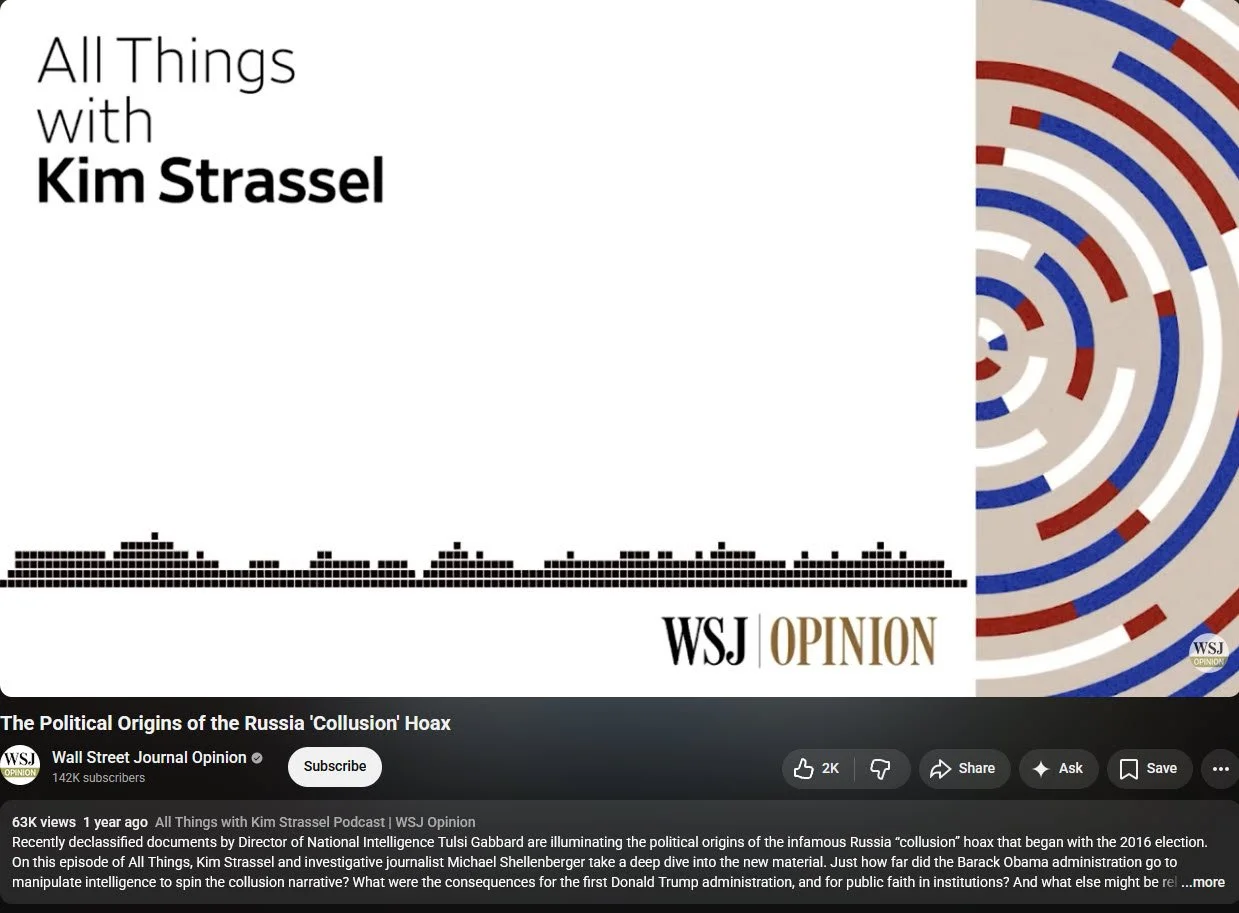
Declassified CIA Notes & Steele Dossier Evaluation
Brennan Briefing Notes (2016): Declassified handwritten notes from former CIA Director John Brennan indicate US intelligence had intercepted a plan approved by Hillary Clinton in July 2016 to vilify Donald Trump by tying him to Russian election interference to draw focus away from her email server issue [50:32].
Executive Awareness: Brennan briefed President Barack Obama, Vice President Joe Biden, and FBI Director James Comey on this intelligence in August 2016 [52:18].
FBI Dossier Review (Early 2017): Internal FBI spreadsheets reviewing Christopher Steele’s dossier concluded that its claims were either provably false, uncorroborated, or based on hearsay from primary subsources like Igor Danchenko [52:43].
Obstacles to Accountability
To successfully indict and convict high-ranking officials from the Democratic administration or Intelligence Community (IC)—such as those involved in the 2016–2017 national security probes—the Department of Justice (DOJ) faces specific legal, statutory, and evidentiary hurdles.
Political allegations or proof of administrative double standards are not sufficient to secure a federal conviction in court. The DOJ would require several concrete legal conditions:
Re-establishing the Statute of Limitations Window
The vast majority of potential federal offenses—including false statements (18 U.S.C. § 1001), general conspiracy to defraud the United States (18 U.S.C. § 371), and civil rights violations under color of law (18 U.S.C. § 242)—are subject to a five-year statute of limitations (18 U.S.C. § 3282).
Because the actions surrounding Crossfire Hurricane, "Oxford," and early FISA applications took place between 2016 and 2017, the statutory window to charge those specific acts expired between 2021 and 2022.
To bring new charges, the DOJ would need evidence of an ongoing overt act in furtherance of a criminal conspiracy that extends into the active 5-year window, or evidence of specific post-2021 offenses (such as lying under oath or committing perjury in recent congressional testimony).
Proving Specific Intent (Mens Rea), Not Just "Confirmation Bias"
To secure an indictment and withstand trial, prosecutors must prove willful criminal intent beyond a reasonable doubt.
As Special Counsel John Durham highlighted in his 2023 final report, while senior FBI and IC leadership exhibited a "serious lack of analytical rigor" and severe confirmation bias, poor judgment and political bias do not constitute federal crimes on their own. The DOJ would need:
Documentary or Direct Evidence of Bad Faith: Internal communications explicitly stating that officials knew allegations (like the Steele Dossier material) were fabricated or uncorroborated, yet intentionally submitted them as verified facts to courts (such as the FISA court).
Proof of Fraud Against the Court: Evidence that officials deliberate omitted exculpatory evidence—not through administrative oversight or poor procedure, but with the specific goal of deceiving federal judges.
Clear Separation Between Executive Discretion and Criminal Conduct
Intelligence Community leaders are granted wide latitude under Executive Order 12333 and statutory guidelines to evaluate intelligence, open counterintelligence assessments, and brief executive leadership.
Courts routinely uphold that executive officials operating within their statutory oversight roles cannot be prosecuted for pursuing theories that turn out to be false.
To overcome qualified immunity and executive protections, the DOJ would need proof that officials crossed from permissible counterintelligence discretion into active illegal acts—such as unauthorized leaks of classified information (18 U.S.C. § 798) or fabricating evidence.
Overcoming CIPA and Declassification Obstacles
If prosecutors attempt to prove a criminal conspiracy within the Intelligence Community, the trial inevitably hinges on sensitive operational documents, intelligence sources, and methods.
Under the Classified Information Procedures Act (CIPA), defense attorneys have a constitutional right to review the classified evidence used against their clients.
The DOJ would need full cooperation from the DNI and intelligence agencies to declassify operational files. If agencies refuse to declassify key records to protect sources and methods, the DOJ is often forced to drop the charges rather than expose sensitive intelligence in open court.
Summary
To move beyond public criticism or congressional reports and bring actual federal indictments, the DOJ requires unexpired statutory timelines, written or recorded proof of explicit criminal intent (rather than institutional bias), and unclassified, admissible physical evidence that can prove a crime to an impartial jury beyond a reasonable doubt.