Segment #1097
Yes. Texas can pass a law that violates the U.S. Constitution, but that does not make the law constitutional or ultimately enforceable. Legislatures are not required to obtain judicial approval before passing legislation. Consequently, an unconstitutional law can remain on the books until someone successfully challenges it in court.
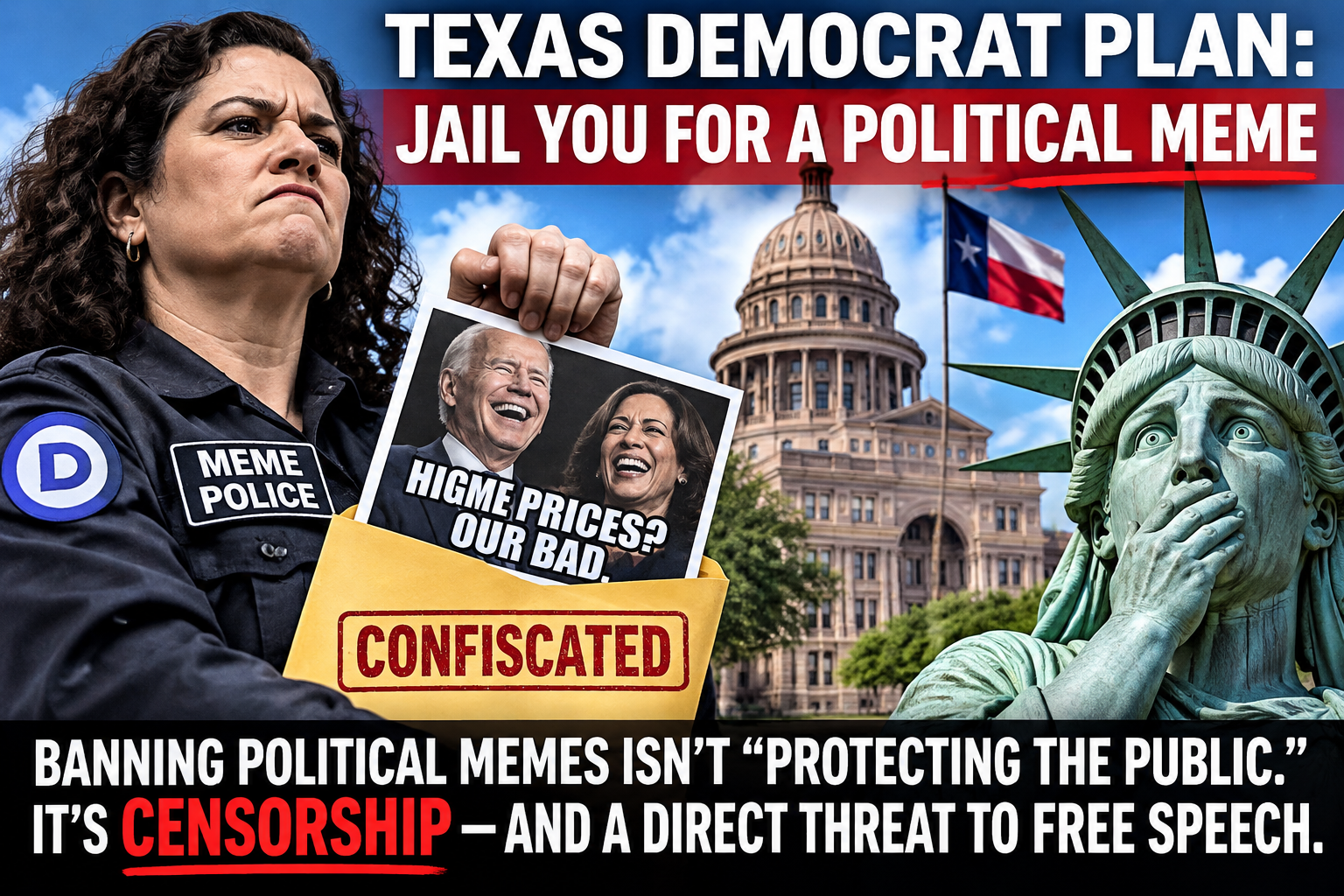
The proposed Texas legislation criminalizing certain altered political images, videos and recordings raises serious First Amendment questions, particularly regarding political satire, parody and memes.
The constitutional protections
Texas must comply with three fundamental constitutional provisions:
First Amendment: Protects freedom of speech, political expression and freedom of the press.
Fourteenth Amendment: Makes First Amendment protections applicable to state governments.
Supremacy Clause (Article VI): Establishes that the U.S. Constitution takes precedence over conflicting state laws.
Additionally, Article I, Section 8 of the Texas Constitution independently protects freedom of speech and the press.
Political expression is among the most strongly protected forms of speech under American constitutional law.
What the proposed Texas law actually does
House Bill 1245, filed by Representative Nicole Collier on November 18, 2026, would require disclosures on certain political advertising containing altered media.
Failure to comply could constitute a Class A misdemeanor, punishable under Texas law by:
Up to one year in jail.
A fine of up to $4,000.
Both imprisonment and a fine.
The legislation is not an outright prohibition on political memes. Rather, it would criminalize certain publications that fail to carry the required government-prescribed disclosure. That distinction is important but does not eliminate the constitutional concerns.
Texas Scorecard+1
Relevant Supreme Court precedents
New York Times Co. v. Sullivan (1964) - Established strong protections for criticism of public officials.
Hustler Magazine v. Falwell (1988) - Protected offensive political and public-figure parody that could not reasonably be interpreted as factual.
McIntyre v. Ohio Elections Commission (1995) - Protected anonymous political expression against certain mandatory disclosure requirements.
United States v. Alvarez (2012) - Established that false statements are not automatically excluded from First Amendment protection.
Susan B. Anthony List v. Driehaus (2014) -Recognized that threatened enforcement of a political speech law can provide standing to challenge it before prosecution.
The Hustler decision is particularly relevant because political satire frequently depicts conduct that never occurred. That is often the entire point of the satire.
California has already lost a similar constitutional case
The most directly relevant case is Kohls v. Bonta (2025).
California passed AB 2839 regulating manipulated political media, including AI-generated political parody.
On August 29, 2025, federal Judge John A. Mendez granted summary judgment against California and permanently prohibited enforcement against the named plaintiffs.
The judge specifically stated: Just as the government may not dictate the canon of comedy, California cannot pre-emptively sterilize political content.
Justia Dockets & Filings+1
California's case subsequently entered the appellate process. The district court ruling is persuasive authority rather than binding precedent in Texas.
Can legislators be held personally accountable?
Generally, legislators enjoy legislative immunity for introducing, debating and voting on legislation, even if it is subsequently declared unconstitutional.
This creates an unfortunate imbalance: citizens may have to incur substantial legal expenses to defend constitutional rights against legislation, while the legislators responsible generally face no personal financial liability.
A citizen facing a credible threat of prosecution could seek a federal injunction before being prosecuted.
My constitutional assessment
Texas has a legitimate interest in preventing deliberately deceptive election advertising. However, there is a considerable difference between maliciously impersonating a candidate and creating a political cartoon or humorous meme that no reasonable person would believe depicts reality.
Mandatory disclosures in political advertising are not inherently unconstitutional. But extending criminal penalties to recognizable political parody presents serious problems involving compelled speech, overbreadth and the chilling of legitimate political expression.
I would consider HB 1245, as currently drafted, highly vulnerable to a First Amendment challenge, particularly as applied to obvious political satire. That is a legal assessment, not a definitive judicial ruling.
The issue should transcend party affiliation. A Republican introduced the previous version in 2025, and a Democrat has introduced the current version.
The fundamental constitutional question is whether elected officials should have the power to threaten citizens with imprisonment for publishing political satire without a government-prescribed disclaimer.
Read the legislation yourself:
As of November 24, 2026, HB 1245 is proposed legislation, not law. Its proposed effective date is September 1, 2027.
The Texas proposal to penalize altered political images, videos and memes could face a substantial First Amendment constitutional challenge if enacted.
The critical distinction is between deliberately deceptive political advertising and constitutionally protected political satire, parody and criticism. A law that fails to adequately distinguish between them would be particularly vulnerable in federal court.
What the proposed law actually does
House Bill 1245, filed November 18, 2026, by Democratic Representative Nicole Collier of Fort Worth, would:
Require disclaimers on certain altered political images, videos and audio recordings.
Extend beyond AI-generated deepfakes to conventional image manipulation.
Apply to candidates, officeholders, political committees, individuals spending more than $100 on covered political advertising, and certain paid distributors.
Make violations a Class A misdemeanor, punishable by up to one year in jail and a $4,000 fine.
Take effect September 1, 2027, if enacted.
Bill Text+1
It is not a blanket prohibition on ordinary citizens posting political memes.
What happens next?
January 2027
Legislative consideration and committee hearings
Legislative debate
Possible amendments explicitly protecting satire and parody
House and Senate
Both chambers must approve the legislation
Governor
Signature, veto or passage into law without signature
Federal court
Potential First Amendment challenge and injunction
Appeals
Potential review by the Fifth Circuit and ultimately the Supreme Court
A similar bill introduced by Republican Dade Phelan passed the Texas House 102–40 in 2025 but failed to become law.
The Texas Tribune+1
The constitutional problem
Three important Supreme Court precedents could become relevant:
Hustler Magazine v. Falwell (1988): Strong constitutional protection for parody involving public figures.
United States v. Alvarez (2012): False statements are not automatically excluded from First Amendment protection.
McIntyre v. Ohio Elections Commission (1995): Constitutional protection for certain anonymous political communications.
However, courts have also upheld some political advertising disclosure requirements. Consequently, the entire bill would not necessarily be struck down.
The proposed legislation's greatest vulnerability is that it contains no explicit exemption for satire or parody and does not require an intent to deceive, even though it requires an intent to influence an election.
My assessment of the likely outcome
The legislation could be substantially narrowed during the legislative process. If enacted unchanged, it would present significant grounds for a constitutional challenge, particularly where enforcement targets obvious political satire.
A federal judge could temporarily block enforcement before the litigation is resolved. That is a possible outcome, not a certainty.
The fundamental question is whether Texas can threaten someone with imprisonment for publishing recognizable political satire without a government-prescribed disclaimer.
Political speech receives exceptionally strong constitutional protection, and Texas cannot override that protection simply by passing legislation.
Primary source: Read the actual text of Texas HB 1245.
As of November 24, 2026, the proposal is only a filed bill, not law.