
Segment #1085
Virtual reality (VR) has considerable potential beyond entertainment. In fact, its most valuable long-term applications may be in medicine, education, industrial training, engineering, and rehabilitation.
The fundamental advantage of VR is that it allows people to experience and practice situations that would otherwise be dangerous, expensive, impractical, or impossible to recreate.
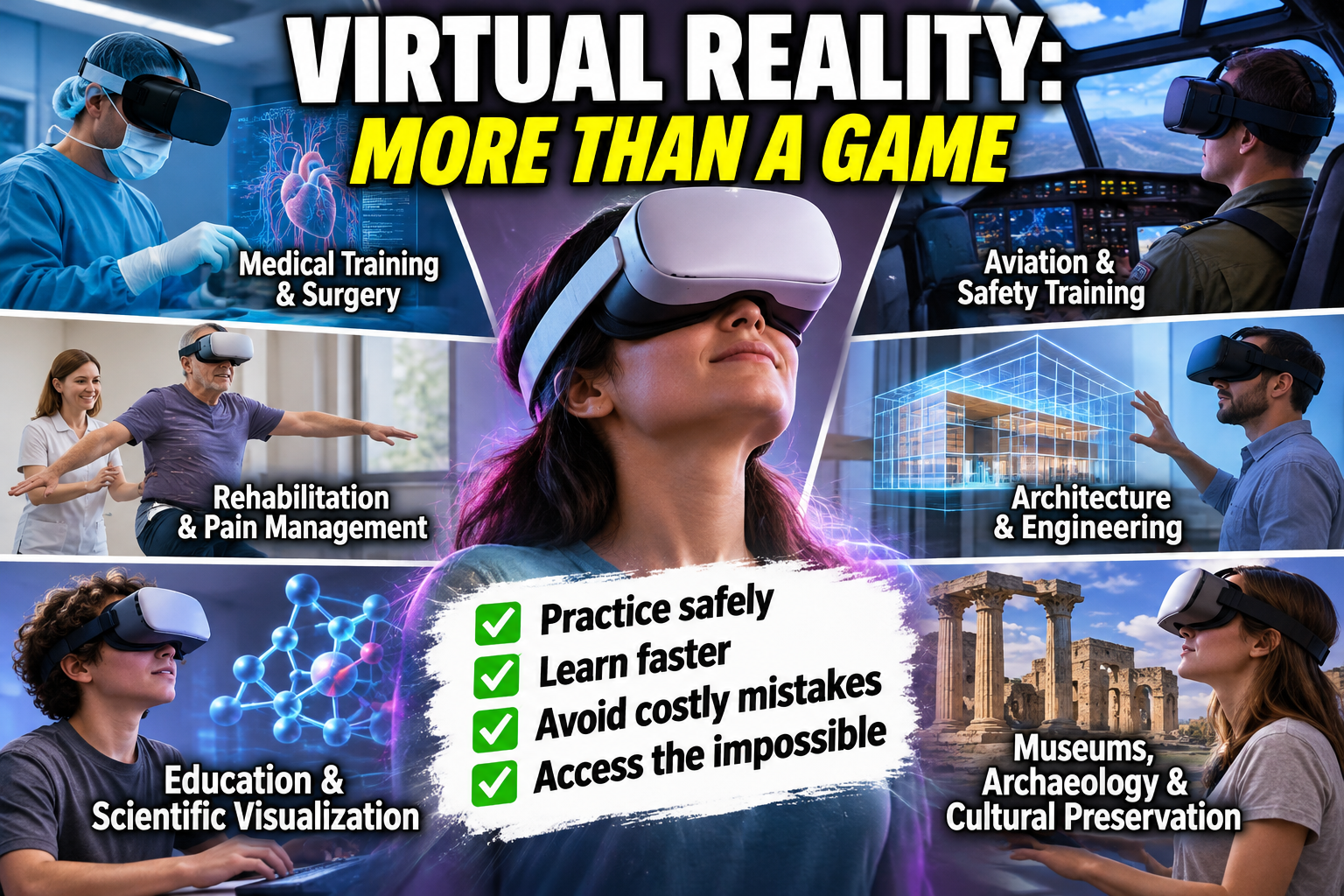
Seven areas where VR has real merit
Revolutionizing Medical Education: The Impact of Virtual ...
1. Medical training and surgery
Surgeons can rehearse complex procedures, practice anatomy, and develop technical skills without putting patients at risk. VR is particularly promising for training where repetition matters.
2. Physical rehabilitation and pain management
VR can support balance training, stroke rehabilitation, movement exercises, and certain pain-management programs. Some applications have clinical evidence, although benefits vary substantially by condition.
How Virtual Reality Accelerates Onboarding for Complex Industrial Roles | Aura Interact
3. Industrial and military training
Pilots, technicians, firefighters, and military personnel can practice emergencies and complex operations without risking lives or expensive equipment.
BIM and VDC Services | Arth Tech Global
4. Architecture and engineering
Engineers can examine full-scale virtual prototypes before manufacturing them. Architects and clients can walk through buildings before construction begins, potentially identifying costly design mistakes.
Roundup: LKCMedicine launching more AI, digital health courses and more briefs | Healthcare IT News
5. Education and scientific visualization
Students can explore molecular structures, ancient civilizations, geological formations, and environments that are otherwise inaccessible. VR is especially useful when spatial understanding is important.
6. Museums, archaeology and cultural preservation
VR can reconstruct archaeological sites, recreate historical settings, and provide immersive access to fragile cultural objects. Museums can present artifacts in their original architectural and cultural settings without physically handling them.
Confronting Your Fears in Virtual Reality Therapy - WSJ
7. Psychological treatment
VR-assisted exposure therapy can help treat certain phobias and anxiety disorders, including fear of heights and flying. PTSD applications are also being studied, with more variable evidence.
Which applications offer the greatest practical value?
Surgical training - High - Equipment and validation costs
Industrial and military simulation - High - Specialized software costs
Physical rehabilitation - Promising - Inconsistent clinical results
Architecture and engineering - High - Integration into existing workflows
Education - Moderate to high - Not always better than conventional teaching
Museums and archaeology - Moderate - Production costs and limited audiences
Mental health treatment - High for selected conditions - Requires appropriate clinical supervision
Why hasn't VR become universal?
Despite decades of investment, VR faces significant obstacles:
Physical discomfort: Headsets can be heavy, tiring, and cause motion sickness.
Cost: Creating high-quality simulations is expensive.
Limited necessity: Many tasks can be accomplished more efficiently with an ordinary computer.
Adoption: Organizations need measurable improvements in productivity, safety, or treatment outcomes to justify investment.
The influence of artificial intelligence
AI could substantially improve VR's usefulness. Instead of expensive, manually programmed simulations, AI could help generate interactive environments, realistic training scenarios, and virtual instructors that respond to users.
That could make specialized VR applications much more economical.
My assessment
VR's strongest commercial justification is not that it makes an experience more entertaining, but that it can make learning safer, training faster, or mistakes less expensive.
For example, a surgeon practicing a complicated operation, a pilot rehearsing an emergency, or a patient recovering balance after a stroke has a concrete reason to use VR.
By comparison, persuading millions of people to wear headsets for ordinary meetings, shopping, or social interaction remains a much weaker proposition.
The distinction is important: VR can be a valuable specialized technology without ever becoming the next smartphone.
The question for Meta, Apple, Google, and other companies investing billions is whether these specialized applications can eventually support a sufficiently large and profitable market.