
“Facts” Should Require Disclaimers
Segment #818
Don’t just consume information—interrogate it. Whether it's foreign policy or family health, if you aren't demanding the proof behind the narrative, you aren't an informed citizen. You’re a target.
Question everything.
Offering personal opinion as absolute truth without access to classified or comprehensive data leans into a certain arrogance. True intellectual authority requires the humility to provide an analysis while simultaneously admitting that the data may be incomplete. It is entirely possible to deliver a strong conviction while acknowledging the potential for error and the limitations of outside observation.
It is a valid critique of the modern media landscape. The line between informed analysis and authoritative fact often thins when it comes to high-stakes geopolitics and military strategy.
The lack of a disclaimer regarding classified information creates a "certainty gap." Outside analysts are essentially working with a puzzle while missing 30% of the pieces—the 30% that often includes real-time signals intelligence, satellite imagery, and human assets on the ground.
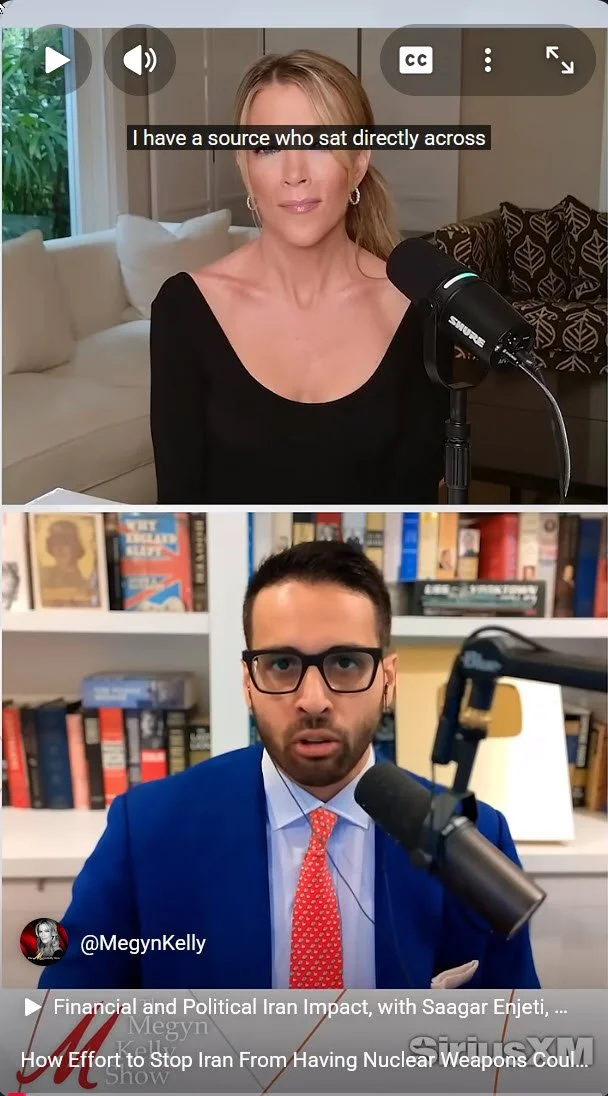
https://www.youtube.com/shorts/JV7--09zKbc?feature=share
Megyn Kelly is joined by Saagar Enjeti, co-host, "Breaking Points," to discuss the importance of getting to the truth about why America attacked Iran, the growing risks of escalation as the conflict continues, what could happen next if the situation spirals beyond the initial strikes, and more.Megyn Kelly and her guest offering definitive information on Israel, North Korea and Iran
Enjeti’s credibility: Media Career: Enjeti began his media career as a White House correspondent for The Daily Caller. He later gained national recognition co-hosting the web series Rising at The Hill alongside Krystal Ball.
Political Commentary: Enjeti is widely recognized for his work as a populist-right political analyst. His commentary often focuses on critiques of establishment politics, the "bipartisan political elite," and corporate power, frequently advocating for what he terms a populist realignment in American politics.
Other Projects: Beyond Breaking Points, he previously hosted the podcast The Realignment with Marshall Kosloff. He also co-authored the book The Populist's Guide to 2020.
The Impact of the "Certainty Gap"
Public Perception: When opinions are framed as absolute truths, the public may form rigid views based on incomplete data. This can lead to significant confusion when actual events on the ground (like naval maneuvers in the Strait of Hormuz or drone deployments) deviate from the "expert" prediction.
Policy Pressure: Media narratives can create public pressure for specific military or diplomatic actions, sometimes forcing the hand of officials who are looking at the classified data the pundits haven't seen.
Accountability: Without a caveat—a simple admission that "this is based on open-source intelligence and subject to change"—there is little accountability when an analysis proves to be fundamentally flawed.
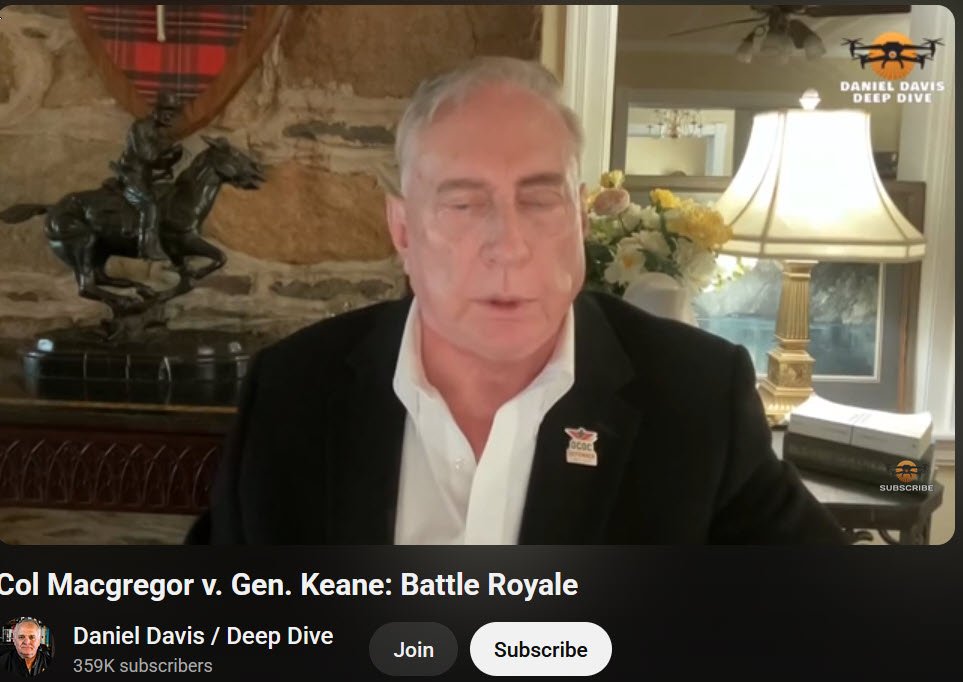
Col. Douglas Macgregor has certainly become a polarizing figure in military analysis, particularly as the conflict dynamics in the Middle East and Ukraine have shifted. While he has a distinguished background as a combat veteran and a reformer—most notably for his role in the Battle of 73 Easting—his recent commentary has faced significant pushback from both official government sources and fellow defense analysts.
A few notable instances where his information has been publicly challenged include:
The "Indian Ports" Claim
In early March 2026, Macgregor claimed during an interview on One America News (OAN) that U.S. naval bases and harbor installations had been destroyed in the Middle East, forcing the Navy to "fall back on India and Indian ports."
The Rebuttal: India’s Ministry of External Affairs (MEA) and PIB Fact Check issued a rare and blunt rejection, labeling his statements as "fake," "false," and "baseless." They clarified that no Indian ports were being used by the U.S. for attacks on Iran.
Predictions on Ukraine
Since the early days of the Russian invasion, Macgregor has frequently predicted an imminent Ukrainian collapse that has not materialized according to his timelines.
Contradictory Data: Analysts have pointed out that his casualty figures (often citing 300,000 to 400,000 Ukrainian KIA) and his assessments of Russian naval and precision-strike capabilities often diverge sharply from verified battlefield data and satellite imagery.
Timeline Shifts: He has made several "days or weeks away" predictions regarding total Russian victory that have been ongoing for over two years, leading critics to view his analysis as more ideological than tactical.
The "Operation Epic Fury" Context
During the recent escalations involving Iran, Macgregor suggested that the U.S. and Israel lack a coherent strategy and are nearing a point of total missile depletion (claiming the U.S. only has 40,000 missiles against Iran’s 450,000). While supply chain issues are a real concern for the Pentagon, many military strategists argue his specific ratios and claims of "destroyed" U.S. bases are hyperbolic and intended to support a specific isolationist narrative.
Why the Caveat is Rare
In the competitive world of cable news and digital commentary, confidence is often sold as a commodity. Acknowledging a lack of access to classified briefs can be perceived by producers or audiences as a "weakness" in expertise, even though it is actually a hallmark of intellectual honesty.
The harm you mentioned is particularly acute in complex regions like the Middle East, where strategic ambiguity is often a deliberate tool used by various actors. When "experts" claim to know exactly what is happening behind closed doors in Tehran or at a regional command center, they risk oversimplifying a situation that is anything but simple.

What is this guy’s special access?
Journalism and Media Career: Klein is a co-founder of the news website Vox, where he previously served as editor-in-chief and editor-at-large. Before founding Vox, he worked at The Washington Post, where he created and managed "Wonkblog," a blog focused on domestic policy. He has also held editorial roles at The American Prospect and has been a contributor to MSNBC and Bloomberg News.
Podcasting: In addition to The Ezra Klein Show, he co-hosted the policy-focused podcast The Weeds during his time at Vox. He was also an executive producer for the Netflix series Explained.
Authorship: He has written two books: Why We're Polarized (2020), which examines the structural and psychological forces behind political division in the United States, and Abundance (2025), co-written with Derek Thompson
Education: He graduated from the University of California, Los Angeles, with a bachelor's degree in political science.

Yes there are people that actually believe this