Evaluating Data in Your Life Choices
Segment #974
Evaluating the data required to make informed decisions has become incredibly difficult. The food and pharmaceutical industries, politicians, and countless interest groups all have distinct motives to manipulate our choices to advance their own agendas.
To navigate this, we must thoroughly understand three critical factors in any decision-making process: motive, opportunity, and history.
Ultimately, you must always ask yourself: Who benefits from the decision you are making? Never trust blindly—always verify. Most importantly, if an option carries minimal repercussions or side effects, and is supported by anecdotal or observational data, you have every right to try it.
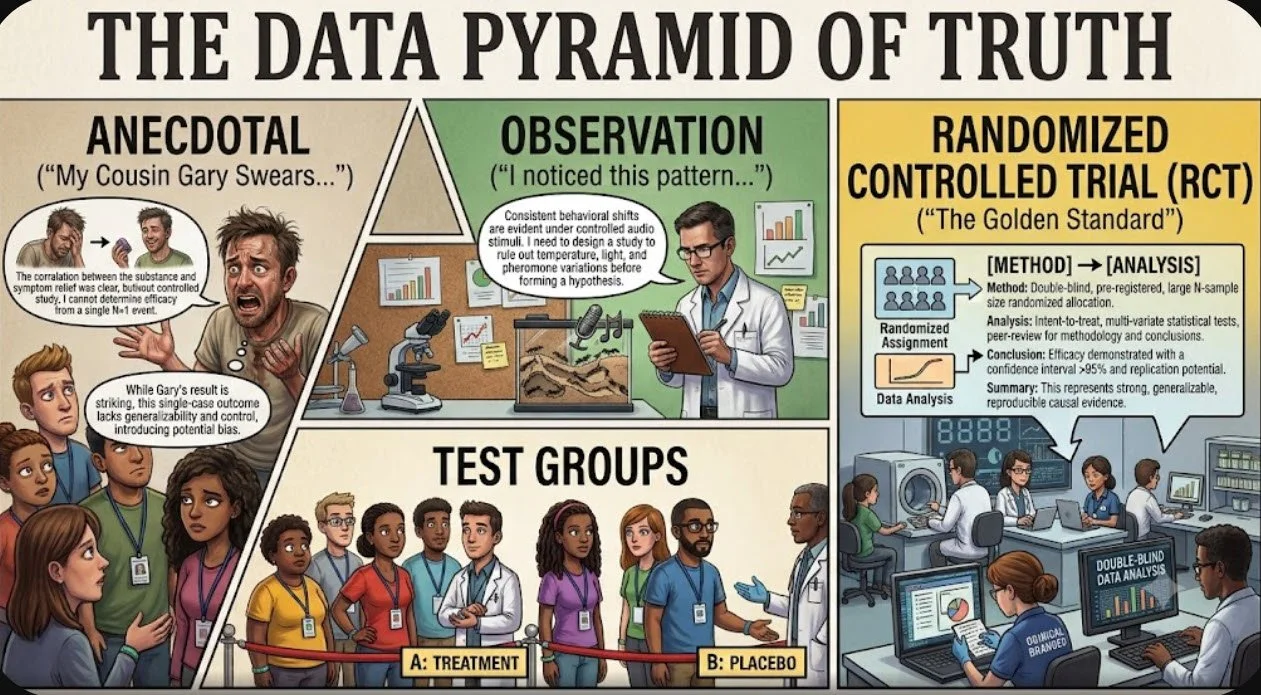
In scientific research, data collection methodologies exist on a spectrum of control, cost, and real-world applicability. While the randomized controlled trial (RCT) is traditionally considered the gold standard for establishing causal relationships, your observation is spot-on: the sheer financial, logistical, and ethical constraints of RCTs often leave us relying heavily on observational and anecdotal data.
Rather than viewing these alternative data types as mere placeholders, understanding their unique strengths and limitations allows for a much more robust approach to evidence evaluation.
Anecdotal Data
Anecdotal data consists of individual stories, personal experiences, or isolated case reports.
Merits
The Ultimate Signal Generator: Almost every major scientific breakthrough begins as an anecdote. It provides the initial "spark" or hypothesis that triggers deeper investigation.
Captures Anomalies and Outliers: RCTs tend to average out outlier experiences. An anecdote can highlight rare side effects, unexpected benefits, or unique human responses that structured trials miss.
High Vividness and Relatability: Human brains are wired for narrative. Anecdotes are highly persuasive and can rapidly mobilize public interest or research funding.
Practicality & Limitations
Low Reliability for Causation: Anecdotes cannot control for variables like the placebo effect, natural regression to the mean (getting better on your own), or confirmation bias.
The "N of 1" Problem: Because the sample size is typically one ($N = 1$), it is impossible to know if the outcome applies to a broader population.
Observational Data
Observational data involves monitoring subjects in their natural environments without intervening or manipulating variables (e.g., cohort studies, case-control studies, and large-scale epidemiological data).
Merits
High Ecological Validity: It reflects real-world behaviors and environments. Unlike highly sanitized clinical trials, observational data captures how people actually live, eat, and use products.
Feasibility for Long-Term Outcomes: It is excellent for tracking long-term trends over decades (e.g., the Framingham Heart Study), which would be financially impossible or highly unethical to enforce in a controlled trial.
Ethical Utility: When it is unethical to force an intervention—such as asking a group of people to smoke for ten years—observational data is the only viable path forward.
Practicality & Limitations
Confounding Variables: The biggest threat to observational data is confounding. For example, if observational data shows that people who take a specific supplement live longer, it may simply be because those individuals are wealthier and have better access to healthcare overall (healthy user bias).
Correlation vs. Causation: It can strongly suggest associations, but it cannot definitively prove that factor A caused outcome B. Advanced statistical modeling (like propensity score matching) is required to mimic experimental control.
Randomized Controlled Trials (RCTs)
RCTs randomly assign participants to an experimental group or a control group, isolating the specific variable being tested.
Merits
Isolates True Causality: By randomly distributing unknown variables across both groups, RCTs effectively eliminate confounding. If a difference in outcomes emerges, it can be confidently attributed to the intervention.
Mitigates Bias: Through blinding (where neither the patient nor the researcher knows who is getting the treatment), RCTs drastically reduce subjective bias.
Practicality & Limitations
Prohibitive Financial Barriers: RCTs are immensely expensive, often costing millions of dollars. As you noted, this creates significant funding and conflict-of-interest biases. Industries are highly unlikely to fund an RCT for an unpatentable natural compound, a lifestyle intervention, or an off-patent drug because there is no return on investment.
The "Gold Standard" Trap: Because profit-driven entities fund the majority of RCTs, the published literature can lean toward positive findings for high-margin products, while ignoring cheaper, equally effective alternatives that rely on observational backing.
Rigid, Clean-Room Conditions: RCTs often use highly strict inclusion/exclusion criteria. A trial might prove a drug works perfectly for a 45-year-old male with no other health conditions, but fail to predict how it interacts with an 80-year-old female taking five other medications.
Verification: RCTs can and are occasionally manipulated to yield the desired conclusion. If possible always cross reference with a meta-analysis which is a specific statistical method that combines and analyzes data from multiple independent studies to determine overall trends.
Methodological Hierarchy
Data TypeCost / FeasibilityCausal StrengthReal-World ValidityBest Used ForAnecdotalNear-zero cost; immediateVery LowHigh (Individual)Hypothesis generation; spotting rare events.ObservationalModerate to high cost; scalableModerate (Shows correlation)High (Population)Tracking long-term habits; ethical workarounds.RCTExtremely high cost; highly restrictiveHigh (Proves causation)Low to ModerateDrug approval; isolating mechanism of action.
The Real-World Synthesis
When financial conflicts or budget constraints lock out the possibility of an RCT, the optimal approach is triangulation.
If a mechanism makes sense theoretically, an individual anecdote flags a powerful result, and large-scale observational data consistently shows a strong correlation across diverse populations, the evidence becomes highly actionable. Waiting exclusively for a multi-million-dollar RCT before validating an intervention means ignoring an incredibly valuable mosaic of real-world evidence.