
SCOTUS Rules on Descrimination
Segment #875
In the last few years, the Supreme Court of the United States (SCOTUS) has issued several landmark rulings that have significantly reshaped discrimination law, particularly regarding employment, education, and voting rights.
The general trend has been a shift toward a "colorblind" interpretation of the Constitution in public sectors while simultaneously lowering the bar for employees to bring discrimination lawsuits in the private sector.
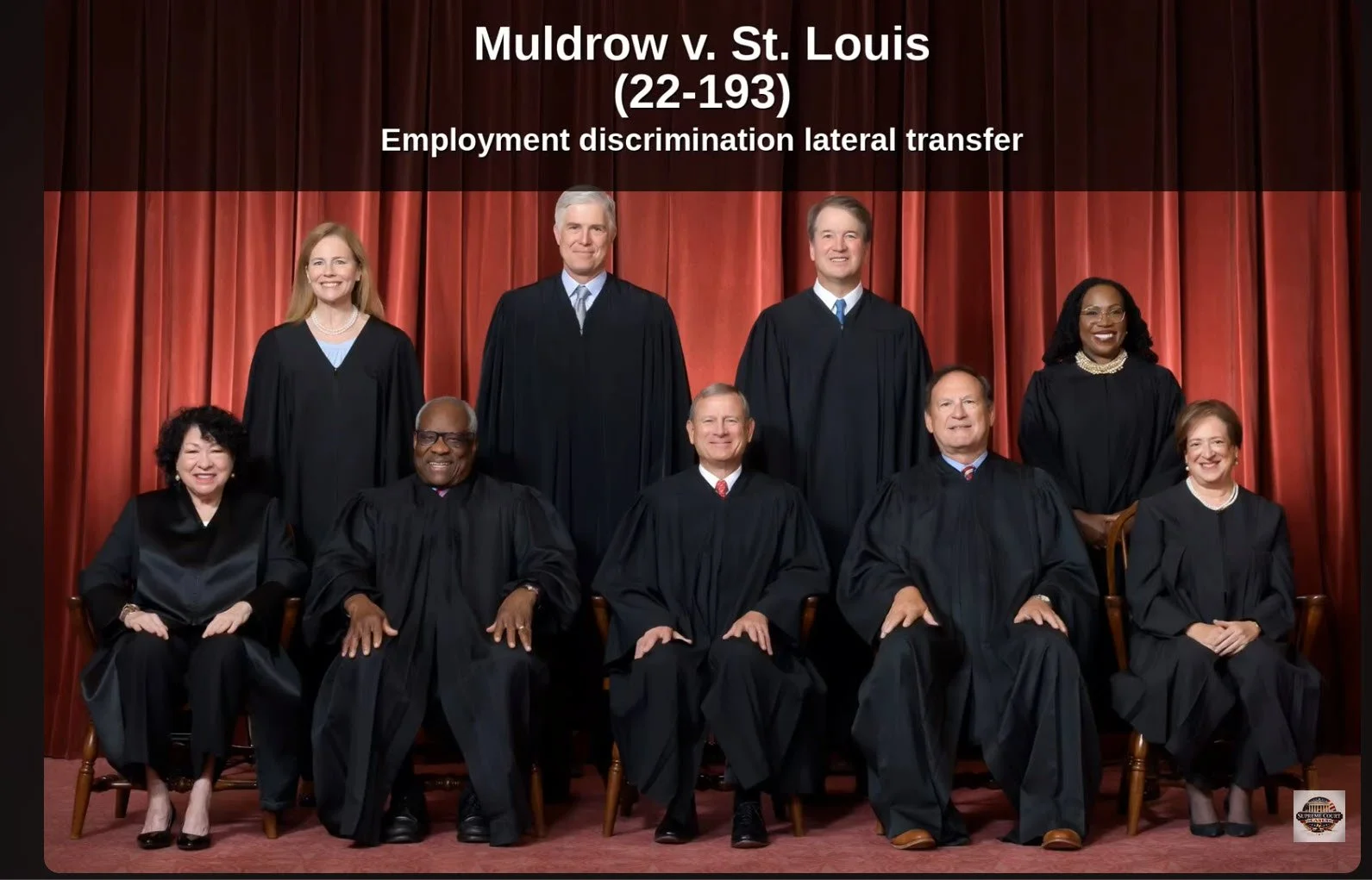
Jatonya Muldrow was a decorated police officer with the St. Louis Police Department. After being promoted to a specialized police unit, the department reassigned her to a different division in what it claimed was a routine administrative decision. Muldrow believed the reassignment was motivated by her gender and was part of a pattern of discrimination against female officers in the department. Muldrow filed a lawsuit under Title VII of the Civil Rights Act of 1964, arguing that the lateral transfer was a discriminatory employment action that violated federal employment discrimination law. The question at the heart of the case was whether a lateral transfer with no change in pay, benefits, or title could constitute an adverse employment action sufficient to support a discrimination claim. The Supreme Court was asked to decide whether an employer's involuntary lateral transfer of an employee to a different job location or position, without any change in salary, benefits, or job title, constitutes an adverse employment action under Title VII that allows the employee to bring a discrimination claim.
Employment Discrimination: Muldrow v. City of St. Louis (2024)
This is perhaps the most significant recent change for everyday workplace law.
The Ruling: The Court unanimously held that an employee does not need to show "significant" or "material" harm (like a pay cut or demotion) to sue for discrimination under Title VII.
The Impact: Now, an employee only needs to show "some harm" regarding the terms or conditions of their employment. For example, being forced to transfer to a less prestigious desk or a shift that makes life difficult is now enough to trigger a lawsuit, even if your salary stays exactly the same.
Affirmative Action: Students for Fair Admissions v. Harvard (2023)
he Supreme Court heard arguments in Students for Fair Admissions v. University of North Carolina and Students for Fair Admissions v. President and Fellows of Harvard — two cases challenging the legality of universities considering race as a factor in their admissions programs.
This ruling ended decades of precedent regarding race-conscious admissions in higher education.
The Ruling: The Court ruled that Harvard’s and UNC’s admissions programs violated the Equal Protection Clause because they used race as a negative factor and relied on racial stereotyping.
The Impact: While it technically only applies to college admissions, it has "unleashed" a wave of challenges against Corporate DEI (Diversity, Equity, and Inclusion) programs. Many legal experts believe this signaling will lead the Court to eventually restrict race-conscious hiring and scholarship programs in the private sector as well.
LGBTQ+ Rights & Medical Care: United States v. Skrmetti (2025)
Equal Protection. Title VII. Experts discuss the Supreme Court's application of rational basis review to restrictions on transgender medical care for minors in United States v. Skrmetti, and in Ames v. Ohio, the application of the same evidentiary standard to all protected classes under Title VII. Participants. Erwin Chemerinsky, Dean and Jesse H. Choper Distinguished Professor of Law, University of California, Berkeley, School of Law; Tara Grove, Vinson and Elkins Chair in Law, University of Texas, Austin, School of Law; and Jim Chance, Senior Education Attorney, Judicial and Legal Education, Federal Judicial Center. The nation's top legal scholars discuss what federal judges need to know about the U.S. Supreme Court's most impactful decisions.
A major ruling regarding transgender rights and state-level protections.
The Ruling: The Court upheld a Tennessee law that banned certain medical treatments for transgender minors. The majority found that such bans do not violate the Equal Protection Clause because they do not "discriminate" against a protected class in a way that requires "heightened scrutiny."
The Impact: This clarifies that SCOTUS currently views gender-affirming care bans as policy choices for state legislatures rather than inherent violations of federal civil rights law.
Voting Rights & Redistricting: Louisiana v. Callais (2026)
https://www.youtube.com/shorts/qnNazcfogjc?feature=share
Overview: The Supreme Court struck down Louisiana's second majority-Black congressional district as an unconstitutional racial gerrymander, overhauled the 40-year-old Gingles framework for vote-dilution claims, and reinterpreted Section 2 to demand a strong inference of intentional discrimination. Question Presented: Whether Section 2 of the Voting Rights Act required Louisiana to create a second majority-minority congressional district, justifying race-based redistricting under strict scrutiny. Posture: Three-judge district court struck down SB8; direct appeal to Supreme Court affirmed 6-3. Holding: Because the Voting Rights Act of 1965, 52 U. S. C. §10301 et seq., did not require Louisiana to create an additional majority-minority district, no compelling interest justified the State’s use of race in creating SB8, and that map is an unconstitutional racial gerrymander. Result: Affirmed and Remanded. Voting Breakdown: 6-3. Justice Alito delivered the opinion of the Court, in which Chief Justice Roberts and Justices Thomas, Gorsuch, Kavanaugh, and Barrett joined. Justice Thomas filed a concurring opinion, in which Justice Gorsuch joined. Justice Kagan filed a dissenting opinion, in which Justices Sotomayor and Jackson joined.
This recent case addressed "reverse" discrimination in how voting maps are drawn.
The Ruling: The Court scrutinized a redistricting map that had been drawn specifically to create a second Black-majority district. The Court reiterated that the Constitution almost never permits a state to discriminate based on race, even if the goal is to increase minority representation, unless it meets "strict scrutiny."
The Impact: It sets a high bar for states trying to use race as a primary factor in drawing political boundaries, reinforcing the Court’s "colorblind" constitutional preference.
Religious Discrimination: Groff v. DeJoy (2023)
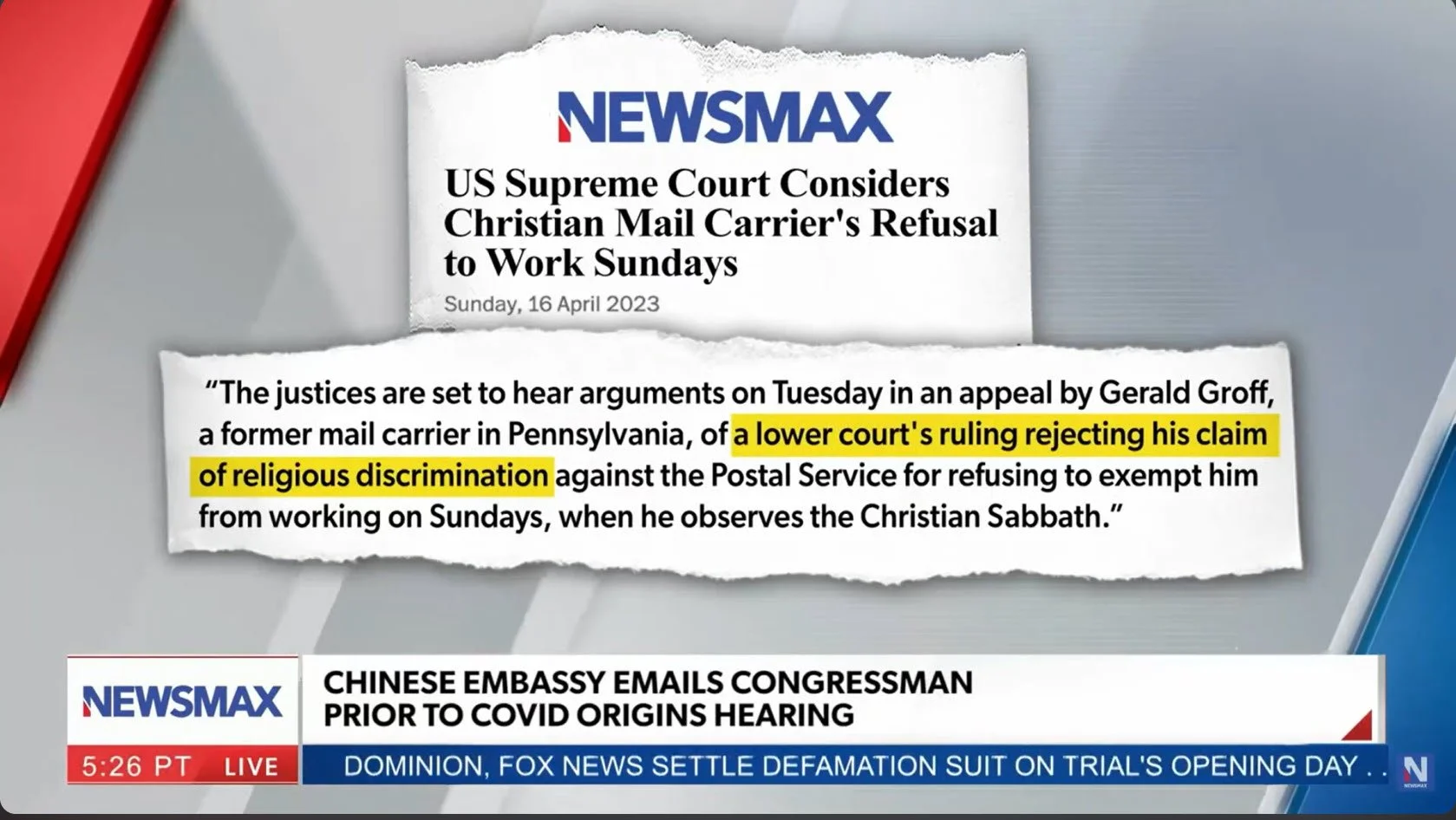
Tony Perkins joined Newsmax's Wake Up America to discuss Groff v. DeJoy, a case involving a former postal carrier who lost his job after the U.S. Postal Service refused to grant him a religious accommodation to observe the Christian Sabbath on Sunday.
The Ruling: The Court strengthened protections for employees seeking religious accommodations (like not working on the Sabbath).
The Impact: Employers can no longer deny a religious request just by showing a "de minimis" (minor) burden. They must now prove that the accommodation would result in substantial increased costs for the business.
SCOTUS Analysis
Recent Supreme Court (SCOTUS) terms have solidified a majority that prioritizes Originalism and Textualism in discrimination cases. This judicial philosophy focuses on the "original public meaning" of the Constitution at the time of its adoption and the plain text of statutes, rather than evolving social standards.
Here is an analysis of how this shift has manifested in key rulings between 2023 and 2026.
Affirmative Action & Colorblindness
The landmark 2023 decision in Students for Fair Admissions v. Harvard marked a definitive originalist turn regarding the 14th Amendment's Equal Protection Clause.
The Ruling: The Court held that race-based admissions programs were unconstitutional.
Originalist Logic: The majority argued that the 14th Amendment was intended to establish a "colorblind" Constitution. By focusing on the historical context of the post-Civil War era, they concluded that any racial classification—even for remedial or "benign" purposes—must meet strict scrutiny, which these programs failed to do.
Statutory Textualism in Employment
In employment discrimination, the Court has leaned into Textualism, which is the statutory cousin of Originalism.
Groff v. DeJoy (2023): In a unanimous decision, the Court clarified the standard for religious accommodations under Title VII. It discarded the "de minimis" (minimal) burden standard that had been used for decades, arguing it was not supported by the actual text of the statute. Employers must now show a "substantial" burden to deny religious requests.
Muldrow v. City of St. Louis (2024): The Court ruled that an employee does not need to show "significant" or "substantial" harm to sue for a discriminatory job transfer under Title VII. The text of the law simply forbids discrimination regarding "terms, conditions, or privileges of employment," and the Court refused to add extra-textual requirements.
The 14th Amendment & Gender Identity
As of early 2026, the Court has moved toward a narrow interpretation of the Equal Protection Clause regarding gender identity.
United States v. Skrmetti (2025): The Court upheld a Tennessee law banning certain medical treatments for transgender minors.
The Logic: The majority opinion (authored by Chief Justice Roberts) applied Rational Basis Review rather than "heightened scrutiny." From an originalist perspective, the Court found that because "gender identity" was not a historically recognized protected class under the 14th Amendment in 1868, the state only needed a "rational" policy reason for its law, rather than a "compelling" one.
4. Religious Exercise vs. Anti-Discrimination
Originalists often view the Free Exercise Clause of the First Amendment as a "preferred" or "first-tier" right.
Mahmoud v. Taylor (2025): The Court ruled in favor of parents seeking to opt their children out of LGBTQ-inclusive curriculum in public schools based on religious objections.
Originalist Impact: The ruling emphasized that the original understanding of religious liberty protects parents' rights to direct the religious upbringing of their children, even when it conflicts with a school's inclusive policy.