
Can the Dems Take Back The Senate in 2026
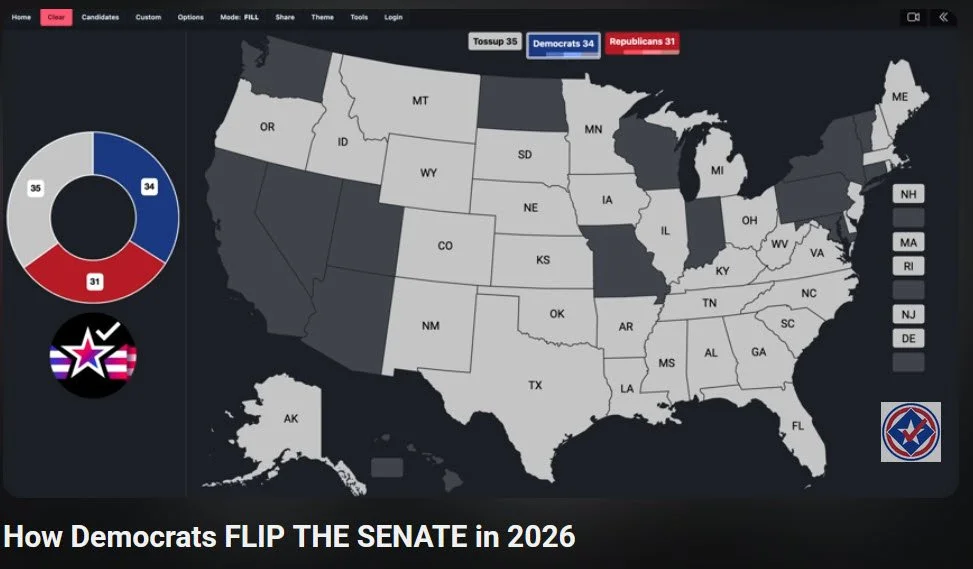
The 2026 Senate map is more favorable to Democrats than the 2024 cycle, but the path to a majority remains steep. Currently, Republicans hold a 53–47 majority (including two independents who caucus with Democrats). To retake control, Democrats need a net gain of four seats.
Here are the primary races Democrats have identified as their best opportunities to flip, along with the key defensive battles they must win to avoid losing more ground.
Top Offensive Targets (Pick-up Opportunities)
Democrats are focusing their resources on states where they have strong recruits or where Republican incumbents are perceived as vulnerable.
North Carolina (Open Seat):
This is widely considered the Democrats' best chance to flip a seat. Following the retirement of GOP Senator Thom Tillis, Democrats have recruited former Governor Roy Cooper, who has a proven track record of winning statewide in North Carolina. He is likely to face RNC Chair Michael Whatley. North Carolina (Projected Win Probability: 60-65% D): Former Governor Roy Cooper is currently the strongest Democratic recruit nationwide. His nearly 8-point lead in the March Carolina Journal poll is significant, especially given his 52% support among Independents. Michael Whatley’s path depends on the national environment tilting further toward the GOP by November. The Numbers: An April 2026 High Point University/YouGov poll has Roy Cooper (D) at 50% and Michael Whatley (R) at 42%. The Reality Check: Cooper’s 8-point lead is bolstered by his massive $13.8M first-quarter haul compared to Whatley’s $5M. However, North Carolina is a "purple" state that has trended GOP in the last three federal cycles. Cook Political Report shifted this to Lean Democrat in late April, but the race remains within the margin of error if Whatley consolidates the rural Trump base.
Maine (Susan Collins):
Senator Susan Collins is the only Republican up for re-election in a state that voted for Kamala Harris in 2024. While Collins has been a resilient incumbent, Democrats view her as their second-strongest offensive target, potentially recruiting Governor Janet Mills to challenge her. Maine (Projected Win Probability: 50-55% D): Senator Susan Collins faces a historically low favorability rating (38%). While she has survived tough races before, the entry of progressive Graham Platner—who currently leads her by 7 points in Emerson polling—has shifted this to a "must-watch" for a Democratic pickup. This race has become increasingly volatile due to a competitive Democratic primary. The Numbers: Graham Platner (D), an oyster farmer running as a progressive outsider, has surged. An April Emerson College poll shows him leading Susan Collins (R) 48% to 41%. Notably, Platner leads Governor Janet Mills by 33 points in the primary. The Reality Check: Collins’ favorability sits at a low 38%, but she has a career-long history of outperforming the top of the ticket. While current polls favor a flip, non-partisan forecasters still categorize this as a Toss-up, noting that Maine’s ranked-choice voting system adds a layer of unpredictability.
Texas (John Cornyn):
Democrats are looking to build on the momentum of previous close races. State Representative James Talarico has emerged as a key candidate. The party’s hopes here rely on whether the GOP primary becomes a "civil war" between Cornyn and the more right-wing Attorney General Ken Paxton. exas (Projected Win Probability: 45-50% D): Texas remains the "white whale" for Democrats. While Representative James Talarico has shown a slight lead in April polls, Texas Republicans historically close strong. The probability of a flip here hinges on whether Ken Paxton primary-challenges Cornyn, potentially bruising the GOP nominee before the general. The "white whale" narrative remains, but the polling is closer than in previous cycles. The Numbers: A Texas Tribune poll from late April shows James Talarico (D) leading John Cornyn (R) 45% to 42% and leading Ken Paxton (R) 46% to 41%. The Reality Check: While Talarico is currently leading in the polls, historical data in Texas shows a late-cycle swing toward Republicans. Most experts (Sabato’s Crystal Ball) still rate this as Lean Republican, citing the inherent 3-5 point GOP structural advantage in the state despite Cornyn's currently underwater favorability (-28 net).
Ohio (Special Election):
Democrats are targeting the seat currently held by Jon Husted (who was appointed to replace JD Vance). Former Senator Sherrod Brown is reportedly considering a comeback run, which would immediately turn this into a top-tier battleground. The Race: Appointed Senator Jon Husted (R) is the presumptive nominee. Former Senator Sherrod Brown (D) is attempting a comeback. The Numbers: Recent aggregates (270toWin, Decision Desk HQ) show Husted holding a steady 3-point lead. While Brown has a significant fundraising advantage ($24M to Husted’s $10M), the state's move toward the GOP in recent cycles makes this a tough climb for Democrats. This is the GOP's strongest defensive position among the states you mentioned. The Numbers: Jon Husted (R) maintains a steady lead in April aggregates, including a WOSU/BGSU poll showing him at +3.0% over Sherrod Brown (D). The Reality Check: Brown remains the Democrats' best hope due to his $24M war chest and high name recognition. However, Ohio has moved roughly 10 points to the right of the national average. Despite the statistical tie in some polls, forecasters rate this Lean Republican because the state's political gravity heavily favors the GOP in a special election cycle.
Critical Defensive Races
To retake the Senate, Democrats cannot afford any losses among their own incumbents.
Georgia (Jon Ossoff):
Senator Ossoff is considered the most vulnerable Democratic incumbent. He is defending a seat in a state that has trended Republican in recent national elections and will face a well-funded GOP challenger. The Race: Jon Ossoff (D) is defending his seat against a likely challenge from Representative Mike Collins (R), who currently leads the GOP primary field with 30%. The Numbers: Ossoff currently outpaces Collins 48% to 43%. However, his support is just under the critical 50% mark, and his lead narrows significantly among male voters and those over 50. Georgia remains a "pure" battleground where turnout will be the deciding factor.
Michigan (Open Seat):
With the retirement of Gary Peters, Democrats must defend an open seat in a "Blue Wall" state that Donald Trump won in 2024. The primary is currently a crowded field including Haley Stevens, Mallory McMorrow, and Abdul El-Sayed.This is a critical defensive race for Democrats following the retirement of Gary Peters. The Race: The Democratic primary is a three-way heat between Abdul El-Sayed, Mallory McMorrow, and Haley Stevens. El-Sayed holds a slight edge (~2%) in recent primary polling. On the GOP side, Mike Rogers is the frontrunner. The Numbers: In general election matchups, Democrats maintain a narrow 2.2% lead. With Trump having carried Michigan in 2024, this is widely viewed as the GOP's best chance to flip a "Blue Wall" seat.
New Hampshire (Open Seat):
Following Jeanne Shaheen’s retirement, Democrats are looking to Representative Chris Pappas to hold this seat in a state that remains highly competitive. With Jeanne Shaheen retiring, Republicans view this as a prime pickup opportunity. The Race: Representative Chris Pappas (D) is the likely Democratic nominee. He faces a formidable potential opponent in former Senator John E. Sununu (R). The Numbers: Early Emerson polling shows a statistical tie between Pappas and Sununu. Cook Political Report currently rates this as Lean D, but notes that the "Sununu" name brand remains exceptionally strong in the Granite State, making this a high-risk seat for Democrats.
The Math for a Majority
Note: If Democrats win the 2028 Presidential election, they would only need a net gain of 3 seats (plus the Vice President's tie-breaking vote), but for the 2026-2028 term, they must reach a flat majority of 51 to ensure control.